

to prepare vinyl functional poly(isobutylene)s and then cyclized them via RCM
reaction by using the same Grubbs catalyst.
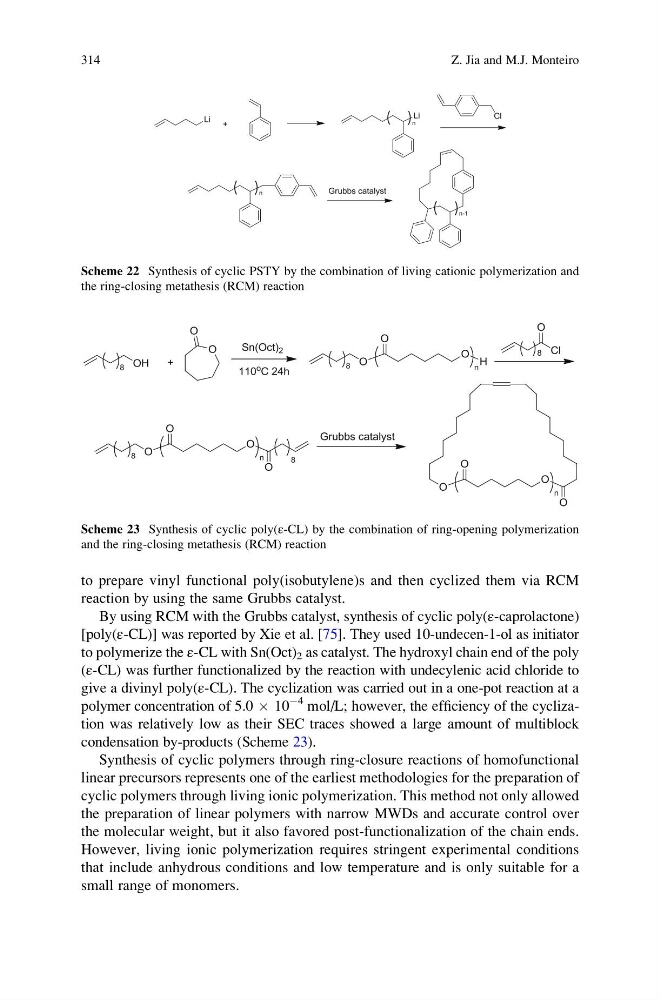
By using RCM with the Grubbs catalyst, synthesis of cyclic poly(ε-caprolactone)
[poly(ε-CL)] was reported by Xie et al. [75]. They used 10-undecen-1-ol as initiator
to polymerize the ε-CL with Sn(Oct) 2 as catalyst. The hydroxyl chain end of the poly
(ε-CL) was further functionalized by the reaction with undecylenic acid chloride to
give a divinyl poly(ε-CL). The cyclization was carried out in a one-pot reaction at a
polymer concentration of 5.0 Â 10
À4 mol/L; however, the efficiency of the cyclization was relatively low as their SEC traces showed a large amount of multiblock
condensation by-products (Scheme 23).
Synthesis of cyclic polymers through ring-closure reactions of homofunctional
linear precursors represents one of the earliest methodologies for the preparation of
cyclic polymers through living ionic polymerization. This method not only allowed
the preparation of linear polymers with narrow MWDs and accurate control over
the molecular weight, but it also favored post-functionalization of the chain ends.
However, living ionic polymerization requires stringent experimental conditions
that include anhydrous conditions and low temperature and is only suitable for a
small range of monomers.
Scheme 22 Synthesis of cyclic PSTY by the combination of living cationic polymerization and
the ring-closing metathesis (RCM) reaction
Scheme 23 Synthesis of cyclic poly(ε-CL) by the combination of ring-opening polymerization
and the ring-closing metathesis (RCM) reaction
314
Z. Jia and M.J. Monteiro
reaction by using the same Grubbs catalyst.
By using RCM with the Grubbs catalyst, synthesis of cyclic poly(ε-caprolactone)
[poly(ε-CL)] was reported by Xie et al. [75]. They used 10-undecen-1-ol as initiator
to polymerize the ε-CL with Sn(Oct) 2 as catalyst. The hydroxyl chain end of the poly
(ε-CL) was further functionalized by the reaction with undecylenic acid chloride to
give a divinyl poly(ε-CL). The cyclization was carried out in a one-pot reaction at a
polymer concentration of 5.0 Â 10
À4 mol/L; however, the efficiency of the cyclization was relatively low as their SEC traces showed a large amount of multiblock
condensation by-products (Scheme 23).
Synthesis of cyclic polymers through ring-closure reactions of homofunctional
linear precursors represents one of the earliest methodologies for the preparation of
cyclic polymers through living ionic polymerization. This method not only allowed
the preparation of linear polymers with narrow MWDs and accurate control over
the molecular weight, but it also favored post-functionalization of the chain ends.
However, living ionic polymerization requires stringent experimental conditions
that include anhydrous conditions and low temperature and is only suitable for a
small range of monomers.
Scheme 22 Synthesis of cyclic PSTY by the combination of living cationic polymerization and
the ring-closing metathesis (RCM) reaction
Scheme 23 Synthesis of cyclic poly(ε-CL) by the combination of ring-opening polymerization
and the ring-closing metathesis (RCM) reaction
314
Z. Jia and M.J. Monteiro