

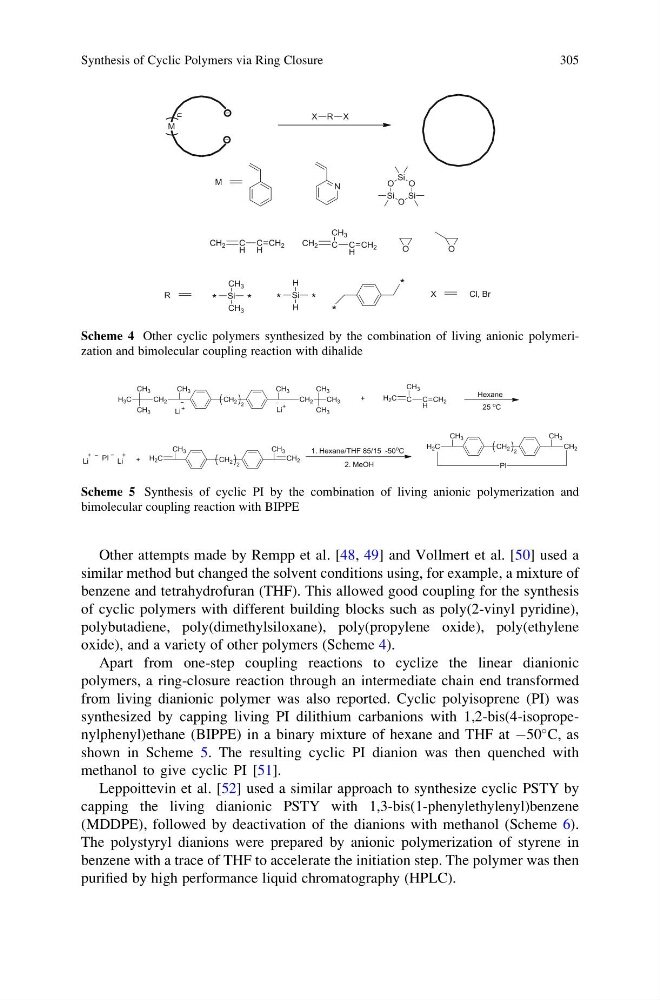
Other attempts made by Rempp et al. [48, 49] and Vollmert et al. [50] used a
similar method but changed the solvent conditions using, for example, a mixture of
benzene and tetrahydrofuran (THF). This allowed good coupling for the synthesis
of cyclic polymers with different building blocks such as poly(2-vinyl pyridine),
polybutadiene, poly(dimethylsiloxane), poly(propylene oxide), poly(ethylene
oxide), and a variety of other polymers (Scheme 4).
Apart from one-step coupling reactions to cyclize the linear dianionic
polymers, a ring-closure reaction through an intermediate chain end transformed
from living dianionic polymer was also reported. Cyclic polyisoprene (PI) was
synthesized by capping living PI dilithium carbanions with 1,2-bis(4-isopropenylphenyl)ethane (BIPPE) in a binary mixture of hexane and THF at À50
C, as
shown in Scheme 5. The resulting cyclic PI dianion was then quenched with
methanol to give cyclic PI [51].
Leppoittevin et al. [52] used a similar approach to synthesize cyclic PSTY by
capping the living dianionic PSTY with 1,3-bis(1-phenylethylenyl)benzene
(MDDPE), followed by deactivation of the dianions with methanol (Scheme 6).
The polystyryl dianions were prepared by anionic polymerization of styrene in
benzene with a trace of THF to accelerate the initiation step. The polymer was then
purified by high performance liquid chromatography (HPLC).
Scheme 4 Other cyclic polymers synthesized by the combination of living anionic polymerization and bimolecular coupling reaction with dihalide
Scheme 5 Synthesis of cyclic PI by the combination of living anionic polymerization and
bimolecular coupling reaction with BIPPE
Synthesis of Cyclic Polymers via Ring Closure
305
similar method but changed the solvent conditions using, for example, a mixture of
benzene and tetrahydrofuran (THF). This allowed good coupling for the synthesis
of cyclic polymers with different building blocks such as poly(2-vinyl pyridine),
polybutadiene, poly(dimethylsiloxane), poly(propylene oxide), poly(ethylene
oxide), and a variety of other polymers (Scheme 4).
Apart from one-step coupling reactions to cyclize the linear dianionic
polymers, a ring-closure reaction through an intermediate chain end transformed
from living dianionic polymer was also reported. Cyclic polyisoprene (PI) was
synthesized by capping living PI dilithium carbanions with 1,2-bis(4-isopropenylphenyl)ethane (BIPPE) in a binary mixture of hexane and THF at À50
C, as
shown in Scheme 5. The resulting cyclic PI dianion was then quenched with
methanol to give cyclic PI [51].
Leppoittevin et al. [52] used a similar approach to synthesize cyclic PSTY by
capping the living dianionic PSTY with 1,3-bis(1-phenylethylenyl)benzene
(MDDPE), followed by deactivation of the dianions with methanol (Scheme 6).
The polystyryl dianions were prepared by anionic polymerization of styrene in
benzene with a trace of THF to accelerate the initiation step. The polymer was then
purified by high performance liquid chromatography (HPLC).
Scheme 4 Other cyclic polymers synthesized by the combination of living anionic polymerization and bimolecular coupling reaction with dihalide
Scheme 5 Synthesis of cyclic PI by the combination of living anionic polymerization and
bimolecular coupling reaction with BIPPE
Synthesis of Cyclic Polymers via Ring Closure
305