

advent of “living” radical polymerization (LRP) provides a far more user-friendly
method for making linear polymers with high chain-end functionality and narrow
MWDs. Typically, LRP comprises a number of techniques, including coppercatalyzed polymerization (ATRP [37, 38] and SET-LRP [39]) and reversible
addition-fragmentation chain transfer (RAFT) polymerization [40, 41]. Combining
LRP with many highly efficient organic coupling reactions such as coppercatalyzed alkyne–azide cycloaddition “click” reaction (CuAAC) [42], Diels–Alder
addition reaction [43], thiol-ene addition reaction [44], and Glaser coupling [45],
polymer chemists can now prepare a range of cyclic polymers with different
chemical compositions and topological structures.
In the next section, we will first discuss synthesis of the linear polymer
precursors with homodifunctional or heterodifunctional groups, and second, we
will discuss the synthesis of cyclic polymers via a ring-closure reaction.
2.1 Ring Closure Through Homodifunctional
Linear Polymers
2.1.1 Ring Closure Through Bimolecular Coupling Between
Homodifunctional Linear Polymers with Difunctional
Small Molecules (A 2 + B 2 )
Synthesis of Linear Polymer Precursors by Living Anionic Polymerization
Anionic polymerization first provided an approach for synthesizing polymers with
controlled molecular weights and low polydispersity indexes (PDIs) [46]. Geisert
and Ho ¨cker [47] reported their pioneering work on the preparation of cyclic
polystyrene (PSTY) by coupling living dianionic linear PSTY with an electrophile
(α, α
0 -dichloro-p-xylene), as shown in Scheme 3. Molecular weights of the cyclic
PSTY ranged from 3,000 to 25,000, and the intrinsic viscosity difference between
linear and cyclic PSTY was then examined.
Scheme 3 Synthesis of cyclic PSTY by the combination of living anionic polymerization and
bimolecular coupling reaction between polystyryl anions and (1,4-dichloromethyl)benzene
304
Z. Jia and M.J. Monteiro
method for making linear polymers with high chain-end functionality and narrow
MWDs. Typically, LRP comprises a number of techniques, including coppercatalyzed polymerization (ATRP [37, 38] and SET-LRP [39]) and reversible
addition-fragmentation chain transfer (RAFT) polymerization [40, 41]. Combining
LRP with many highly efficient organic coupling reactions such as coppercatalyzed alkyne–azide cycloaddition “click” reaction (CuAAC) [42], Diels–Alder
addition reaction [43], thiol-ene addition reaction [44], and Glaser coupling [45],
polymer chemists can now prepare a range of cyclic polymers with different
chemical compositions and topological structures.
In the next section, we will first discuss synthesis of the linear polymer
precursors with homodifunctional or heterodifunctional groups, and second, we
will discuss the synthesis of cyclic polymers via a ring-closure reaction.
2.1 Ring Closure Through Homodifunctional
Linear Polymers
2.1.1 Ring Closure Through Bimolecular Coupling Between
Homodifunctional Linear Polymers with Difunctional
Small Molecules (A 2 + B 2 )
Synthesis of Linear Polymer Precursors by Living Anionic Polymerization
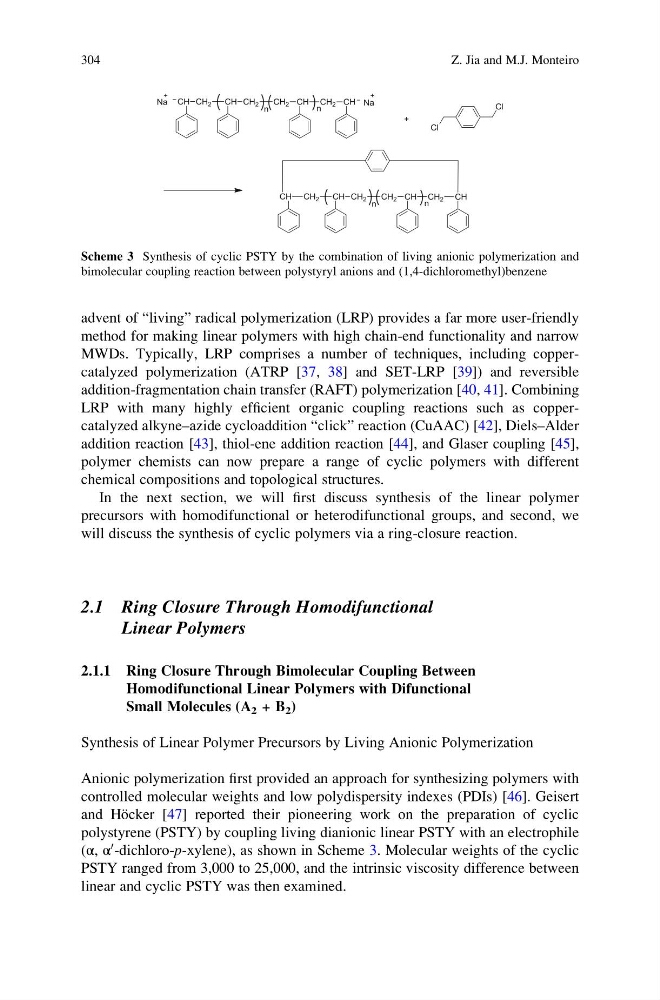
Anionic polymerization first provided an approach for synthesizing polymers with
controlled molecular weights and low polydispersity indexes (PDIs) [46]. Geisert
and Ho ¨cker [47] reported their pioneering work on the preparation of cyclic
polystyrene (PSTY) by coupling living dianionic linear PSTY with an electrophile
(α, α
0 -dichloro-p-xylene), as shown in Scheme 3. Molecular weights of the cyclic
PSTY ranged from 3,000 to 25,000, and the intrinsic viscosity difference between
linear and cyclic PSTY was then examined.
Scheme 3 Synthesis of cyclic PSTY by the combination of living anionic polymerization and
bimolecular coupling reaction between polystyryl anions and (1,4-dichloromethyl)benzene
304
Z. Jia and M.J. Monteiro