

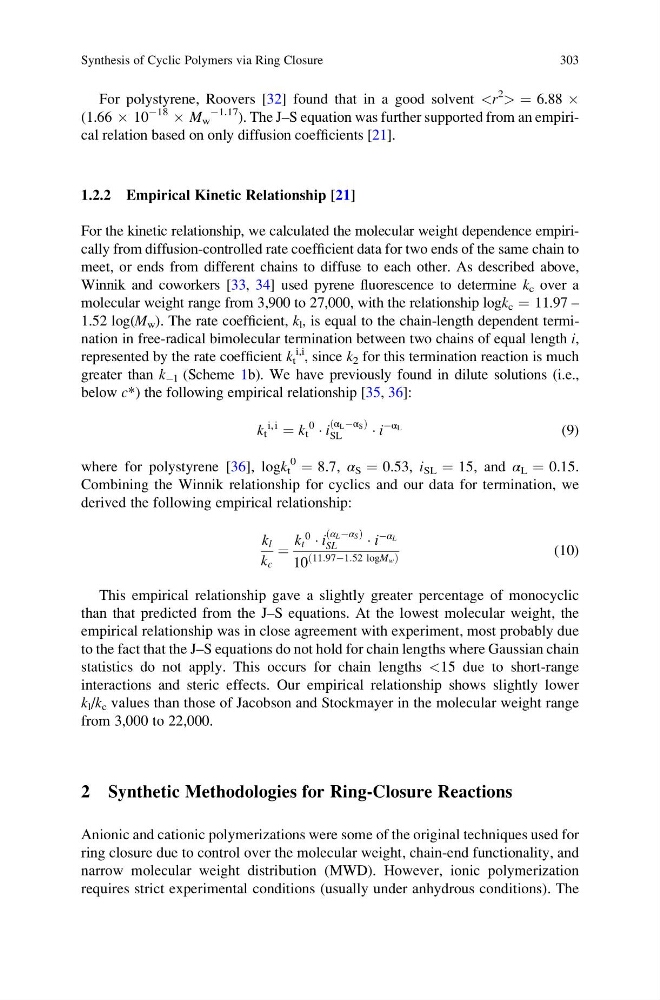
For polystyrene, Roovers [32] found that in a good solvent
> ¼ 6.88 Â
(1.66 Â 10
À18
 M w
À1.17
). The J–S equation was further supported from an empirical relation based on only diffusion coefficients [21].
1.2.2 Empirical Kinetic Relationship [21]
For the kinetic relationship, we calculated the molecular weight dependence empirically from diffusion-controlled rate coefficient data for two ends of the same chain to
meet, or ends from different chains to diffuse to each other. As described above,
Winnik and coworkers [33, 34] used pyrene fluorescence to determine k c over a
molecular weight range from 3,900 to 27,000, with the relationship logk c ¼ 11.97 –
1.52 log(M w ). The rate coefficient, k l , is equal to the chain-length dependent termination in free-radical bimolecular termination between two chains of equal length i,
represented by the rate coefficient k t
i,i
, since k 2 for this termination reaction is much
greater than k Àl (Scheme 1b). We have previously found in dilute solutions (i.e.,
below c*) the following empirical relationship [35, 36]:
k t
i, i
¼ k t
0
Á i
α L Àα S
ð
Þ
SL
Á i
Àα L
(9)
where for polystyrene [36], logk t
0
¼ 8.7, α S ¼ 0.53, i SL ¼ 15, and α L ¼ 0.15.
Combining the Winnik relationship for cyclics and our data for termination, we
derived the following empirical relationship:
k l
k c
¼
k t
0
Á i
α L Àα S
ð
Þ
SL
Á i
Àα L
10
11:97À1:52 logM w
ð
Þ
(10)
This empirical relationship gave a slightly greater percentage of monocyclic
than that predicted from the J–S equations. At the lowest molecular weight, the
empirical relationship was in close agreement with experiment, most probably due
to the fact that the J–S equations do not hold for chain lengths where Gaussian chain
statistics do not apply. This occurs for chain lengths <15 due to short-range
interactions and steric effects. Our empirical relationship shows slightly lower
k l /k c values than those of Jacobson and Stockmayer in the molecular weight range
from 3,000 to 22,000.
2 Synthetic Methodologies for Ring-Closure Reactions
Anionic and cationic polymerizations were some of the original techniques used for
ring closure due to control over the molecular weight, chain-end functionality, and
narrow molecular weight distribution (MWD). However, ionic polymerization
requires strict experimental conditions (usually under anhydrous conditions). The
Synthesis of Cyclic Polymers via Ring Closure
303
> ¼ 6.88 Â
(1.66 Â 10
À18
 M w
À1.17
). The J–S equation was further supported from an empirical relation based on only diffusion coefficients [21].
1.2.2 Empirical Kinetic Relationship [21]
For the kinetic relationship, we calculated the molecular weight dependence empirically from diffusion-controlled rate coefficient data for two ends of the same chain to
meet, or ends from different chains to diffuse to each other. As described above,
Winnik and coworkers [33, 34] used pyrene fluorescence to determine k c over a
molecular weight range from 3,900 to 27,000, with the relationship logk c ¼ 11.97 –
1.52 log(M w ). The rate coefficient, k l , is equal to the chain-length dependent termination in free-radical bimolecular termination between two chains of equal length i,
represented by the rate coefficient k t
i,i
, since k 2 for this termination reaction is much
greater than k Àl (Scheme 1b). We have previously found in dilute solutions (i.e.,
below c*) the following empirical relationship [35, 36]:
k t
i, i
¼ k t
0
Á i
α L Àα S
ð
Þ
SL
Á i
Àα L
(9)
where for polystyrene [36], logk t
0
¼ 8.7, α S ¼ 0.53, i SL ¼ 15, and α L ¼ 0.15.
Combining the Winnik relationship for cyclics and our data for termination, we
derived the following empirical relationship:
k l
k c
¼
k t
0
Á i
α L Àα S
ð
Þ
SL
Á i
Àα L
10
11:97À1:52 logM w
ð
Þ
(10)
This empirical relationship gave a slightly greater percentage of monocyclic
than that predicted from the J–S equations. At the lowest molecular weight, the
empirical relationship was in close agreement with experiment, most probably due
to the fact that the J–S equations do not hold for chain lengths where Gaussian chain
statistics do not apply. This occurs for chain lengths <15 due to short-range
interactions and steric effects. Our empirical relationship shows slightly lower
k l /k c values than those of Jacobson and Stockmayer in the molecular weight range
from 3,000 to 22,000.
2 Synthetic Methodologies for Ring-Closure Reactions
Anionic and cationic polymerizations were some of the original techniques used for
ring closure due to control over the molecular weight, chain-end functionality, and
narrow molecular weight distribution (MWD). However, ionic polymerization
requires strict experimental conditions (usually under anhydrous conditions). The
Synthesis of Cyclic Polymers via Ring Closure
303