

coefficient k À1 . This kinetic scheme is similar to that for an “encounter-pair” model,
and should k À1 >> k 2 then cyclization is controlled by its equilibrium kinetics.
This allows us to use the well-known thermodynamic Jacobson–Stockmayer (J–S)
equation [30] to determine the probability of cyclization at a given polymer
molecular weight. The J–S equation is based on statistical mechanics and thus
requires large ensembles to produce accurate outcomes. This limits the utility of the
J–S equation at low molecular weights, where most ring-closure cyclic reactions are
carried out. The kinetic empirical diffusion relationship developed by Monteiro and
coworkers provides accurate predictions at such molecular weights [21].
1.2.1 Jacobson–Stockmayer Equation [30]
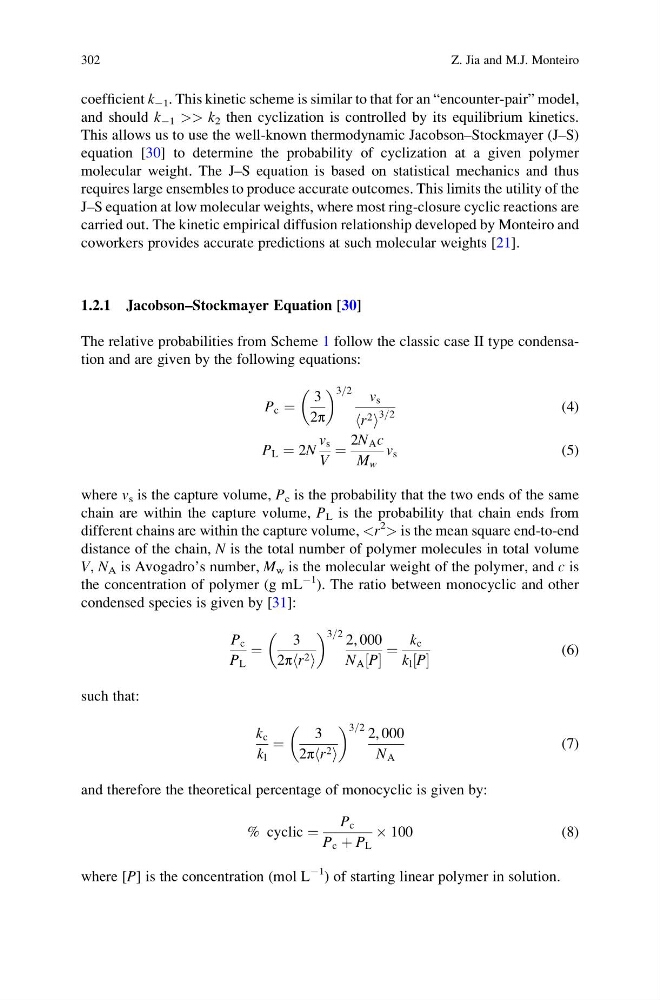
The relative probabilities from Scheme 1 follow the classic case II type condensation and are given by the following equations:
P c ¼
3
2π
3=2 v s
r 2
h i
3=2
(4)
P L ¼ 2N
v s
V
¼
2N A c
M w
v s
(5)
where v s is the capture volume, P c is the probability that the two ends of the same
chain are within the capture volume, P L is the probability that chain ends from
different chains are within the capture volume,
> is the mean square end-to-end
distance of the chain, N is the total number of polymer molecules in total volume
V, N A is Avogadro’s number, M w is the molecular weight of the polymer, and c is
the concentration of polymer (g mL
À1 ). The ratio between monocyclic and other
condensed species is given by [31]:
P c
P L
¼
3
2π r 2
h i
3=2 2, 000
N A P
½
¼
k c
k l P
½
(6)
such that:
k c
k l
¼
3
2π r 2
h i
3=2 2, 000
N A
(7)
and therefore the theoretical percentage of monocyclic is given by:
% cyclic ¼
P c
P c þ P L
 100
(8)
where [P] is the concentration (mol L
À1 ) of starting linear polymer in solution.
302
Z. Jia and M.J. Monteiro
and should k À1 >> k 2 then cyclization is controlled by its equilibrium kinetics.
This allows us to use the well-known thermodynamic Jacobson–Stockmayer (J–S)
equation [30] to determine the probability of cyclization at a given polymer
molecular weight. The J–S equation is based on statistical mechanics and thus
requires large ensembles to produce accurate outcomes. This limits the utility of the
J–S equation at low molecular weights, where most ring-closure cyclic reactions are
carried out. The kinetic empirical diffusion relationship developed by Monteiro and
coworkers provides accurate predictions at such molecular weights [21].
1.2.1 Jacobson–Stockmayer Equation [30]
The relative probabilities from Scheme 1 follow the classic case II type condensation and are given by the following equations:
P c ¼
3
2π
3=2 v s
r 2
h i
3=2
(4)
P L ¼ 2N
v s
V
¼
2N A c
M w
v s
(5)
where v s is the capture volume, P c is the probability that the two ends of the same
chain are within the capture volume, P L is the probability that chain ends from
different chains are within the capture volume,
> is the mean square end-to-end
distance of the chain, N is the total number of polymer molecules in total volume
V, N A is Avogadro’s number, M w is the molecular weight of the polymer, and c is
the concentration of polymer (g mL
À1 ). The ratio between monocyclic and other
condensed species is given by [31]:
P c
P L
¼
3
2π r 2
h i
3=2 2, 000
N A P
½
¼
k c
k l P
½
(6)
such that:
k c
k l
¼
3
2π r 2
h i
3=2 2, 000
N A
(7)
and therefore the theoretical percentage of monocyclic is given by:
% cyclic ¼
P c
P c þ P L
 100
(8)
where [P] is the concentration (mol L
À1 ) of starting linear polymer in solution.
302
Z. Jia and M.J. Monteiro