

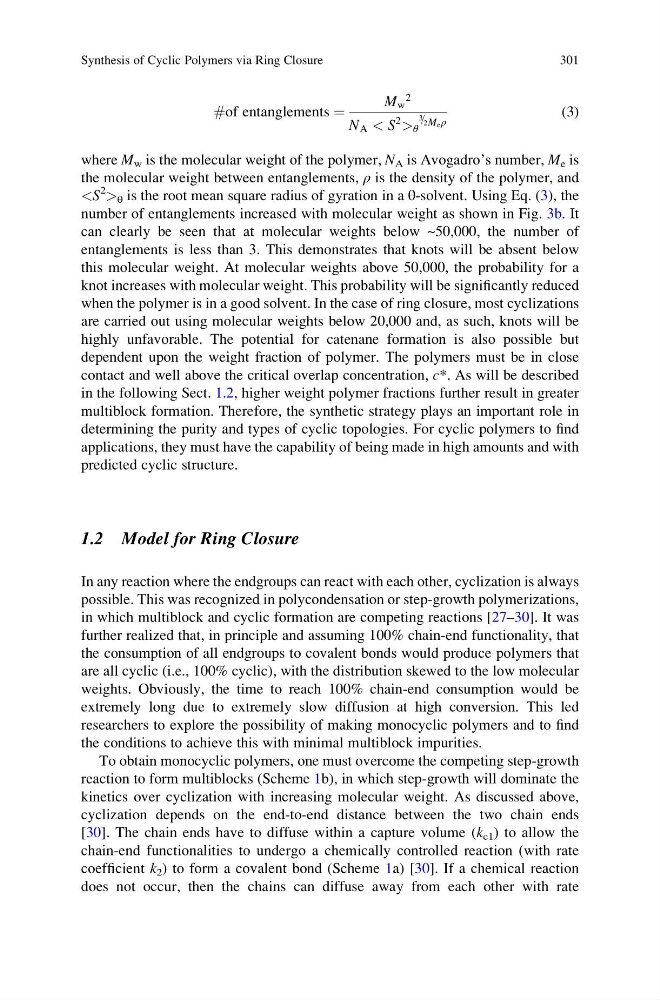
#of entanglements ¼
M w
2
N A < S
2
> θ
3 = 2 M e ρ
(3)
where M w is the molecular weight of the polymer, N A is Avogadro’s number, M e is
the molecular weight between entanglements, ρ is the density of the polymer, and
> θ is the root mean square radius of gyration in a θ-solvent. Using Eq. (3), the
number of entanglements increased with molecular weight as shown in Fig. 3b. It
can clearly be seen that at molecular weights below ~50,000, the number of
entanglements is less than 3. This demonstrates that knots will be absent below
this molecular weight. At molecular weights above 50,000, the probability for a
knot increases with molecular weight. This probability will be significantly reduced
when the polymer is in a good solvent. In the case of ring closure, most cyclizations
are carried out using molecular weights below 20,000 and, as such, knots will be
highly unfavorable. The potential for catenane formation is also possible but
dependent upon the weight fraction of polymer. The polymers must be in close
contact and well above the critical overlap concentration, c*. As will be described
in the following Sect. 1.2, higher weight polymer fractions further result in greater
multiblock formation. Therefore, the synthetic strategy plays an important role in
determining the purity and types of cyclic topologies. For cyclic polymers to find
applications, they must have the capability of being made in high amounts and with
predicted cyclic structure.
1.2 Model for Ring Closure
In any reaction where the endgroups can react with each other, cyclization is always
possible. This was recognized in polycondensation or step-growth polymerizations,
in which multiblock and cyclic formation are competing reactions [27–30]. It was
further realized that, in principle and assuming 100% chain-end functionality, that
the consumption of all endgroups to covalent bonds would produce polymers that
are all cyclic (i.e., 100% cyclic), with the distribution skewed to the low molecular
weights. Obviously, the time to reach 100% chain-end consumption would be
extremely long due to extremely slow diffusion at high conversion. This led
researchers to explore the possibility of making monocyclic polymers and to find
the conditions to achieve this with minimal multiblock impurities.
To obtain monocyclic polymers, one must overcome the competing step-growth
reaction to form multiblocks (Scheme 1b), in which step-growth will dominate the
kinetics over cyclization with increasing molecular weight. As discussed above,
cyclization depends on the end-to-end distance between the two chain ends
[30]. The chain ends have to diffuse within a capture volume (k c1 ) to allow the
chain-end functionalities to undergo a chemically controlled reaction (with rate
coefficient k 2 ) to form a covalent bond (Scheme 1a) [30]. If a chemical reaction
does not occur, then the chains can diffuse away from each other with rate
Synthesis of Cyclic Polymers via Ring Closure
301
M w
2
N A < S
2
> θ
3 = 2 M e ρ
(3)
where M w is the molecular weight of the polymer, N A is Avogadro’s number, M e is
the molecular weight between entanglements, ρ is the density of the polymer, and
> θ is the root mean square radius of gyration in a θ-solvent. Using Eq. (3), the
number of entanglements increased with molecular weight as shown in Fig. 3b. It
can clearly be seen that at molecular weights below ~50,000, the number of
entanglements is less than 3. This demonstrates that knots will be absent below
this molecular weight. At molecular weights above 50,000, the probability for a
knot increases with molecular weight. This probability will be significantly reduced
when the polymer is in a good solvent. In the case of ring closure, most cyclizations
are carried out using molecular weights below 20,000 and, as such, knots will be
highly unfavorable. The potential for catenane formation is also possible but
dependent upon the weight fraction of polymer. The polymers must be in close
contact and well above the critical overlap concentration, c*. As will be described
in the following Sect. 1.2, higher weight polymer fractions further result in greater
multiblock formation. Therefore, the synthetic strategy plays an important role in
determining the purity and types of cyclic topologies. For cyclic polymers to find
applications, they must have the capability of being made in high amounts and with
predicted cyclic structure.
1.2 Model for Ring Closure
In any reaction where the endgroups can react with each other, cyclization is always
possible. This was recognized in polycondensation or step-growth polymerizations,
in which multiblock and cyclic formation are competing reactions [27–30]. It was
further realized that, in principle and assuming 100% chain-end functionality, that
the consumption of all endgroups to covalent bonds would produce polymers that
are all cyclic (i.e., 100% cyclic), with the distribution skewed to the low molecular
weights. Obviously, the time to reach 100% chain-end consumption would be
extremely long due to extremely slow diffusion at high conversion. This led
researchers to explore the possibility of making monocyclic polymers and to find
the conditions to achieve this with minimal multiblock impurities.
To obtain monocyclic polymers, one must overcome the competing step-growth
reaction to form multiblocks (Scheme 1b), in which step-growth will dominate the
kinetics over cyclization with increasing molecular weight. As discussed above,
cyclization depends on the end-to-end distance between the two chain ends
[30]. The chain ends have to diffuse within a capture volume (k c1 ) to allow the
chain-end functionalities to undergo a chemically controlled reaction (with rate
coefficient k 2 ) to form a covalent bond (Scheme 1a) [30]. If a chemical reaction
does not occur, then the chains can diffuse away from each other with rate
Synthesis of Cyclic Polymers via Ring Closure
301