

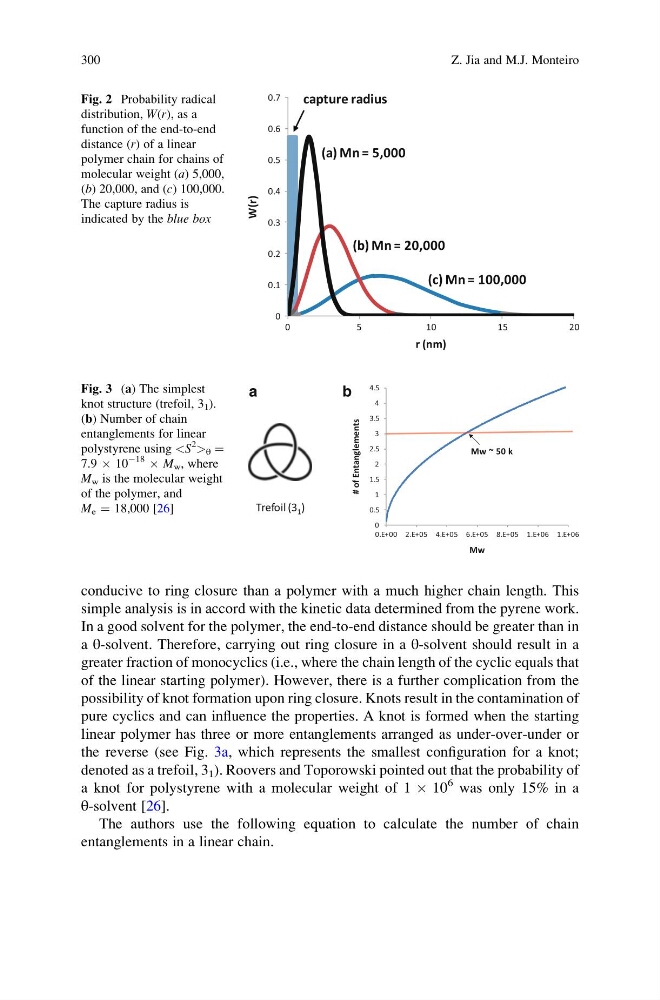
conducive to ring closure than a polymer with a much higher chain length. This
simple analysis is in accord with the kinetic data determined from the pyrene work.
In a good solvent for the polymer, the end-to-end distance should be greater than in
a θ-solvent. Therefore, carrying out ring closure in a θ-solvent should result in a
greater fraction of monocyclics (i.e., where the chain length of the cyclic equals that
of the linear starting polymer). However, there is a further complication from the
possibility of knot formation upon ring closure. Knots result in the contamination of
pure cyclics and can influence the properties. A knot is formed when the starting
linear polymer has three or more entanglements arranged as under-over-under or
the reverse (see Fig. 3a, which represents the smallest configuration for a knot;
denoted as a trefoil, 3 1 ). Roovers and Toporowski pointed out that the probability of
a knot for polystyrene with a molecular weight of 1 Â 10
6 was only 15% in a
θ-solvent [26].
The authors use the following equation to calculate the number of chain
entanglements in a linear chain.
Fig. 2 Probability radical
distribution, W(r), as a
function of the end-to-end
distance (r) of a linear
polymer chain for chains of
molecular weight (a) 5,000,
(b) 20,000, and (c) 100,000.
The capture radius is
indicated by the blue box
0
0.5
1
1.5
2
2.5
3
3.5
4
4.5
0.E+00 2.E+05 4.E+05 6.E+05 8.E+05 1.E+06 1.E+06
# of Entanglements
Mw
Mw ~ 50 k
Trefoil (3 1 )
a
b
Fig. 3 (a) The simplest
knot structure (trefoil, 3 1 ).
(b) Number of chain
entanglements for linear
polystyrene using
> θ ¼
7.9 Â 10
À18 Â M w , where
M w is the molecular weight
of the polymer, and
M e ¼ 18,000 [26]
300
Z. Jia and M.J. Monteiro
simple analysis is in accord with the kinetic data determined from the pyrene work.
In a good solvent for the polymer, the end-to-end distance should be greater than in
a θ-solvent. Therefore, carrying out ring closure in a θ-solvent should result in a
greater fraction of monocyclics (i.e., where the chain length of the cyclic equals that
of the linear starting polymer). However, there is a further complication from the
possibility of knot formation upon ring closure. Knots result in the contamination of
pure cyclics and can influence the properties. A knot is formed when the starting
linear polymer has three or more entanglements arranged as under-over-under or
the reverse (see Fig. 3a, which represents the smallest configuration for a knot;
denoted as a trefoil, 3 1 ). Roovers and Toporowski pointed out that the probability of
a knot for polystyrene with a molecular weight of 1 Â 10
6 was only 15% in a
θ-solvent [26].
The authors use the following equation to calculate the number of chain
entanglements in a linear chain.
Fig. 2 Probability radical
distribution, W(r), as a
function of the end-to-end
distance (r) of a linear
polymer chain for chains of
molecular weight (a) 5,000,
(b) 20,000, and (c) 100,000.
The capture radius is
indicated by the blue box
0
0.5
1
1.5
2
2.5
3
3.5
4
4.5
0.E+00 2.E+05 4.E+05 6.E+05 8.E+05 1.E+06 1.E+06
# of Entanglements
Mw
Mw ~ 50 k
Trefoil (3 1 )
a
b
Fig. 3 (a) The simplest
knot structure (trefoil, 3 1 ).
(b) Number of chain
entanglements for linear
polystyrene using
> θ ¼
7.9 Â 10
À18 Â M w , where
M w is the molecular weight
of the polymer, and
M e ¼ 18,000 [26]
300
Z. Jia and M.J. Monteiro