

Because polymer chains are always in dynamic motion, one of the best methods for
studying the location (or probability) that two chain ends are within the capture
volume is via fluorescence labeling of the chain ends with pyrene [22–25]. The
chain ends in Scheme 1a could represent pyrene groups, and when the chain ends
are within the capture volume, the two pyrenes produce an excimer. Winnik and
coworkers found that k c1 was dependent on chain length and close to diffusion rate
control, increasing in value with chain length [24]. The reverse process (i.e., k À1 )
was logically found to be independent of chain length. These researchers also
determined the entropy of cyclization, which in turn provided the probability of
cyclization to the capture radius. For example, polystyrene with an M n of 3,900 had
a probability of cyclization of 1.61 Â 10
À5 , while the probability decreased to
5.56 Â 10
À6 at an M n of 9,200, demonstrating the sensitivity of cyclization to
chain length.
The discussion above highlights the importance of the chain end-to-end distance
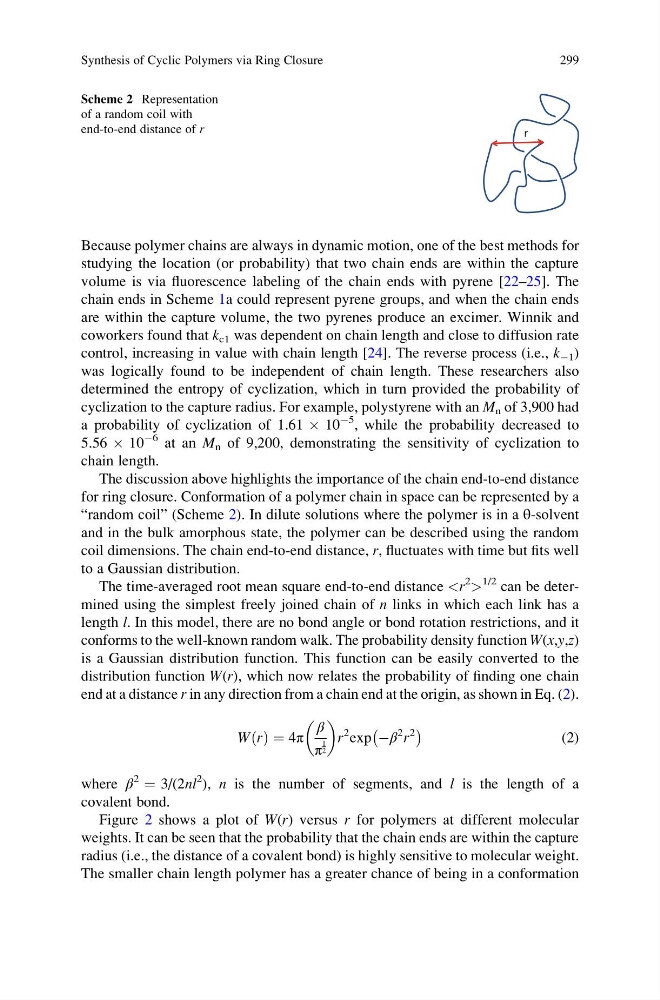
for ring closure. Conformation of a polymer chain in space can be represented by a
“random coil” (Scheme 2). In dilute solutions where the polymer is in a θ-solvent
and in the bulk amorphous state, the polymer can be described using the random
coil dimensions. The chain end-to-end distance, r, fluctuates with time but fits well
to a Gaussian distribution.
The time-averaged root mean square end-to-end distance
>
1/2 can be determined using the simplest freely joined chain of n links in which each link has a
length l. In this model, there are no bond angle or bond rotation restrictions, and it
conforms to the well-known random walk. The probability density function W(x,y,z)
is a Gaussian distribution function. This function can be easily converted to the
distribution function W(r), which now relates the probability of finding one chain
end at a distance r in any direction from a chain end at the origin, as shown in Eq. (2).
W r
ð Þ ¼ 4π
β
π
1
2
r
2 exp Àβ
2 r
2
À
Á
(2)
where β
2
¼ 3/(2nl
2
), n is the number of segments, and l is the length of a
covalent bond.
Figure 2 shows a plot of W(r) versus r for polymers at different molecular
weights. It can be seen that the probability that the chain ends are within the capture
radius (i.e., the distance of a covalent bond) is highly sensitive to molecular weight.
The smaller chain length polymer has a greater chance of being in a conformation
r
Scheme 2 Representation
of a random coil with
end-to-end distance of r
Synthesis of Cyclic Polymers via Ring Closure
299
studying the location (or probability) that two chain ends are within the capture
volume is via fluorescence labeling of the chain ends with pyrene [22–25]. The
chain ends in Scheme 1a could represent pyrene groups, and when the chain ends
are within the capture volume, the two pyrenes produce an excimer. Winnik and
coworkers found that k c1 was dependent on chain length and close to diffusion rate
control, increasing in value with chain length [24]. The reverse process (i.e., k À1 )
was logically found to be independent of chain length. These researchers also
determined the entropy of cyclization, which in turn provided the probability of
cyclization to the capture radius. For example, polystyrene with an M n of 3,900 had
a probability of cyclization of 1.61 Â 10
À5 , while the probability decreased to
5.56 Â 10
À6 at an M n of 9,200, demonstrating the sensitivity of cyclization to
chain length.
The discussion above highlights the importance of the chain end-to-end distance
for ring closure. Conformation of a polymer chain in space can be represented by a
“random coil” (Scheme 2). In dilute solutions where the polymer is in a θ-solvent
and in the bulk amorphous state, the polymer can be described using the random
coil dimensions. The chain end-to-end distance, r, fluctuates with time but fits well
to a Gaussian distribution.
The time-averaged root mean square end-to-end distance
>
1/2 can be determined using the simplest freely joined chain of n links in which each link has a
length l. In this model, there are no bond angle or bond rotation restrictions, and it
conforms to the well-known random walk. The probability density function W(x,y,z)
is a Gaussian distribution function. This function can be easily converted to the
distribution function W(r), which now relates the probability of finding one chain
end at a distance r in any direction from a chain end at the origin, as shown in Eq. (2).
W r
ð Þ ¼ 4π
β
π
1
2
r
2 exp Àβ
2 r
2
À
Á
(2)
where β
2
¼ 3/(2nl
2
), n is the number of segments, and l is the length of a
covalent bond.
Figure 2 shows a plot of W(r) versus r for polymers at different molecular
weights. It can be seen that the probability that the chain ends are within the capture
radius (i.e., the distance of a covalent bond) is highly sensitive to molecular weight.
The smaller chain length polymer has a greater chance of being in a conformation
r
Scheme 2 Representation
of a random coil with
end-to-end distance of r
Synthesis of Cyclic Polymers via Ring Closure
299