

limiting value for T g (i.e., T g
1 ). Dendrimers have many endgroups, which increase
with each generational layer. These endgroups result in a decrease in the T g that is
slightly offset by the constraints of the branching points [16]. Significant
constraints, as found in crosslinked polymers, can also significantly influence the
T g through the loss of entropy to values much greater than T g
1 [17, 18]. Because
cyclic polymers have no chain ends and a compact topology, the lower degree of
configurational freedom and the lower free volume results in a higher T g at lower
molecular weights. At very high molecular weights, the configurational constraints
become similar to that for linear polymers, resulting in a T g approaching T g
1 [19].
There has been some debate in the literature over the physical properties of
cyclic polymers due to the difficulty in synthesizing pure cyclic polymers without
linear contaminants and in producing cyclic polymers in large quantities. This
contribution provides an overview of recent techniques used in the synthesis of
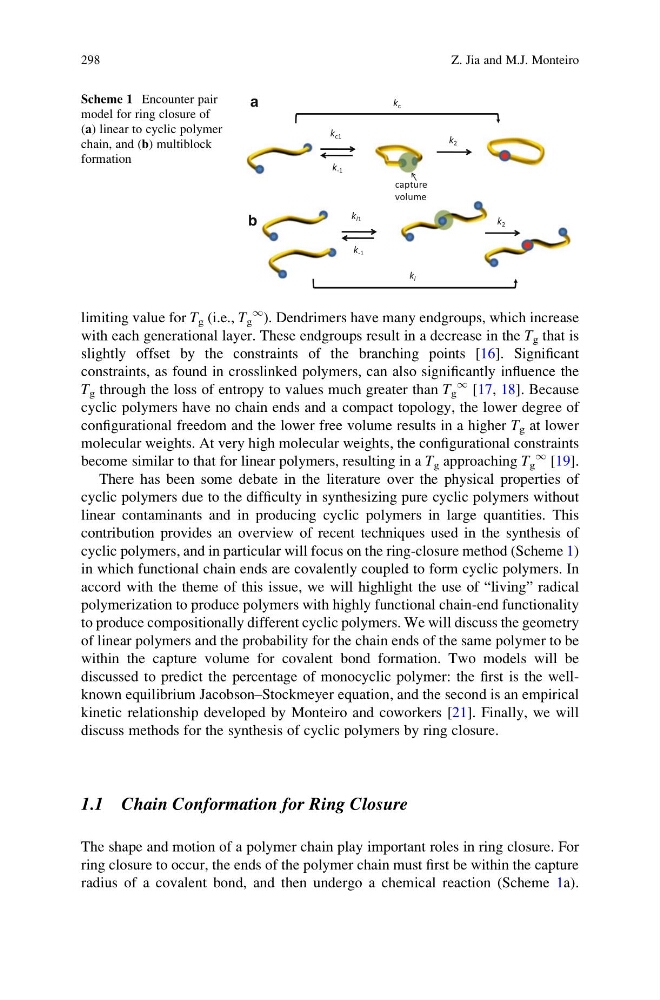
cyclic polymers, and in particular will focus on the ring-closure method (Scheme 1)
in which functional chain ends are covalently coupled to form cyclic polymers. In
accord with the theme of this issue, we will highlight the use of “living” radical
polymerization to produce polymers with highly functional chain-end functionality
to produce compositionally different cyclic polymers. We will discuss the geometry
of linear polymers and the probability for the chain ends of the same polymer to be
within the capture volume for covalent bond formation. Two models will be
discussed to predict the percentage of monocyclic polymer: the first is the wellknown equilibrium Jacobson–Stockmeyer equation, and the second is an empirical
kinetic relationship developed by Monteiro and coworkers [21]. Finally, we will
discuss methods for the synthesis of cyclic polymers by ring closure.
1.1 Chain Conformation for Ring Closure
The shape and motion of a polymer chain play important roles in ring closure. For
ring closure to occur, the ends of the polymer chain must first be within the capture
radius of a covalent bond, and then undergo a chemical reaction (Scheme 1a).
k c1
k -1
k 2
capture
volume
k c
a
b
k l1
k -1
k 2
k l
Scheme 1 Encounter pair
model for ring closure of
(a) linear to cyclic polymer
chain, and (b) multiblock
formation
298
Z. Jia and M.J. Monteiro
1 ). Dendrimers have many endgroups, which increase
with each generational layer. These endgroups result in a decrease in the T g that is
slightly offset by the constraints of the branching points [16]. Significant
constraints, as found in crosslinked polymers, can also significantly influence the
T g through the loss of entropy to values much greater than T g
1 [17, 18]. Because
cyclic polymers have no chain ends and a compact topology, the lower degree of
configurational freedom and the lower free volume results in a higher T g at lower
molecular weights. At very high molecular weights, the configurational constraints
become similar to that for linear polymers, resulting in a T g approaching T g
1 [19].
There has been some debate in the literature over the physical properties of
cyclic polymers due to the difficulty in synthesizing pure cyclic polymers without
linear contaminants and in producing cyclic polymers in large quantities. This
contribution provides an overview of recent techniques used in the synthesis of
cyclic polymers, and in particular will focus on the ring-closure method (Scheme 1)
in which functional chain ends are covalently coupled to form cyclic polymers. In
accord with the theme of this issue, we will highlight the use of “living” radical
polymerization to produce polymers with highly functional chain-end functionality
to produce compositionally different cyclic polymers. We will discuss the geometry
of linear polymers and the probability for the chain ends of the same polymer to be
within the capture volume for covalent bond formation. Two models will be
discussed to predict the percentage of monocyclic polymer: the first is the wellknown equilibrium Jacobson–Stockmeyer equation, and the second is an empirical
kinetic relationship developed by Monteiro and coworkers [21]. Finally, we will
discuss methods for the synthesis of cyclic polymers by ring closure.
1.1 Chain Conformation for Ring Closure
The shape and motion of a polymer chain play important roles in ring closure. For
ring closure to occur, the ends of the polymer chain must first be within the capture
radius of a covalent bond, and then undergo a chemical reaction (Scheme 1a).
k c1
k -1
k 2
capture
volume
k c
a
b
k l1
k -1
k 2
k l
Scheme 1 Encounter pair
model for ring closure of
(a) linear to cyclic polymer
chain, and (b) multiblock
formation
298
Z. Jia and M.J. Monteiro