

polymers [5]. The compact nature of cyclic polymers, as exemplified by the
lower radius of gyration (i.e.
> cyclic /
> linear ¼ 0.5 in a theta solvent and
0.526 in a good solvent) [6] are in good agreement with experimental results
[7]. The different diffusion and conformational restricted topology of cyclic
polymers has resulted in properties quite different to those of their linear
counterparts [8]. These include higher density [9], lower intrinsic viscosity
[10], lower translational friction coefficients, higher glass transition temperatures
[10], higher critical solution temperature [11], increased rate of crystallization
[12], and higher refractive index [13].
The glass transition temperature (T g ) is one property that is significantly different for linear and cyclic polymers at low molecular weights (M w ). Linear polymers
show an increase in T g with M w that can be predicted using the Kanig–Ueberreiter
equation [14]:
T g ¼
1
T g
1
þ
K
M w
! À1
(1)
where T g
1 is the T g at infinite molecular weight, K is a constant dependent upon the
polymer (for polystyrene, K ¼ 0.78), and M w is the molecular weight of the polymer.
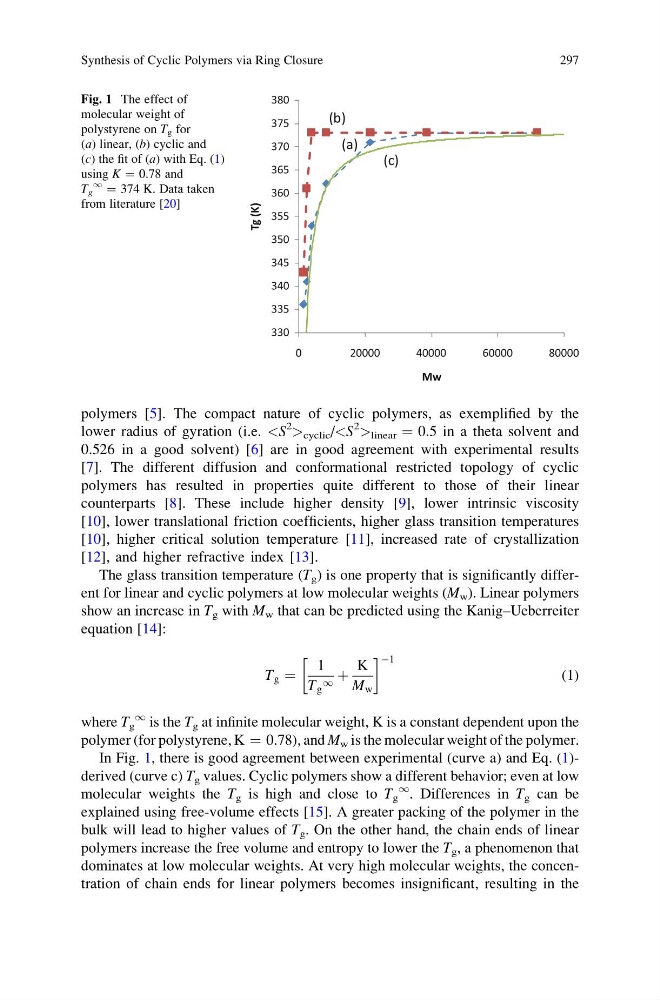
In Fig. 1, there is good agreement between experimental (curve a) and Eq. (1)derived (curve c) T g values. Cyclic polymers show a different behavior; even at low
molecular weights the T g is high and close to T g
1 . Differences in T g can be
explained using free-volume effects [15]. A greater packing of the polymer in the
bulk will lead to higher values of T g . On the other hand, the chain ends of linear
polymers increase the free volume and entropy to lower the T g , a phenomenon that
dominates at low molecular weights. At very high molecular weights, the concentration of chain ends for linear polymers becomes insignificant, resulting in the
330
335
340
345
350
355
360
365
370
375
380
0
20000
40000
60000
80000
Tg (K)
Mw
(a)
(b)
(c)
Fig. 1 The effect of
molecular weight of
polystyrene on T g for
(a) linear, (b) cyclic and
(c) the fit of (a) with Eq. (1)
using K ¼ 0.78 and
T g
1 ¼ 374 K. Data taken
from literature [20]
Synthesis of Cyclic Polymers via Ring Closure
297
lower radius of gyration (i.e.
> cyclic /
> linear ¼ 0.5 in a theta solvent and
0.526 in a good solvent) [6] are in good agreement with experimental results
[7]. The different diffusion and conformational restricted topology of cyclic
polymers has resulted in properties quite different to those of their linear
counterparts [8]. These include higher density [9], lower intrinsic viscosity
[10], lower translational friction coefficients, higher glass transition temperatures
[10], higher critical solution temperature [11], increased rate of crystallization
[12], and higher refractive index [13].
The glass transition temperature (T g ) is one property that is significantly different for linear and cyclic polymers at low molecular weights (M w ). Linear polymers
show an increase in T g with M w that can be predicted using the Kanig–Ueberreiter
equation [14]:
T g ¼
1
T g
1
þ
K
M w
! À1
(1)
where T g
1 is the T g at infinite molecular weight, K is a constant dependent upon the
polymer (for polystyrene, K ¼ 0.78), and M w is the molecular weight of the polymer.
In Fig. 1, there is good agreement between experimental (curve a) and Eq. (1)derived (curve c) T g values. Cyclic polymers show a different behavior; even at low
molecular weights the T g is high and close to T g
1 . Differences in T g can be
explained using free-volume effects [15]. A greater packing of the polymer in the
bulk will lead to higher values of T g . On the other hand, the chain ends of linear
polymers increase the free volume and entropy to lower the T g , a phenomenon that
dominates at low molecular weights. At very high molecular weights, the concentration of chain ends for linear polymers becomes insignificant, resulting in the
330
335
340
345
350
355
360
365
370
375
380
0
20000
40000
60000
80000
Tg (K)
Mw
(a)
(b)
(c)
Fig. 1 The effect of
molecular weight of
polystyrene on T g for
(a) linear, (b) cyclic and
(c) the fit of (a) with Eq. (1)
using K ¼ 0.78 and
T g
1 ¼ 374 K. Data taken
from literature [20]
Synthesis of Cyclic Polymers via Ring Closure
297