

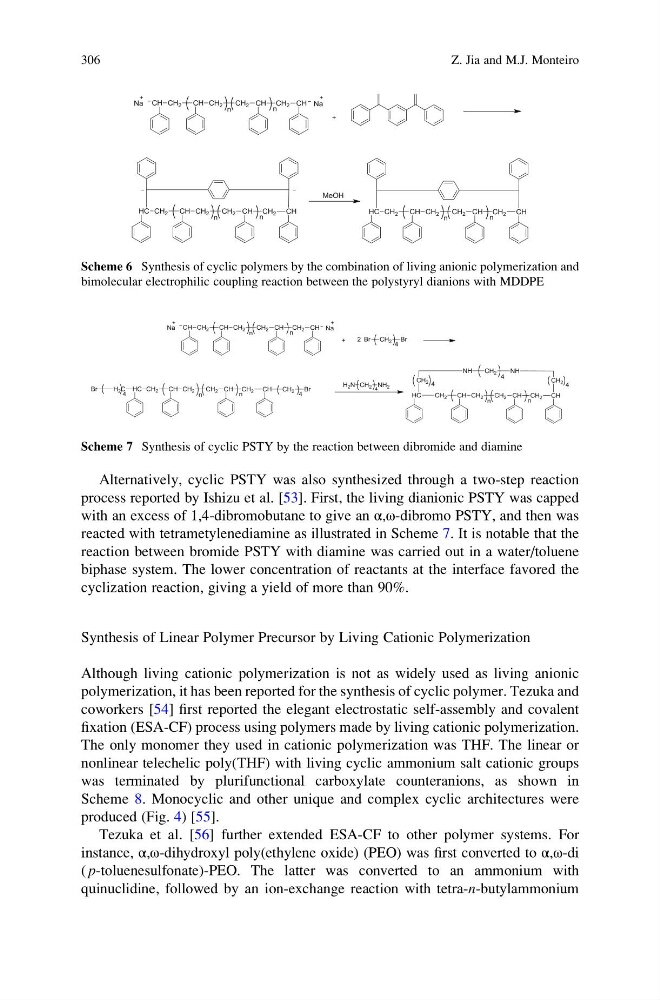
Alternatively, cyclic PSTY was also synthesized through a two-step reaction
process reported by Ishizu et al. [53]. First, the living dianionic PSTY was capped
with an excess of 1,4-dibromobutane to give an α,ω-dibromo PSTY, and then was
reacted with tetrametylenediamine as illustrated in Scheme 7. It is notable that the
reaction between bromide PSTY with diamine was carried out in a water/toluene
biphase system. The lower concentration of reactants at the interface favored the
cyclization reaction, giving a yield of more than 90%.
Synthesis of Linear Polymer Precursor by Living Cationic Polymerization
Although living cationic polymerization is not as widely used as living anionic
polymerization, it has been reported for the synthesis of cyclic polymer. Tezuka and
coworkers [54] first reported the elegant electrostatic self-assembly and covalent
fixation (ESA-CF) process using polymers made by living cationic polymerization.
The only monomer they used in cationic polymerization was THF. The linear or
nonlinear telechelic poly(THF) with living cyclic ammonium salt cationic groups
was terminated by plurifunctional carboxylate counteranions, as shown in
Scheme 8. Monocyclic and other unique and complex cyclic architectures were
produced (Fig. 4) [55].
Tezuka et al. [56] further extended ESA-CF to other polymer systems. For
instance, α,ω-dihydroxyl poly(ethylene oxide) (PEO) was first converted to α,ω-di
( p-toluenesulfonate)-PEO. The latter was converted to an ammonium with
quinuclidine, followed by an ion-exchange reaction with tetra-n-butylammonium
Scheme 6 Synthesis of cyclic polymers by the combination of living anionic polymerization and
bimolecular electrophilic coupling reaction between the polystyryl dianions with MDDPE
Scheme 7 Synthesis of cyclic PSTY by the reaction between dibromide and diamine
306
Z. Jia and M.J. Monteiro
process reported by Ishizu et al. [53]. First, the living dianionic PSTY was capped
with an excess of 1,4-dibromobutane to give an α,ω-dibromo PSTY, and then was
reacted with tetrametylenediamine as illustrated in Scheme 7. It is notable that the
reaction between bromide PSTY with diamine was carried out in a water/toluene
biphase system. The lower concentration of reactants at the interface favored the
cyclization reaction, giving a yield of more than 90%.
Synthesis of Linear Polymer Precursor by Living Cationic Polymerization
Although living cationic polymerization is not as widely used as living anionic
polymerization, it has been reported for the synthesis of cyclic polymer. Tezuka and
coworkers [54] first reported the elegant electrostatic self-assembly and covalent
fixation (ESA-CF) process using polymers made by living cationic polymerization.
The only monomer they used in cationic polymerization was THF. The linear or
nonlinear telechelic poly(THF) with living cyclic ammonium salt cationic groups
was terminated by plurifunctional carboxylate counteranions, as shown in
Scheme 8. Monocyclic and other unique and complex cyclic architectures were
produced (Fig. 4) [55].
Tezuka et al. [56] further extended ESA-CF to other polymer systems. For
instance, α,ω-dihydroxyl poly(ethylene oxide) (PEO) was first converted to α,ω-di
( p-toluenesulfonate)-PEO. The latter was converted to an ammonium with
quinuclidine, followed by an ion-exchange reaction with tetra-n-butylammonium
Scheme 6 Synthesis of cyclic polymers by the combination of living anionic polymerization and
bimolecular electrophilic coupling reaction between the polystyryl dianions with MDDPE
Scheme 7 Synthesis of cyclic PSTY by the reaction between dibromide and diamine
306
Z. Jia and M.J. Monteiro