

nickelacycle polypeptide chain ends could be quantitatively capped by reaction
with excess isocyanate, isothiocyanate, or acid chloride [40]. Using this chemistry,
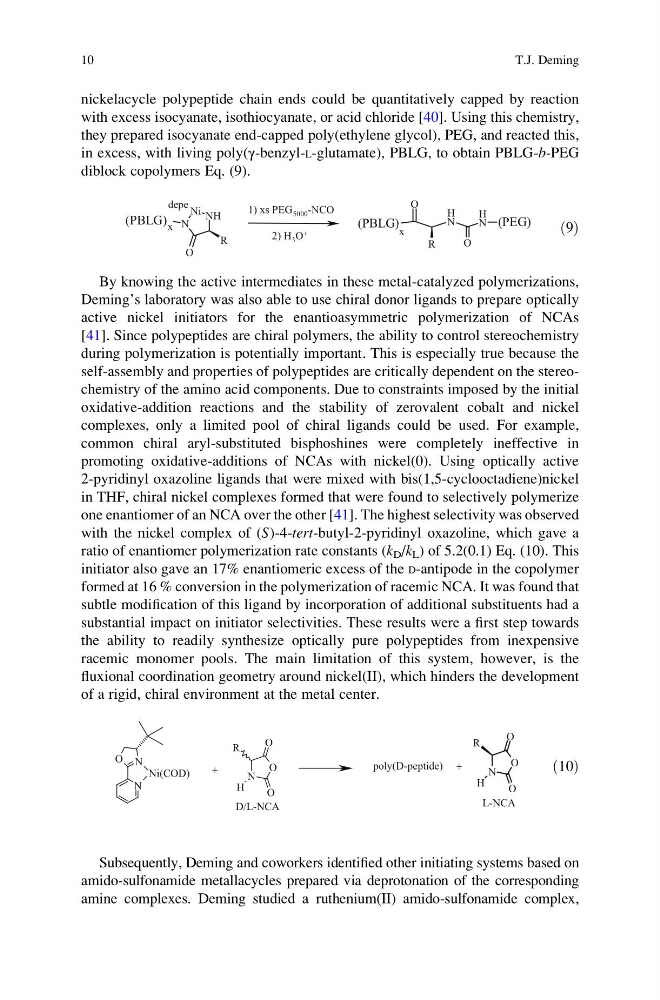
they prepared isocyanate end-capped poly(ethylene glycol), PEG, and reacted this,
in excess, with living poly(γ-benzyl-L-glutamate), PBLG, to obtain PBLG-b-PEG
diblock copolymers Eq. (9).
N
Ni NH
R
O
N
H
O
N
H
R
O
depe
(PBLG) x
2) H 3 O +
(PBLG)
x
1) xs PEG 5000 -NCO
(PEG)
ð9Þ
By knowing the active intermediates in these metal-catalyzed polymerizations,
Deming’s laboratory was also able to use chiral donor ligands to prepare optically
active nickel initiators for the enantioasymmetric polymerization of NCAs
[41]. Since polypeptides are chiral polymers, the ability to control stereochemistry
during polymerization is potentially important. This is especially true because the
self-assembly and properties of polypeptides are critically dependent on the stereochemistry of the amino acid components. Due to constraints imposed by the initial
oxidative-addition reactions and the stability of zerovalent cobalt and nickel
complexes, only a limited pool of chiral ligands could be used. For example,
common chiral aryl-substituted bisphoshines were completely ineffective in
promoting oxidative-additions of NCAs with nickel(0). Using optically active
2-pyridinyl oxazoline ligands that were mixed with bis(1,5-cyclooctadiene)nickel
in THF, chiral nickel complexes formed that were found to selectively polymerize
one enantiomer of an NCA over the other [41]. The highest selectivity was observed
with the nickel complex of (S)-4-tert-butyl-2-pyridinyl oxazoline, which gave a
ratio of enantiomer polymerization rate constants (k D /k L ) of 5.2(0.1) Eq. (10). This
initiator also gave an 17% enantiomeric excess of the D-antipode in the copolymer
formed at 16 % conversion in the polymerization of racemic NCA. It was found that
subtle modification of this ligand by incorporation of additional substituents had a
substantial impact on initiator selectivities. These results were a first step towards
the ability to readily synthesize optically pure polypeptides from inexpensive
racemic monomer pools. The main limitation of this system, however, is the
fluxional coordination geometry around nickel(II), which hinders the development
of a rigid, chiral environment at the metal center.
N
O
N
N
O
R
O
O
H
N
O
R
O
O
H
Ni(COD)
+
D/L-NCA
poly(D-peptide) +
L-NCA
ð10Þ
Subsequently, Deming and coworkers identified other initiating systems based on
amido-sulfonamide metallacycles prepared via deprotonation of the corresponding
amine complexes. Deming studied a ruthenium(II) amido-sulfonamide complex,
10
T.J. Deming
with excess isocyanate, isothiocyanate, or acid chloride [40]. Using this chemistry,
they prepared isocyanate end-capped poly(ethylene glycol), PEG, and reacted this,
in excess, with living poly(γ-benzyl-L-glutamate), PBLG, to obtain PBLG-b-PEG
diblock copolymers Eq. (9).
N
Ni NH
R
O
N
H
O
N
H
R
O
depe
(PBLG) x
2) H 3 O +
(PBLG)
x
1) xs PEG 5000 -NCO
(PEG)
ð9Þ
By knowing the active intermediates in these metal-catalyzed polymerizations,
Deming’s laboratory was also able to use chiral donor ligands to prepare optically
active nickel initiators for the enantioasymmetric polymerization of NCAs
[41]. Since polypeptides are chiral polymers, the ability to control stereochemistry
during polymerization is potentially important. This is especially true because the
self-assembly and properties of polypeptides are critically dependent on the stereochemistry of the amino acid components. Due to constraints imposed by the initial
oxidative-addition reactions and the stability of zerovalent cobalt and nickel
complexes, only a limited pool of chiral ligands could be used. For example,
common chiral aryl-substituted bisphoshines were completely ineffective in
promoting oxidative-additions of NCAs with nickel(0). Using optically active
2-pyridinyl oxazoline ligands that were mixed with bis(1,5-cyclooctadiene)nickel
in THF, chiral nickel complexes formed that were found to selectively polymerize
one enantiomer of an NCA over the other [41]. The highest selectivity was observed
with the nickel complex of (S)-4-tert-butyl-2-pyridinyl oxazoline, which gave a
ratio of enantiomer polymerization rate constants (k D /k L ) of 5.2(0.1) Eq. (10). This
initiator also gave an 17% enantiomeric excess of the D-antipode in the copolymer
formed at 16 % conversion in the polymerization of racemic NCA. It was found that
subtle modification of this ligand by incorporation of additional substituents had a
substantial impact on initiator selectivities. These results were a first step towards
the ability to readily synthesize optically pure polypeptides from inexpensive
racemic monomer pools. The main limitation of this system, however, is the
fluxional coordination geometry around nickel(II), which hinders the development
of a rigid, chiral environment at the metal center.
N
O
N
N
O
R
O
O
H
N
O
R
O
O
H
Ni(COD)
+
D/L-NCA
poly(D-peptide) +
L-NCA
ð10Þ
Subsequently, Deming and coworkers identified other initiating systems based on
amido-sulfonamide metallacycles prepared via deprotonation of the corresponding
amine complexes. Deming studied a ruthenium(II) amido-sulfonamide complex,
10
T.J. Deming