

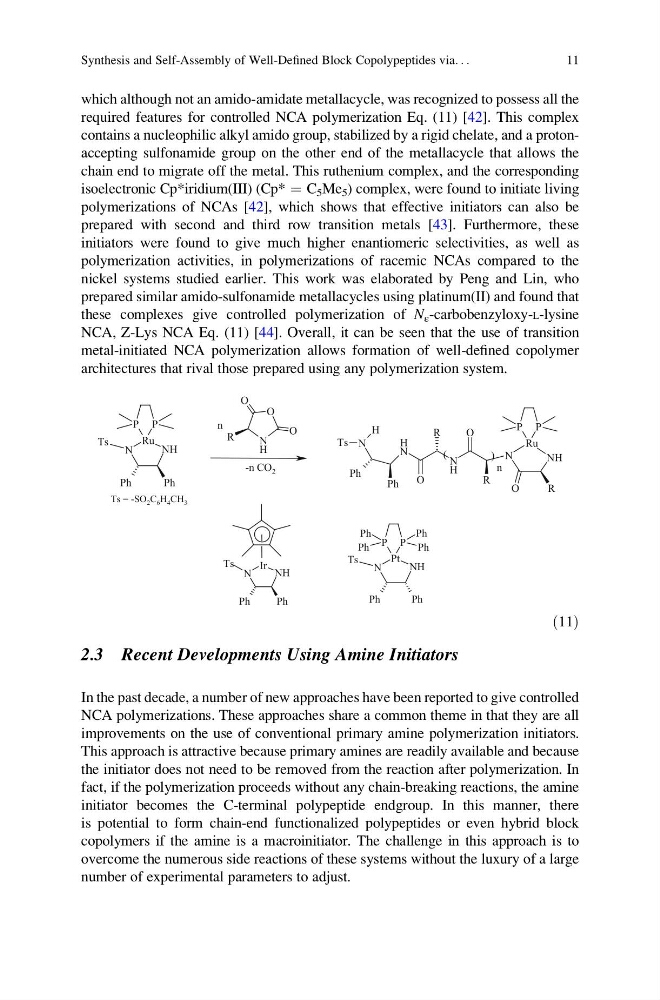
which although not an amido-amidate metallacycle, was recognized to possess all the
required features for controlled NCA polymerization Eq. (11) [42]. This complex
contains a nucleophilic alkyl amido group, stabilized by a rigid chelate, and a protonaccepting sulfonamide group on the other end of the metallacycle that allows the
chain end to migrate off the metal. This ruthenium complex, and the corresponding
isoelectronic Cp*iridium(III) (Cp* ¼ C 5 Me 5 ) complex, were found to initiate living
polymerizations of NCAs [42], which shows that effective initiators can also be
prepared with second and third row transition metals [43]. Furthermore, these
initiators were found to give much higher enantiomeric selectivities, as well as
polymerization activities, in polymerizations of racemic NCAs compared to the
nickel systems studied earlier. This work was elaborated by Peng and Lin, who
prepared similar amido-sulfonamide metallacycles using platinum(II) and found that
these complexes give controlled polymerization of N ε -carbobenzyloxy-L-lysine
NCA, Z-Lys NCA Eq. (11) [44]. Overall, it can be seen that the use of transition
metal-initiated NCA polymerization allows formation of well-defined copolymer
architectures that rival those prepared using any polymerization system.
Ir
N
NH
Ph
Ph
Ru
N
NH
P P
Ph
Ph
N
H
O
O
O
R
Ru
P P
NH
R
O
N
R
N
H
O
R
O
N
H
N
Ph
Ph
H
Pt
N
NH
P P
Ph
Ph
Ph
Ph
Ph
Ph
Ts = -SO 2 C 6 H 4 CH 3
Ts
Ts
n
-n CO 2
Ts
)
(
n
Ts
ð11Þ
2.3 Recent Developments Using Amine Initiators
In the past decade, a number of new approaches have been reported to give controlled
NCA polymerizations. These approaches share a common theme in that they are all
improvements on the use of conventional primary amine polymerization initiators.
This approach is attractive because primary amines are readily available and because
the initiator does not need to be removed from the reaction after polymerization. In
fact, if the polymerization proceeds without any chain-breaking reactions, the amine
initiator becomes the C-terminal polypeptide endgroup. In this manner, there
is potential to form chain-end functionalized polypeptides or even hybrid block
copolymers if the amine is a macroinitiator. The challenge in this approach is to
overcome the numerous side reactions of these systems without the luxury of a large
number of experimental parameters to adjust.
Synthesis and Self-Assembly of Well-Defined Block Copolypeptides via. . .
11
required features for controlled NCA polymerization Eq. (11) [42]. This complex
contains a nucleophilic alkyl amido group, stabilized by a rigid chelate, and a protonaccepting sulfonamide group on the other end of the metallacycle that allows the
chain end to migrate off the metal. This ruthenium complex, and the corresponding
isoelectronic Cp*iridium(III) (Cp* ¼ C 5 Me 5 ) complex, were found to initiate living
polymerizations of NCAs [42], which shows that effective initiators can also be
prepared with second and third row transition metals [43]. Furthermore, these
initiators were found to give much higher enantiomeric selectivities, as well as
polymerization activities, in polymerizations of racemic NCAs compared to the
nickel systems studied earlier. This work was elaborated by Peng and Lin, who
prepared similar amido-sulfonamide metallacycles using platinum(II) and found that
these complexes give controlled polymerization of N ε -carbobenzyloxy-L-lysine
NCA, Z-Lys NCA Eq. (11) [44]. Overall, it can be seen that the use of transition
metal-initiated NCA polymerization allows formation of well-defined copolymer
architectures that rival those prepared using any polymerization system.
Ir
N
NH
Ph
Ph
Ru
N
NH
P P
Ph
Ph
N
H
O
O
O
R
Ru
P P
NH
R
O
N
R
N
H
O
R
O
N
H
N
Ph
Ph
H
Pt
N
NH
P P
Ph
Ph
Ph
Ph
Ph
Ph
Ts = -SO 2 C 6 H 4 CH 3
Ts
Ts
n
-n CO 2
Ts
)
(
n
Ts
ð11Þ
2.3 Recent Developments Using Amine Initiators
In the past decade, a number of new approaches have been reported to give controlled
NCA polymerizations. These approaches share a common theme in that they are all
improvements on the use of conventional primary amine polymerization initiators.
This approach is attractive because primary amines are readily available and because
the initiator does not need to be removed from the reaction after polymerization. In
fact, if the polymerization proceeds without any chain-breaking reactions, the amine
initiator becomes the C-terminal polypeptide endgroup. In this manner, there
is potential to form chain-end functionalized polypeptides or even hybrid block
copolymers if the amine is a macroinitiator. The challenge in this approach is to
overcome the numerous side reactions of these systems without the luxury of a large
number of experimental parameters to adjust.
Synthesis and Self-Assembly of Well-Defined Block Copolypeptides via. . .
11