

nickelacycles. These simple amino acid derivatives undergo tandem oxidativeadditions to nickel(0) to give active NCA polymerization initiators Eq. (7) [36].
These complexes were found to initiate polymerization of NCAs, yielding polypeptides with defined molecular weights, narrow molecular weight distributions, and with
quantitative incorporation of the initiating ligand as a C-terminal endgroup. This
chemistry provides a facile means to incorporate diverse molecules such as polymers,
peptides, oligosaccharides, or other ligands onto the chain ends of polypeptides via
a robust amide linkage, and was further elaborated by Menzel’s group to grow polypeptides off polystyrene particles [37]. Recently, this methodology was used by Patton
and coworkers to attach nickel initiators to silicon oxide substrates and then grow
lysine–cysteine and glutamate–cysteine block copolypeptides from the surfaces [38].
O
N
H
N
H
X
O
R
O
L 2 Ni
N
H
R
O
N
X
H
Ni
O
N
H
O
L 2
R
O
N
X
H
Ni(COD) 2
L 2
-
X = ligand, peptide, polymer
ð7Þ
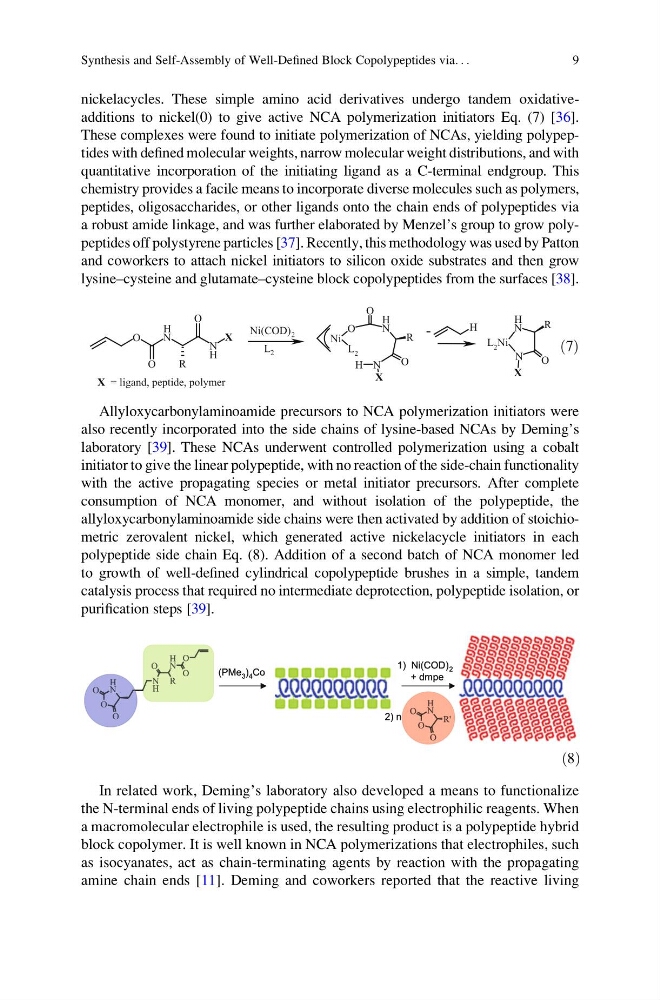
Allyloxycarbonylaminoamide precursors to NCA polymerization initiators were
also recently incorporated into the side chains of lysine-based NCAs by Deming’s
laboratory [39]. These NCAs underwent controlled polymerization using a cobalt
initiator to give the linear polypeptide, with no reaction of the side-chain functionality
with the active propagating species or metal initiator precursors. After complete
consumption of NCA monomer, and without isolation of the polypeptide, the
allyloxycarbonylaminoamide side chains were then activated by addition of stoichiometric zerovalent nickel, which generated active nickelacycle initiators in each
polypeptide side chain Eq. (8). Addition of a second batch of NCA monomer led
to growth of well-defined cylindrical copolypeptide brushes in a simple, tandem
catalysis process that required no intermediate deprotection, polypeptide isolation, or
purification steps [39].
N
H
O
R'
O
O
2) n
1) Ni(COD) 2
+ dmpe
(PMe 3 ) 4 Co
N
H
O
N
H
O
O
O
N
H O
R
O
N
H
O
R'
O
O N N
H H
O O
R R' '
O O
O O
2) n
1) Ni(COD) 2
+ dmpe
(PMe 3 ) 4 Co
N
H
O
N
H
O
O
O
N
H O
R
O
N N
H H
O O
O O
O O
N N
H H
O O N N
H H O O
R R
O O
ð8Þ
In related work, Deming’s laboratory also developed a means to functionalize
the N-terminal ends of living polypeptide chains using electrophilic reagents. When
a macromolecular electrophile is used, the resulting product is a polypeptide hybrid
block copolymer. It is well known in NCA polymerizations that electrophiles, such
as isocyanates, act as chain-terminating agents by reaction with the propagating
amine chain ends [11]. Deming and coworkers reported that the reactive living
Synthesis and Self-Assembly of Well-Defined Block Copolypeptides via. . .
9
These complexes were found to initiate polymerization of NCAs, yielding polypeptides with defined molecular weights, narrow molecular weight distributions, and with
quantitative incorporation of the initiating ligand as a C-terminal endgroup. This
chemistry provides a facile means to incorporate diverse molecules such as polymers,
peptides, oligosaccharides, or other ligands onto the chain ends of polypeptides via
a robust amide linkage, and was further elaborated by Menzel’s group to grow polypeptides off polystyrene particles [37]. Recently, this methodology was used by Patton
and coworkers to attach nickel initiators to silicon oxide substrates and then grow
lysine–cysteine and glutamate–cysteine block copolypeptides from the surfaces [38].
O
N
H
N
H
X
O
R
O
L 2 Ni
N
H
R
O
N
X
H
Ni
O
N
H
O
L 2
R
O
N
X
H
Ni(COD) 2
L 2
-
X = ligand, peptide, polymer
ð7Þ
Allyloxycarbonylaminoamide precursors to NCA polymerization initiators were
also recently incorporated into the side chains of lysine-based NCAs by Deming’s
laboratory [39]. These NCAs underwent controlled polymerization using a cobalt
initiator to give the linear polypeptide, with no reaction of the side-chain functionality
with the active propagating species or metal initiator precursors. After complete
consumption of NCA monomer, and without isolation of the polypeptide, the
allyloxycarbonylaminoamide side chains were then activated by addition of stoichiometric zerovalent nickel, which generated active nickelacycle initiators in each
polypeptide side chain Eq. (8). Addition of a second batch of NCA monomer led
to growth of well-defined cylindrical copolypeptide brushes in a simple, tandem
catalysis process that required no intermediate deprotection, polypeptide isolation, or
purification steps [39].
N
H
O
R'
O
O
2) n
1) Ni(COD) 2
+ dmpe
(PMe 3 ) 4 Co
N
H
O
N
H
O
O
O
N
H O
R
O
N
H
O
R'
O
O N N
H H
O O
R R' '
O O
O O
2) n
1) Ni(COD) 2
+ dmpe
(PMe 3 ) 4 Co
N
H
O
N
H
O
O
O
N
H O
R
O
N N
H H
O O
O O
O O
N N
H H
O O N N
H H O O
R R
O O
ð8Þ
In related work, Deming’s laboratory also developed a means to functionalize
the N-terminal ends of living polypeptide chains using electrophilic reagents. When
a macromolecular electrophile is used, the resulting product is a polypeptide hybrid
block copolymer. It is well known in NCA polymerizations that electrophiles, such
as isocyanates, act as chain-terminating agents by reaction with the propagating
amine chain ends [11]. Deming and coworkers reported that the reactive living
Synthesis and Self-Assembly of Well-Defined Block Copolypeptides via. . .
9