

resulting in an immobilization of the mobile phase and a (complete) healing of the
scratch (Fig. 6).
A second example of coatings based on self-healing metallopolymers was
recently described by Schubert et al. [100]. A polymer network was synthesized
by the crosslinking of terpyridine-functionalized poly(alkyl methacrylates). For this
purpose, an iron salt was added, resulting in insoluble and very hard polymer films
after drying. Furthermore, it could be shown that decomplexation is not the main
process for the self-healing process. In contrast, the ionic interactions between the
charged complexes and the counterions (i.e. sulfate) are the basic principle of the
self-healing behavior of such crosslinked metallopolymer networks (comparable to
ionomers).
Recently, the basic concept of self-healing metallopolymer networks was
improved. For this purpose, the Schubert group utilized cadmium(II)-bisterpyridine complexes [101]. A metallopolymer network based on these complexes
was synthesized by the addition of cadmium acetate. The authors could show that
these materials behave completely different due to a different coordination of the
metal center. Presumably, the acetate moiety also coordinates to the cadmium, but
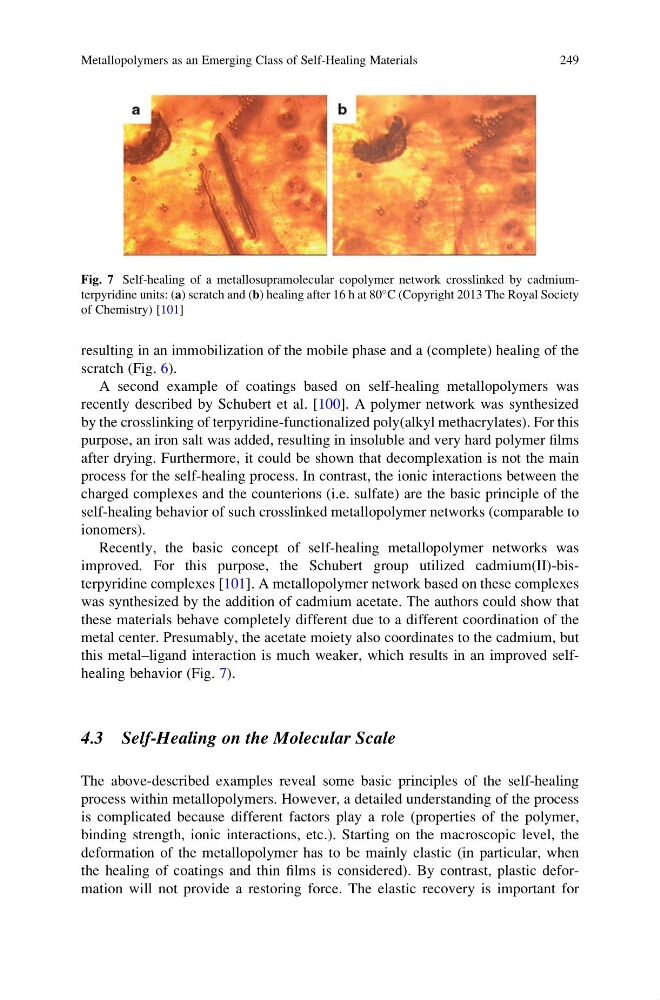
this metal–ligand interaction is much weaker, which results in an improved selfhealing behavior (Fig. 7).
4.3 Self-Healing on the Molecular Scale
The above-described examples reveal some basic principles of the self-healing
process within metallopolymers. However, a detailed understanding of the process
is complicated because different factors play a role (properties of the polymer,
binding strength, ionic interactions, etc.). Starting on the macroscopic level, the
deformation of the metallopolymer has to be mainly elastic (in particular, when
the healing of coatings and thin films is considered). By contrast, plastic deformation will not provide a restoring force. The elastic recovery is important for
Fig. 7 Self-healing of a metallosupramolecular copolymer network crosslinked by cadmiumterpyridine units: (a) scratch and (b) healing after 16 h at 80
C (Copyright 2013 The Royal Society
of Chemistry) [101]
Metallopolymers as an Emerging Class of Self-Healing Materials
249
scratch (Fig. 6).
A second example of coatings based on self-healing metallopolymers was
recently described by Schubert et al. [100]. A polymer network was synthesized
by the crosslinking of terpyridine-functionalized poly(alkyl methacrylates). For this
purpose, an iron salt was added, resulting in insoluble and very hard polymer films
after drying. Furthermore, it could be shown that decomplexation is not the main
process for the self-healing process. In contrast, the ionic interactions between the
charged complexes and the counterions (i.e. sulfate) are the basic principle of the
self-healing behavior of such crosslinked metallopolymer networks (comparable to
ionomers).
Recently, the basic concept of self-healing metallopolymer networks was
improved. For this purpose, the Schubert group utilized cadmium(II)-bisterpyridine complexes [101]. A metallopolymer network based on these complexes
was synthesized by the addition of cadmium acetate. The authors could show that
these materials behave completely different due to a different coordination of the
metal center. Presumably, the acetate moiety also coordinates to the cadmium, but
this metal–ligand interaction is much weaker, which results in an improved selfhealing behavior (Fig. 7).
4.3 Self-Healing on the Molecular Scale
The above-described examples reveal some basic principles of the self-healing
process within metallopolymers. However, a detailed understanding of the process
is complicated because different factors play a role (properties of the polymer,
binding strength, ionic interactions, etc.). Starting on the macroscopic level, the
deformation of the metallopolymer has to be mainly elastic (in particular, when
the healing of coatings and thin films is considered). By contrast, plastic deformation will not provide a restoring force. The elastic recovery is important for
Fig. 7 Self-healing of a metallosupramolecular copolymer network crosslinked by cadmiumterpyridine units: (a) scratch and (b) healing after 16 h at 80
C (Copyright 2013 The Royal Society
of Chemistry) [101]
Metallopolymers as an Emerging Class of Self-Healing Materials
249