

self-healing because it is the first step of the self-healing process [72]. The healing
of bulk materials can also be promoted by bringing the damaged sites into
contact.
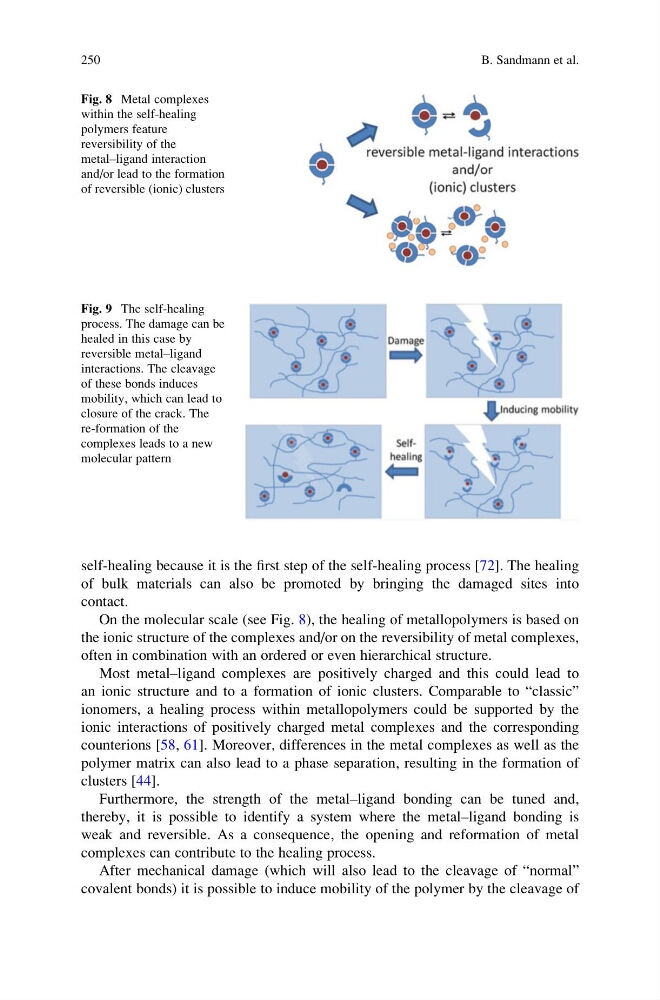
On the molecular scale (see Fig. 8), the healing of metallopolymers is based on
the ionic structure of the complexes and/or on the reversibility of metal complexes,
often in combination with an ordered or even hierarchical structure.
Most metal–ligand complexes are positively charged and this could lead to
an ionic structure and to a formation of ionic clusters. Comparable to “classic”
ionomers, a healing process within metallopolymers could be supported by the
ionic interactions of positively charged metal complexes and the corresponding
counterions [58, 61]. Moreover, differences in the metal complexes as well as the
polymer matrix can also lead to a phase separation, resulting in the formation of
clusters [44].
Furthermore, the strength of the metal–ligand bonding can be tuned and,
thereby, it is possible to identify a system where the metal–ligand bonding is
weak and reversible. As a consequence, the opening and reformation of metal
complexes can contribute to the healing process.
After mechanical damage (which will also lead to the cleavage of “normal”
covalent bonds) it is possible to induce mobility of the polymer by the cleavage of
Fig. 8 Metal complexes
within the self-healing
polymers feature
reversibility of the
metal–ligand interaction
and/or lead to the formation
of reversible (ionic) clusters
Fig. 9 The self-healing
process. The damage can be
healed in this case by
reversible metal–ligand
interactions. The cleavage
of these bonds induces
mobility, which can lead to
closure of the crack. The
re-formation of the
complexes leads to a new
molecular pattern
250
B. Sandmann et al.
of bulk materials can also be promoted by bringing the damaged sites into
contact.
On the molecular scale (see Fig. 8), the healing of metallopolymers is based on
the ionic structure of the complexes and/or on the reversibility of metal complexes,
often in combination with an ordered or even hierarchical structure.
Most metal–ligand complexes are positively charged and this could lead to
an ionic structure and to a formation of ionic clusters. Comparable to “classic”
ionomers, a healing process within metallopolymers could be supported by the
ionic interactions of positively charged metal complexes and the corresponding
counterions [58, 61]. Moreover, differences in the metal complexes as well as the
polymer matrix can also lead to a phase separation, resulting in the formation of
clusters [44].
Furthermore, the strength of the metal–ligand bonding can be tuned and,
thereby, it is possible to identify a system where the metal–ligand bonding is
weak and reversible. As a consequence, the opening and reformation of metal
complexes can contribute to the healing process.
After mechanical damage (which will also lead to the cleavage of “normal”
covalent bonds) it is possible to induce mobility of the polymer by the cleavage of
Fig. 8 Metal complexes
within the self-healing
polymers feature
reversibility of the
metal–ligand interaction
and/or lead to the formation
of reversible (ionic) clusters
Fig. 9 The self-healing
process. The damage can be
healed in this case by
reversible metal–ligand
interactions. The cleavage
of these bonds induces
mobility, which can lead to
closure of the crack. The
re-formation of the
complexes leads to a new
molecular pattern
250
B. Sandmann et al.