

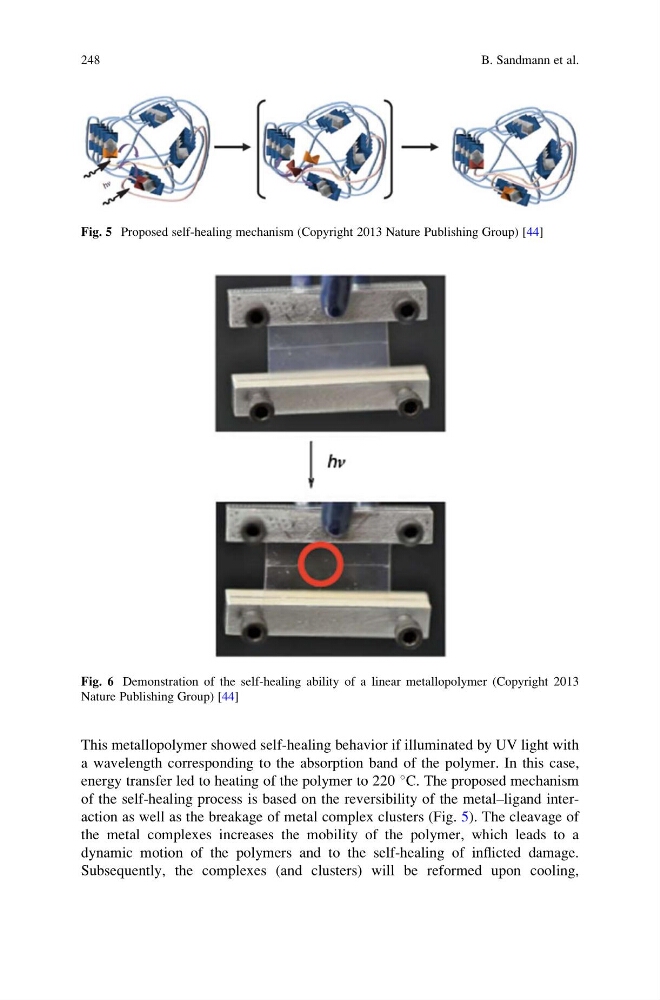
This metallopolymer showed self-healing behavior if illuminated by UV light with
a wavelength corresponding to the absorption band of the polymer. In this case,
energy transfer led to heating of the polymer to 220
C. The proposed mechanism
of the self-healing process is based on the reversibility of the metal–ligand interaction as well as the breakage of metal complex clusters (Fig. 5). The cleavage of
the metal complexes increases the mobility of the polymer, which leads to a
dynamic motion of the polymers and to the self-healing of inflicted damage.
Subsequently, the complexes (and clusters) will be reformed upon cooling,
Fig. 5 Proposed self-healing mechanism (Copyright 2013 Nature Publishing Group) [44]
Fig. 6 Demonstration of the self-healing ability of a linear metallopolymer (Copyright 2013
Nature Publishing Group) [44]
248
B. Sandmann et al.
a wavelength corresponding to the absorption band of the polymer. In this case,
energy transfer led to heating of the polymer to 220
C. The proposed mechanism
of the self-healing process is based on the reversibility of the metal–ligand interaction as well as the breakage of metal complex clusters (Fig. 5). The cleavage of
the metal complexes increases the mobility of the polymer, which leads to a
dynamic motion of the polymers and to the self-healing of inflicted damage.
Subsequently, the complexes (and clusters) will be reformed upon cooling,
Fig. 5 Proposed self-healing mechanism (Copyright 2013 Nature Publishing Group) [44]
Fig. 6 Demonstration of the self-healing ability of a linear metallopolymer (Copyright 2013
Nature Publishing Group) [44]
248
B. Sandmann et al.