

within the main chain [98]. The authors used polyurethane analogue polymers as
the backbone, in which bis(1,2,3-trizol-4-yl) pyridine was incorporated as ligand.
Afterwards, these polymers were complexed with zinc(II) and europium(III) ions,
respectively, which led to self-healing properties.
In this case, the question also arises as to whether the metal–ligand interaction is
the only reason for the self-healing process. There is also the possibility of hydrogen bond formation, which could also contribute to the self-healing properties. In
addition, the self-healing efficiency was not quantified.
Furthermore, Terech et al. presented a self-healing metallopolymer gel that was
based on the diterpyridyl moiety polymerized by the addition of nickel ions
[99]. The resulting linear polymer exhibited very poor mechanical properties and
showed a good healing efficiency due to high flexibility of the polymer itself.
In 2011, Rowan and Weder et al. described the self-healing properties of a
linear metallopolymer. In order to obtain self-healing behavior, the authors
used UV light [44]. For this purpose, poly(ethylene-co-butylene) was functionalized with two 2,6-bis(1’-methylbenzimidazolyl)pyridine moieties at the
termini and the subsequent addition of zinc di[bis(trifluoromethylsulfonyl)imide]
or lanthanum tri[bis(trifluoromethylsulfonyl)imide] led to a linear metallopolymer.
(A) native; phase I
first
loading
first
loading
second
loading
(C) stretched (ε = 50%);
phase II
(B) stretched (ε = 50%);
phase I and II
(E)
(F) healing
(D) unloaded; phase II
unloading
Collagen domain
extensible domain
phase I
extensible domain
phase II
(A)
(D)
(E)
(F)
(B)
(C)
top view of
preCol 6+1 bundle
top view of preCol
Monomer
His
Flank
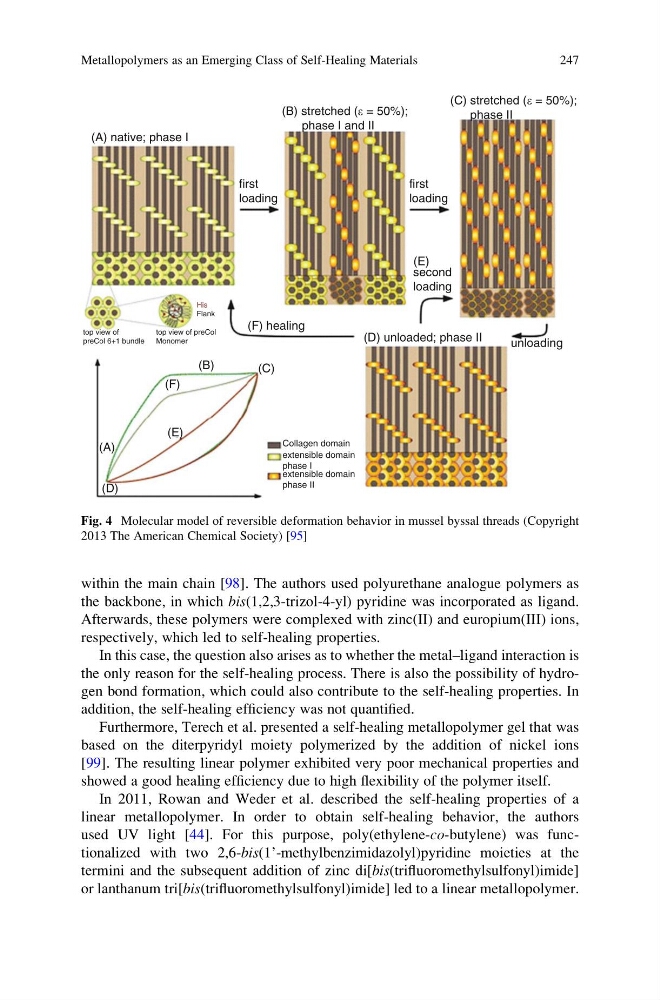
Fig. 4 Molecular model of reversible deformation behavior in mussel byssal threads (Copyright
2013 The American Chemical Society) [95]
Metallopolymers as an Emerging Class of Self-Healing Materials
247
the backbone, in which bis(1,2,3-trizol-4-yl) pyridine was incorporated as ligand.
Afterwards, these polymers were complexed with zinc(II) and europium(III) ions,
respectively, which led to self-healing properties.
In this case, the question also arises as to whether the metal–ligand interaction is
the only reason for the self-healing process. There is also the possibility of hydrogen bond formation, which could also contribute to the self-healing properties. In
addition, the self-healing efficiency was not quantified.
Furthermore, Terech et al. presented a self-healing metallopolymer gel that was
based on the diterpyridyl moiety polymerized by the addition of nickel ions
[99]. The resulting linear polymer exhibited very poor mechanical properties and
showed a good healing efficiency due to high flexibility of the polymer itself.
In 2011, Rowan and Weder et al. described the self-healing properties of a
linear metallopolymer. In order to obtain self-healing behavior, the authors
used UV light [44]. For this purpose, poly(ethylene-co-butylene) was functionalized with two 2,6-bis(1’-methylbenzimidazolyl)pyridine moieties at the
termini and the subsequent addition of zinc di[bis(trifluoromethylsulfonyl)imide]
or lanthanum tri[bis(trifluoromethylsulfonyl)imide] led to a linear metallopolymer.
(A) native; phase I
first
loading
first
loading
second
loading
(C) stretched (ε = 50%);
phase II
(B) stretched (ε = 50%);
phase I and II
(E)
(F) healing
(D) unloaded; phase II
unloading
Collagen domain
extensible domain
phase I
extensible domain
phase II
(A)
(D)
(E)
(F)
(B)
(C)
top view of
preCol 6+1 bundle
top view of preCol
Monomer
His
Flank
Fig. 4 Molecular model of reversible deformation behavior in mussel byssal threads (Copyright
2013 The American Chemical Society) [95]
Metallopolymers as an Emerging Class of Self-Healing Materials
247