

[141]. After the development of catalyst-transfer condensation polymerization of
polythiophene, the block copolymer of polythiophene and poly(alkyl acrylate) was
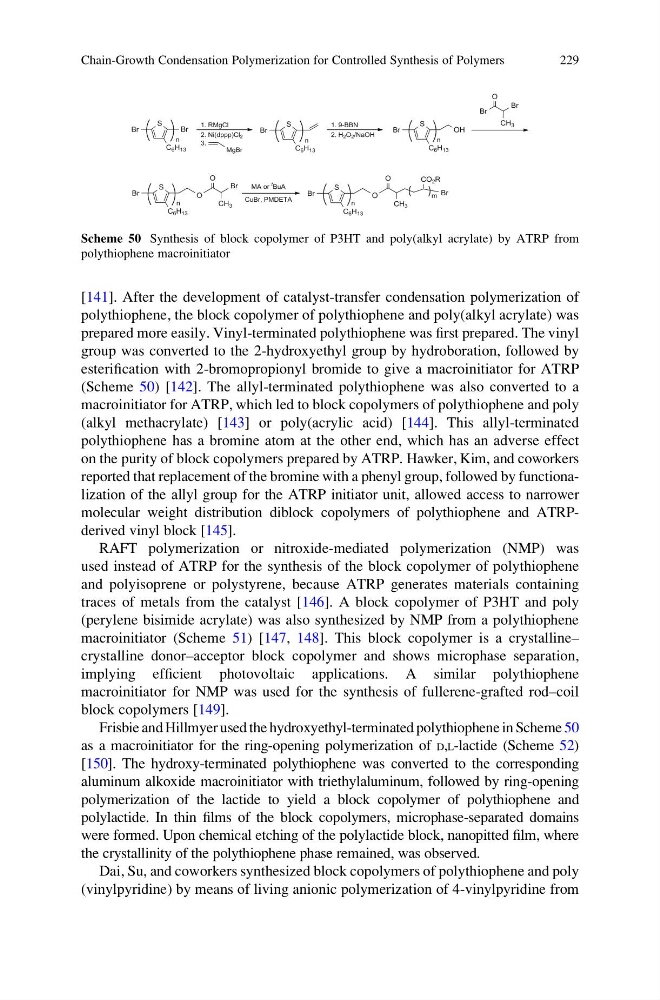
prepared more easily. Vinyl-terminated polythiophene was first prepared. The vinyl
group was converted to the 2-hydroxyethyl group by hydroboration, followed by
esterification with 2-bromopropionyl bromide to give a macroinitiator for ATRP
(Scheme 50) [142]. The allyl-terminated polythiophene was also converted to a
macroinitiator for ATRP, which led to block copolymers of polythiophene and poly
(alkyl methacrylate) [143] or poly(acrylic acid) [144]. This allyl-terminated
polythiophene has a bromine atom at the other end, which has an adverse effect
on the purity of block copolymers prepared by ATRP. Hawker, Kim, and coworkers
reported that replacement of the bromine with a phenyl group, followed by functionalization of the allyl group for the ATRP initiator unit, allowed access to narrower
molecular weight distribution diblock copolymers of polythiophene and ATRPderived vinyl block [145].
RAFT polymerization or nitroxide-mediated polymerization (NMP) was
used instead of ATRP for the synthesis of the block copolymer of polythiophene
and polyisoprene or polystyrene, because ATRP generates materials containing
traces of metals from the catalyst [146]. A block copolymer of P3HT and poly
(perylene bisimide acrylate) was also synthesized by NMP from a polythiophene
macroinitiator (Scheme 51) [147, 148]. This block copolymer is a crystalline–
crystalline donor–acceptor block copolymer and shows microphase separation,
implying efficient photovoltaic applications. A similar polythiophene
macroinitiator for NMP was used for the synthesis of fullerene-grafted rod–coil
block copolymers [149].
Frisbie and Hillmyer used the hydroxyethyl-terminated polythiophene in Scheme 50
as a macroinitiator for the ring-opening polymerization of D,L-lactide (Scheme 52)
[150]. The hydroxy-terminated polythiophene was converted to the corresponding
aluminum alkoxide macroinitiator with triethylaluminum, followed by ring-opening
polymerization of the lactide to yield a block copolymer of polythiophene and
polylactide. In thin films of the block copolymers, microphase-separated domains
were formed. Upon chemical etching of the polylactide block, nanopitted film, where
the crystallinity of the polythiophene phase remained, was observed.
Dai, Su, and coworkers synthesized block copolymers of polythiophene and poly
(vinylpyridine) by means of living anionic polymerization of 4-vinylpyridine from
Scheme 50 Synthesis of block copolymer of P3HT and poly(alkyl acrylate) by ATRP from
polythiophene macroinitiator
Chain-Growth Condensation Polymerization for Controlled Synthesis of Polymers
229
polythiophene, the block copolymer of polythiophene and poly(alkyl acrylate) was
prepared more easily. Vinyl-terminated polythiophene was first prepared. The vinyl
group was converted to the 2-hydroxyethyl group by hydroboration, followed by
esterification with 2-bromopropionyl bromide to give a macroinitiator for ATRP
(Scheme 50) [142]. The allyl-terminated polythiophene was also converted to a
macroinitiator for ATRP, which led to block copolymers of polythiophene and poly
(alkyl methacrylate) [143] or poly(acrylic acid) [144]. This allyl-terminated
polythiophene has a bromine atom at the other end, which has an adverse effect
on the purity of block copolymers prepared by ATRP. Hawker, Kim, and coworkers
reported that replacement of the bromine with a phenyl group, followed by functionalization of the allyl group for the ATRP initiator unit, allowed access to narrower
molecular weight distribution diblock copolymers of polythiophene and ATRPderived vinyl block [145].
RAFT polymerization or nitroxide-mediated polymerization (NMP) was
used instead of ATRP for the synthesis of the block copolymer of polythiophene
and polyisoprene or polystyrene, because ATRP generates materials containing
traces of metals from the catalyst [146]. A block copolymer of P3HT and poly
(perylene bisimide acrylate) was also synthesized by NMP from a polythiophene
macroinitiator (Scheme 51) [147, 148]. This block copolymer is a crystalline–
crystalline donor–acceptor block copolymer and shows microphase separation,
implying efficient photovoltaic applications. A similar polythiophene
macroinitiator for NMP was used for the synthesis of fullerene-grafted rod–coil
block copolymers [149].
Frisbie and Hillmyer used the hydroxyethyl-terminated polythiophene in Scheme 50
as a macroinitiator for the ring-opening polymerization of D,L-lactide (Scheme 52)
[150]. The hydroxy-terminated polythiophene was converted to the corresponding
aluminum alkoxide macroinitiator with triethylaluminum, followed by ring-opening
polymerization of the lactide to yield a block copolymer of polythiophene and
polylactide. In thin films of the block copolymers, microphase-separated domains
were formed. Upon chemical etching of the polylactide block, nanopitted film, where
the crystallinity of the polythiophene phase remained, was observed.
Dai, Su, and coworkers synthesized block copolymers of polythiophene and poly
(vinylpyridine) by means of living anionic polymerization of 4-vinylpyridine from
Scheme 50 Synthesis of block copolymer of P3HT and poly(alkyl acrylate) by ATRP from
polythiophene macroinitiator
Chain-Growth Condensation Polymerization for Controlled Synthesis of Polymers
229