

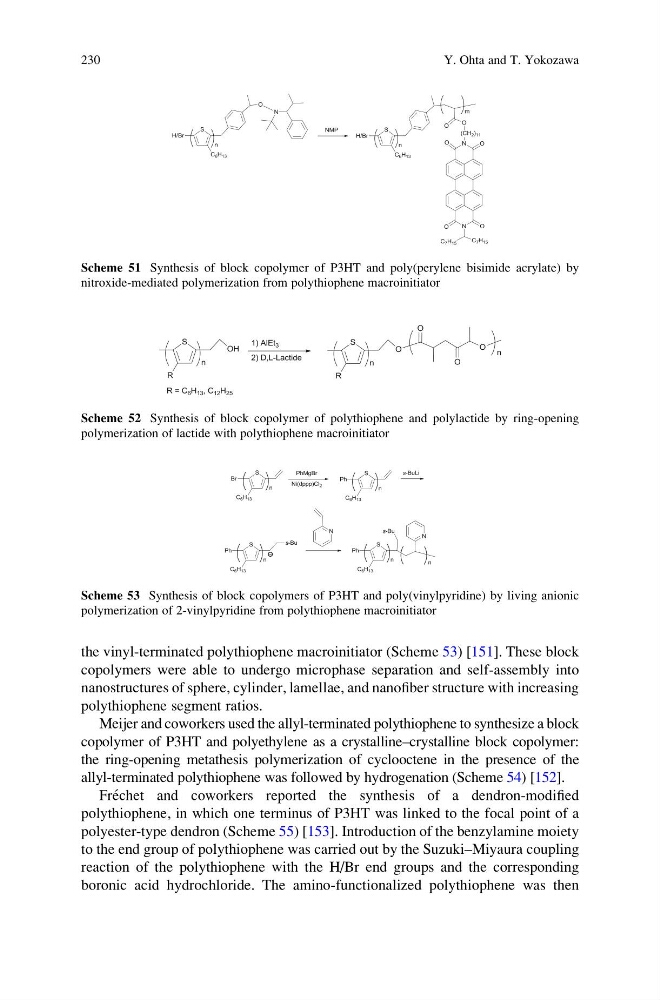
the vinyl-terminated polythiophene macroinitiator (Scheme 53) [151]. These block
copolymers were able to undergo microphase separation and self-assembly into
nanostructures of sphere, cylinder, lamellae, and nanofiber structure with increasing
polythiophene segment ratios.
Meijer and coworkers used the allyl-terminated polythiophene to synthesize a block
copolymer of P3HT and polyethylene as a crystalline–crystalline block copolymer:
the ring-opening metathesis polymerization of cyclooctene in the presence of the
allyl-terminated polythiophene was followed by hydrogenation (Scheme 54) [152].
Fre ´chet and coworkers reported the synthesis of a dendron-modified
polythiophene, in which one terminus of P3HT was linked to the focal point of a
polyester-type dendron (Scheme 55) [153]. Introduction of the benzylamine moiety
to the end group of polythiophene was carried out by the Suzuki–Miyaura coupling
reaction of the polythiophene with the H/Br end groups and the corresponding
boronic acid hydrochloride. The amino-functionalized polythiophene was then
Scheme 52 Synthesis of block copolymer of polythiophene and polylactide by ring-opening
polymerization of lactide with polythiophene macroinitiator
Scheme 51 Synthesis of block copolymer of P3HT and poly(perylene bisimide acrylate) by
nitroxide-mediated polymerization from polythiophene macroinitiator
Scheme 53 Synthesis of block copolymers of P3HT and poly(vinylpyridine) by living anionic
polymerization of 2-vinylpyridine from polythiophene macroinitiator
230
Y. Ohta and T. Yokozawa
copolymers were able to undergo microphase separation and self-assembly into
nanostructures of sphere, cylinder, lamellae, and nanofiber structure with increasing
polythiophene segment ratios.
Meijer and coworkers used the allyl-terminated polythiophene to synthesize a block
copolymer of P3HT and polyethylene as a crystalline–crystalline block copolymer:
the ring-opening metathesis polymerization of cyclooctene in the presence of the
allyl-terminated polythiophene was followed by hydrogenation (Scheme 54) [152].
Fre ´chet and coworkers reported the synthesis of a dendron-modified
polythiophene, in which one terminus of P3HT was linked to the focal point of a
polyester-type dendron (Scheme 55) [153]. Introduction of the benzylamine moiety
to the end group of polythiophene was carried out by the Suzuki–Miyaura coupling
reaction of the polythiophene with the H/Br end groups and the corresponding
boronic acid hydrochloride. The amino-functionalized polythiophene was then
Scheme 52 Synthesis of block copolymer of polythiophene and polylactide by ring-opening
polymerization of lactide with polythiophene macroinitiator
Scheme 51 Synthesis of block copolymer of P3HT and poly(perylene bisimide acrylate) by
nitroxide-mediated polymerization from polythiophene macroinitiator
Scheme 53 Synthesis of block copolymers of P3HT and poly(vinylpyridine) by living anionic
polymerization of 2-vinylpyridine from polythiophene macroinitiator
230
Y. Ohta and T. Yokozawa