

work-up of the prepared 40/Zn complex resulted in recovery of 40, but not the
hydrized monobromo compound. Electron paramagnetic resonance measurements
revealed that the 40/Zn complex was a radical anion; single electron transfer from
Zn to the electron-deficient 40 occurred. This radical anion was polymerized with
Ni(dppe)Br 2 or PhNi(dppe)Br at room temperature. The polymerization behavior
showed a chain-growth polymerization mechanism: the molecular weight increased
with increasing feed ratio of monomer to the Ni catalyst, with retention of low
polydispersity (M n ¼ 25,000–104,000, M w /M n ¼ 1.3–1.7), and the phenyl group
was introduced into the polymer end group when PhNi(dppe)Br was used.
Suzuki–Miyaura coupling polymerization also proceeds in the catalyst-transfer
mechanism. In this polymerization, stable arylpalladium(II) halide complex was
used as an externally added initiator, and the aryl group of the complex served as an
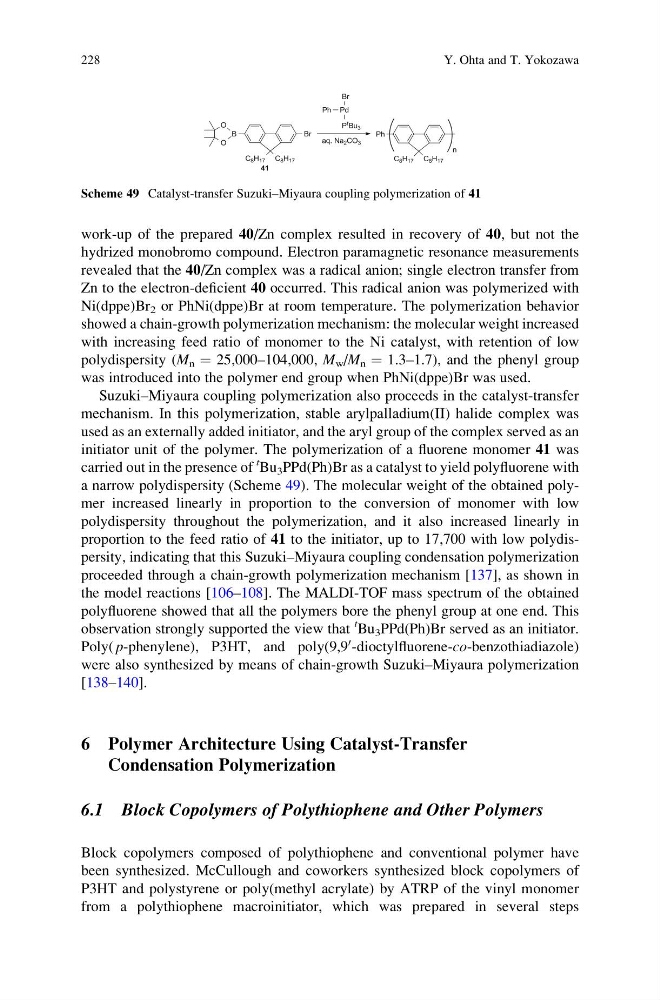
initiator unit of the polymer. The polymerization of a fluorene monomer 41 was
carried out in the presence of
t
Bu 3 PPd(Ph)Br as a catalyst to yield polyfluorene with
a narrow polydispersity (Scheme 49). The molecular weight of the obtained polymer increased linearly in proportion to the conversion of monomer with low
polydispersity throughout the polymerization, and it also increased linearly in
proportion to the feed ratio of 41 to the initiator, up to 17,700 with low polydispersity, indicating that this Suzuki–Miyaura coupling condensation polymerization
proceeded through a chain-growth polymerization mechanism [137], as shown in
the model reactions [106–108]. The MALDI-TOF mass spectrum of the obtained
polyfluorene showed that all the polymers bore the phenyl group at one end. This
observation strongly supported the view that
t
Bu 3 PPd(Ph)Br served as an initiator.
Poly( p-phenylene), P3HT, and poly(9,9
0 -dioctylfluorene-co-benzothiadiazole)
were also synthesized by means of chain-growth Suzuki–Miyaura polymerization
[138–140].
6 Polymer Architecture Using Catalyst-Transfer
Condensation Polymerization
6.1 Block Copolymers of Polythiophene and Other Polymers
Block copolymers composed of polythiophene and conventional polymer have
been synthesized. McCullough and coworkers synthesized block copolymers of
P3HT and polystyrene or poly(methyl acrylate) by ATRP of the vinyl monomer
from a polythiophene macroinitiator, which was prepared in several steps
Scheme 49 Catalyst-transfer Suzuki–Miyaura coupling polymerization of 41
228
Y. Ohta and T. Yokozawa
hydrized monobromo compound. Electron paramagnetic resonance measurements
revealed that the 40/Zn complex was a radical anion; single electron transfer from
Zn to the electron-deficient 40 occurred. This radical anion was polymerized with
Ni(dppe)Br 2 or PhNi(dppe)Br at room temperature. The polymerization behavior
showed a chain-growth polymerization mechanism: the molecular weight increased
with increasing feed ratio of monomer to the Ni catalyst, with retention of low
polydispersity (M n ¼ 25,000–104,000, M w /M n ¼ 1.3–1.7), and the phenyl group
was introduced into the polymer end group when PhNi(dppe)Br was used.
Suzuki–Miyaura coupling polymerization also proceeds in the catalyst-transfer
mechanism. In this polymerization, stable arylpalladium(II) halide complex was
used as an externally added initiator, and the aryl group of the complex served as an
initiator unit of the polymer. The polymerization of a fluorene monomer 41 was
carried out in the presence of
t
Bu 3 PPd(Ph)Br as a catalyst to yield polyfluorene with
a narrow polydispersity (Scheme 49). The molecular weight of the obtained polymer increased linearly in proportion to the conversion of monomer with low
polydispersity throughout the polymerization, and it also increased linearly in
proportion to the feed ratio of 41 to the initiator, up to 17,700 with low polydispersity, indicating that this Suzuki–Miyaura coupling condensation polymerization
proceeded through a chain-growth polymerization mechanism [137], as shown in
the model reactions [106–108]. The MALDI-TOF mass spectrum of the obtained
polyfluorene showed that all the polymers bore the phenyl group at one end. This
observation strongly supported the view that
t
Bu 3 PPd(Ph)Br served as an initiator.
Poly( p-phenylene), P3HT, and poly(9,9
0 -dioctylfluorene-co-benzothiadiazole)
were also synthesized by means of chain-growth Suzuki–Miyaura polymerization
[138–140].
6 Polymer Architecture Using Catalyst-Transfer
Condensation Polymerization
6.1 Block Copolymers of Polythiophene and Other Polymers
Block copolymers composed of polythiophene and conventional polymer have
been synthesized. McCullough and coworkers synthesized block copolymers of
P3HT and polystyrene or poly(methyl acrylate) by ATRP of the vinyl monomer
from a polythiophene macroinitiator, which was prepared in several steps
Scheme 49 Catalyst-transfer Suzuki–Miyaura coupling polymerization of 41
228
Y. Ohta and T. Yokozawa