

and found that polymerization of 37 with Ni(dppe)Cl 2 in the presence of additional
dppe equimolar to the catalyst at 0
C gave a polypyrrole with a low polydispersity
(M w /M n ¼ 1.11) without formation of byproduct. The conversion-M n and feed
ratio-M n relationships indicated that this polymerization proceeded in a catalysttransfer polymerization manner [133].
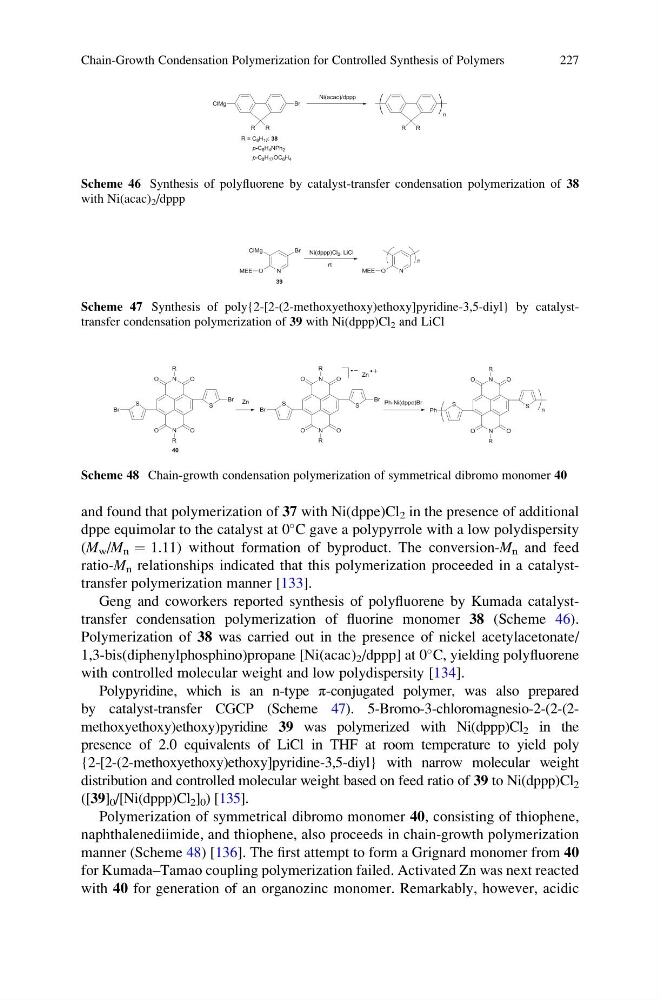
Geng and coworkers reported synthesis of polyfluorene by Kumada catalysttransfer condensation polymerization of fluorine monomer 38 (Scheme 46).
Polymerization of 38 was carried out in the presence of nickel acetylacetonate/
1,3-bis(diphenylphosphino)propane [Ni(acac) 2 /dppp] at 0
C, yielding polyfluorene
with controlled molecular weight and low polydispersity [134].
Polypyridine, which is an n-type π-conjugated polymer, was also prepared
by catalyst-transfer CGCP (Scheme 47). 5-Bromo-3-chloromagnesio-2-(2-(2methoxyethoxy)ethoxy)pyridine 39 was polymerized with Ni(dppp)Cl 2 in the
presence of 2.0 equivalents of LiCl in THF at room temperature to yield poly
{2-[2-(2-methoxyethoxy)ethoxy]pyridine-3,5-diyl} with narrow molecular weight
distribution and controlled molecular weight based on feed ratio of 39 to Ni(dppp)Cl 2
([39] 0 /[Ni(dppp)Cl 2 ] 0 ) [135].
Polymerization of symmetrical dibromo monomer 40, consisting of thiophene,
naphthalenediimide, and thiophene, also proceeds in chain-growth polymerization
manner (Scheme 48) [136]. The first attempt to form a Grignard monomer from 40
for Kumada–Tamao coupling polymerization failed. Activated Zn was next reacted
with 40 for generation of an organozinc monomer. Remarkably, however, acidic
Scheme 46 Synthesis of polyfluorene by catalyst-transfer condensation polymerization of 38
with Ni(acac) 2 /dppp
Scheme 47 Synthesis of poly{2-[2-(2-methoxyethoxy)ethoxy]pyridine-3,5-diyl} by catalysttransfer condensation polymerization of 39 with Ni(dppp)Cl 2 and LiCl
Scheme 48 Chain-growth condensation polymerization of symmetrical dibromo monomer 40
Chain-Growth Condensation Polymerization for Controlled Synthesis of Polymers
227
dppe equimolar to the catalyst at 0
C gave a polypyrrole with a low polydispersity
(M w /M n ¼ 1.11) without formation of byproduct. The conversion-M n and feed
ratio-M n relationships indicated that this polymerization proceeded in a catalysttransfer polymerization manner [133].
Geng and coworkers reported synthesis of polyfluorene by Kumada catalysttransfer condensation polymerization of fluorine monomer 38 (Scheme 46).
Polymerization of 38 was carried out in the presence of nickel acetylacetonate/
1,3-bis(diphenylphosphino)propane [Ni(acac) 2 /dppp] at 0
C, yielding polyfluorene
with controlled molecular weight and low polydispersity [134].
Polypyridine, which is an n-type π-conjugated polymer, was also prepared
by catalyst-transfer CGCP (Scheme 47). 5-Bromo-3-chloromagnesio-2-(2-(2methoxyethoxy)ethoxy)pyridine 39 was polymerized with Ni(dppp)Cl 2 in the
presence of 2.0 equivalents of LiCl in THF at room temperature to yield poly
{2-[2-(2-methoxyethoxy)ethoxy]pyridine-3,5-diyl} with narrow molecular weight
distribution and controlled molecular weight based on feed ratio of 39 to Ni(dppp)Cl 2
([39] 0 /[Ni(dppp)Cl 2 ] 0 ) [135].
Polymerization of symmetrical dibromo monomer 40, consisting of thiophene,
naphthalenediimide, and thiophene, also proceeds in chain-growth polymerization
manner (Scheme 48) [136]. The first attempt to form a Grignard monomer from 40
for Kumada–Tamao coupling polymerization failed. Activated Zn was next reacted
with 40 for generation of an organozinc monomer. Remarkably, however, acidic
Scheme 46 Synthesis of polyfluorene by catalyst-transfer condensation polymerization of 38
with Ni(acac) 2 /dppp
Scheme 47 Synthesis of poly{2-[2-(2-methoxyethoxy)ethoxy]pyridine-3,5-diyl} by catalysttransfer condensation polymerization of 39 with Ni(dppp)Cl 2 and LiCl
Scheme 48 Chain-growth condensation polymerization of symmetrical dibromo monomer 40
Chain-Growth Condensation Polymerization for Controlled Synthesis of Polymers
227