

It is important to clarify whether catalyst-transfer condensation polymerization
is specific to polythiophene or whether it is generally applicable to the synthesis
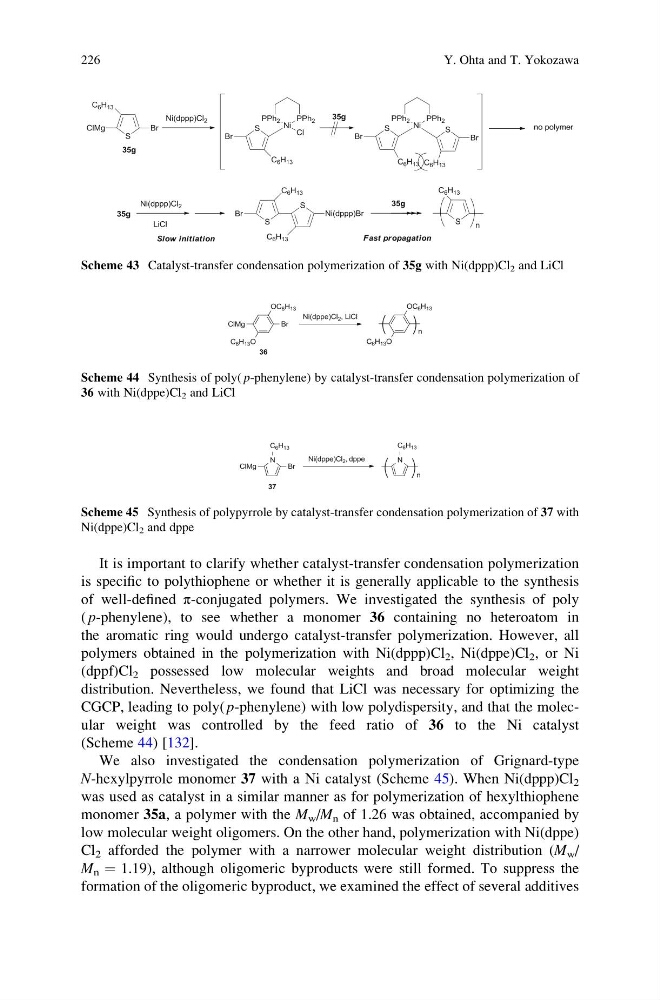
of well-defined π-conjugated polymers. We investigated the synthesis of poly
( p-phenylene), to see whether a monomer 36 containing no heteroatom in
the aromatic ring would undergo catalyst-transfer polymerization. However, all
polymers obtained in the polymerization with Ni(dppp)Cl 2 , Ni(dppe)Cl 2 , or Ni
(dppf)Cl 2 possessed low molecular weights and broad molecular weight
distribution. Nevertheless, we found that LiCl was necessary for optimizing the
CGCP, leading to poly( p-phenylene) with low polydispersity, and that the molecular weight was controlled by the feed ratio of 36 to the Ni catalyst
(Scheme 44) [132].
We also investigated the condensation polymerization of Grignard-type
N-hexylpyrrole monomer 37 with a Ni catalyst (Scheme 45). When Ni(dppp)Cl 2
was used as catalyst in a similar manner as for polymerization of hexylthiophene
monomer 35a, a polymer with the M w /M n of 1.26 was obtained, accompanied by
low molecular weight oligomers. On the other hand, polymerization with Ni(dppe)
Cl 2 afforded the polymer with a narrower molecular weight distribution (M w /
M n ¼ 1.19), although oligomeric byproducts were still formed. To suppress the
formation of the oligomeric byproduct, we examined the effect of several additives
Scheme 43 Catalyst-transfer condensation polymerization of 35g with Ni(dppp)Cl 2 and LiCl
Scheme 44 Synthesis of poly( p-phenylene) by catalyst-transfer condensation polymerization of
36 with Ni(dppe)Cl 2 and LiCl
Scheme 45 Synthesis of polypyrrole by catalyst-transfer condensation polymerization of 37 with
Ni(dppe)Cl 2 and dppe
226
Y. Ohta and T. Yokozawa
is specific to polythiophene or whether it is generally applicable to the synthesis
of well-defined π-conjugated polymers. We investigated the synthesis of poly
( p-phenylene), to see whether a monomer 36 containing no heteroatom in
the aromatic ring would undergo catalyst-transfer polymerization. However, all
polymers obtained in the polymerization with Ni(dppp)Cl 2 , Ni(dppe)Cl 2 , or Ni
(dppf)Cl 2 possessed low molecular weights and broad molecular weight
distribution. Nevertheless, we found that LiCl was necessary for optimizing the
CGCP, leading to poly( p-phenylene) with low polydispersity, and that the molecular weight was controlled by the feed ratio of 36 to the Ni catalyst
(Scheme 44) [132].
We also investigated the condensation polymerization of Grignard-type
N-hexylpyrrole monomer 37 with a Ni catalyst (Scheme 45). When Ni(dppp)Cl 2
was used as catalyst in a similar manner as for polymerization of hexylthiophene
monomer 35a, a polymer with the M w /M n of 1.26 was obtained, accompanied by
low molecular weight oligomers. On the other hand, polymerization with Ni(dppe)
Cl 2 afforded the polymer with a narrower molecular weight distribution (M w /
M n ¼ 1.19), although oligomeric byproducts were still formed. To suppress the
formation of the oligomeric byproduct, we examined the effect of several additives
Scheme 43 Catalyst-transfer condensation polymerization of 35g with Ni(dppp)Cl 2 and LiCl
Scheme 44 Synthesis of poly( p-phenylene) by catalyst-transfer condensation polymerization of
36 with Ni(dppe)Cl 2 and LiCl
Scheme 45 Synthesis of polypyrrole by catalyst-transfer condensation polymerization of 37 with
Ni(dppe)Cl 2 and dppe
226
Y. Ohta and T. Yokozawa