

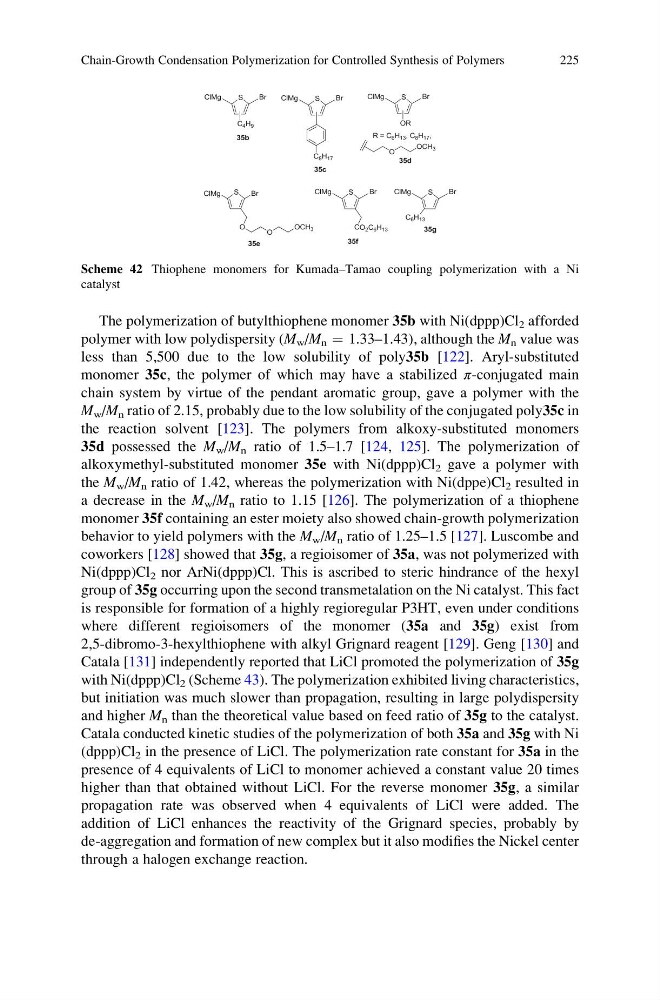
The polymerization of butylthiophene monomer 35b with Ni(dppp)Cl 2 afforded
polymer with low polydispersity (M w /M n ¼ 1.33–1.43), although the M n value was
less than 5,500 due to the low solubility of poly35b [122]. Aryl-substituted
monomer 35c, the polymer of which may have a stabilized π-conjugated main
chain system by virtue of the pendant aromatic group, gave a polymer with the
M w /M n ratio of 2.15, probably due to the low solubility of the conjugated poly35c in
the reaction solvent [123]. The polymers from alkoxy-substituted monomers
35d possessed the M w /M n ratio of 1.5–1.7 [124, 125]. The polymerization of
alkoxymethyl-substituted monomer 35e with Ni(dppp)Cl 2 gave a polymer with
the M w /M n ratio of 1.42, whereas the polymerization with Ni(dppe)Cl 2 resulted in
a decrease in the M w /M n ratio to 1.15 [126]. The polymerization of a thiophene
monomer 35f containing an ester moiety also showed chain-growth polymerization
behavior to yield polymers with the M w /M n ratio of 1.25–1.5 [127]. Luscombe and
coworkers [128] showed that 35g, a regioisomer of 35a, was not polymerized with
Ni(dppp)Cl 2 nor ArNi(dppp)Cl. This is ascribed to steric hindrance of the hexyl
group of 35g occurring upon the second transmetalation on the Ni catalyst. This fact
is responsible for formation of a highly regioregular P3HT, even under conditions
where different regioisomers of the monomer (35a and 35g) exist from
2,5-dibromo-3-hexylthiophene with alkyl Grignard reagent [129]. Geng [130] and
Catala [131] independently reported that LiCl promoted the polymerization of 35g
with Ni(dppp)Cl 2 (Scheme 43). The polymerization exhibited living characteristics,
but initiation was much slower than propagation, resulting in large polydispersity
and higher M n than the theoretical value based on feed ratio of 35g to the catalyst.
Catala conducted kinetic studies of the polymerization of both 35a and 35g with Ni
(dppp)Cl 2 in the presence of LiCl. The polymerization rate constant for 35a in the
presence of 4 equivalents of LiCl to monomer achieved a constant value 20 times
higher than that obtained without LiCl. For the reverse monomer 35g, a similar
propagation rate was observed when 4 equivalents of LiCl were added. The
addition of LiCl enhances the reactivity of the Grignard species, probably by
de-aggregation and formation of new complex but it also modifies the Nickel center
through a halogen exchange reaction.
Scheme 42 Thiophene monomers for Kumada–Tamao coupling polymerization with a Ni
catalyst
Chain-Growth Condensation Polymerization for Controlled Synthesis of Polymers
225
polymer with low polydispersity (M w /M n ¼ 1.33–1.43), although the M n value was
less than 5,500 due to the low solubility of poly35b [122]. Aryl-substituted
monomer 35c, the polymer of which may have a stabilized π-conjugated main
chain system by virtue of the pendant aromatic group, gave a polymer with the
M w /M n ratio of 2.15, probably due to the low solubility of the conjugated poly35c in
the reaction solvent [123]. The polymers from alkoxy-substituted monomers
35d possessed the M w /M n ratio of 1.5–1.7 [124, 125]. The polymerization of
alkoxymethyl-substituted monomer 35e with Ni(dppp)Cl 2 gave a polymer with
the M w /M n ratio of 1.42, whereas the polymerization with Ni(dppe)Cl 2 resulted in
a decrease in the M w /M n ratio to 1.15 [126]. The polymerization of a thiophene
monomer 35f containing an ester moiety also showed chain-growth polymerization
behavior to yield polymers with the M w /M n ratio of 1.25–1.5 [127]. Luscombe and
coworkers [128] showed that 35g, a regioisomer of 35a, was not polymerized with
Ni(dppp)Cl 2 nor ArNi(dppp)Cl. This is ascribed to steric hindrance of the hexyl
group of 35g occurring upon the second transmetalation on the Ni catalyst. This fact
is responsible for formation of a highly regioregular P3HT, even under conditions
where different regioisomers of the monomer (35a and 35g) exist from
2,5-dibromo-3-hexylthiophene with alkyl Grignard reagent [129]. Geng [130] and
Catala [131] independently reported that LiCl promoted the polymerization of 35g
with Ni(dppp)Cl 2 (Scheme 43). The polymerization exhibited living characteristics,
but initiation was much slower than propagation, resulting in large polydispersity
and higher M n than the theoretical value based on feed ratio of 35g to the catalyst.
Catala conducted kinetic studies of the polymerization of both 35a and 35g with Ni
(dppp)Cl 2 in the presence of LiCl. The polymerization rate constant for 35a in the
presence of 4 equivalents of LiCl to monomer achieved a constant value 20 times
higher than that obtained without LiCl. For the reverse monomer 35g, a similar
propagation rate was observed when 4 equivalents of LiCl were added. The
addition of LiCl enhances the reactivity of the Grignard species, probably by
de-aggregation and formation of new complex but it also modifies the Nickel center
through a halogen exchange reaction.
Scheme 42 Thiophene monomers for Kumada–Tamao coupling polymerization with a Ni
catalyst
Chain-Growth Condensation Polymerization for Controlled Synthesis of Polymers
225