

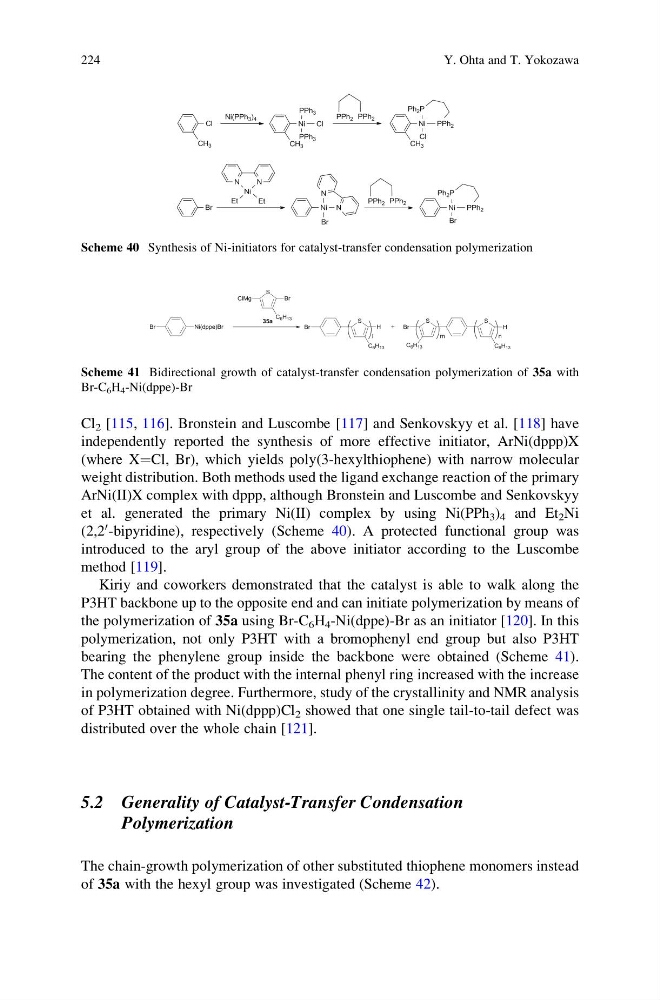
Cl 2 [115, 116]. Bronstein and Luscombe [117] and Senkovskyy et al. [118] have
independently reported the synthesis of more effective initiator, ArNi(dppp)X
(where X¼Cl, Br), which yields poly(3-hexylthiophene) with narrow molecular
weight distribution. Both methods used the ligand exchange reaction of the primary
ArNi(II)X complex with dppp, although Bronstein and Luscombe and Senkovskyy
et al. generated the primary Ni(II) complex by using Ni(PPh 3 ) 4 and Et 2 Ni
(2,2
0 -bipyridine), respectively (Scheme 40). A protected functional group was
introduced to the aryl group of the above initiator according to the Luscombe
method [119].
Kiriy and coworkers demonstrated that the catalyst is able to walk along the
P3HT backbone up to the opposite end and can initiate polymerization by means of
the polymerization of 35a using Br-C 6 H 4 -Ni(dppe)-Br as an initiator [120]. In this
polymerization, not only P3HT with a bromophenyl end group but also P3HT
bearing the phenylene group inside the backbone were obtained (Scheme 41).
The content of the product with the internal phenyl ring increased with the increase
in polymerization degree. Furthermore, study of the crystallinity and NMR analysis
of P3HT obtained with Ni(dppp)Cl 2 showed that one single tail-to-tail defect was
distributed over the whole chain [121].
5.2 Generality of Catalyst-Transfer Condensation
Polymerization
The chain-growth polymerization of other substituted thiophene monomers instead
of 35a with the hexyl group was investigated (Scheme 42).
Scheme 40 Synthesis of Ni-initiators for catalyst-transfer condensation polymerization
Scheme 41 Bidirectional growth of catalyst-transfer condensation polymerization of 35a with
Br-C 6 H 4 -Ni(dppe)-Br
224
Y. Ohta and T. Yokozawa
independently reported the synthesis of more effective initiator, ArNi(dppp)X
(where X¼Cl, Br), which yields poly(3-hexylthiophene) with narrow molecular
weight distribution. Both methods used the ligand exchange reaction of the primary
ArNi(II)X complex with dppp, although Bronstein and Luscombe and Senkovskyy
et al. generated the primary Ni(II) complex by using Ni(PPh 3 ) 4 and Et 2 Ni
(2,2
0 -bipyridine), respectively (Scheme 40). A protected functional group was
introduced to the aryl group of the above initiator according to the Luscombe
method [119].
Kiriy and coworkers demonstrated that the catalyst is able to walk along the
P3HT backbone up to the opposite end and can initiate polymerization by means of
the polymerization of 35a using Br-C 6 H 4 -Ni(dppe)-Br as an initiator [120]. In this
polymerization, not only P3HT with a bromophenyl end group but also P3HT
bearing the phenylene group inside the backbone were obtained (Scheme 41).
The content of the product with the internal phenyl ring increased with the increase
in polymerization degree. Furthermore, study of the crystallinity and NMR analysis
of P3HT obtained with Ni(dppp)Cl 2 showed that one single tail-to-tail defect was
distributed over the whole chain [121].
5.2 Generality of Catalyst-Transfer Condensation
Polymerization
The chain-growth polymerization of other substituted thiophene monomers instead
of 35a with the hexyl group was investigated (Scheme 42).
Scheme 40 Synthesis of Ni-initiators for catalyst-transfer condensation polymerization
Scheme 41 Bidirectional growth of catalyst-transfer condensation polymerization of 35a with
Br-C 6 H 4 -Ni(dppe)-Br
224
Y. Ohta and T. Yokozawa