

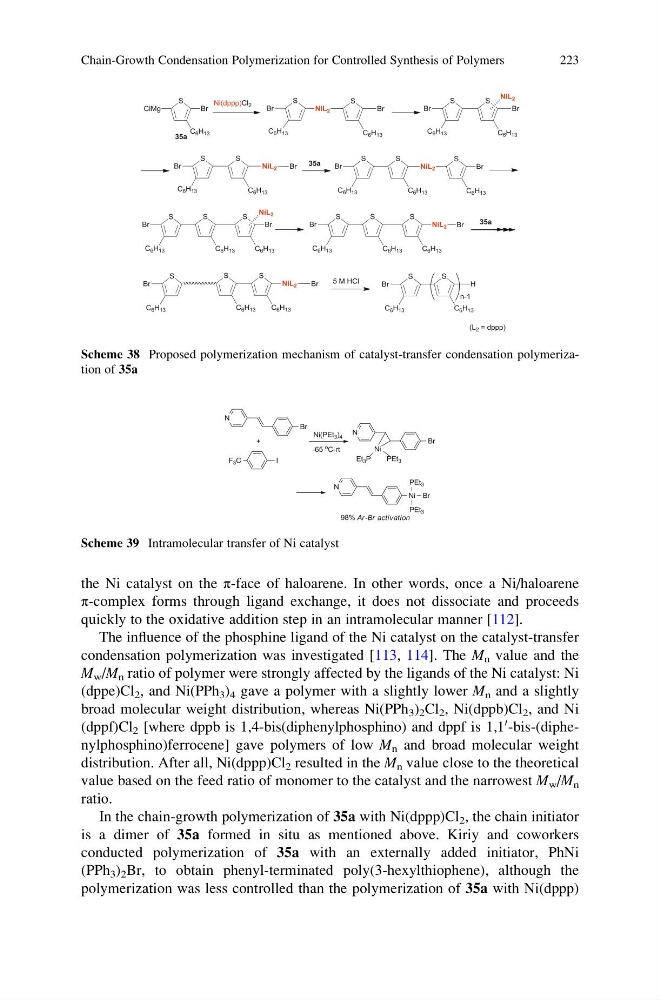
the Ni catalyst on the π-face of haloarene. In other words, once a Ni/haloarene
π-complex forms through ligand exchange, it does not dissociate and proceeds
quickly to the oxidative addition step in an intramolecular manner [112].
The influence of the phosphine ligand of the Ni catalyst on the catalyst-transfer
condensation polymerization was investigated [113, 114]. The M n value and the
M w /M n ratio of polymer were strongly affected by the ligands of the Ni catalyst: Ni
(dppe)Cl 2 , and Ni(PPh 3 ) 4 gave a polymer with a slightly lower M n and a slightly
broad molecular weight distribution, whereas Ni(PPh 3 ) 2 Cl 2 , Ni(dppb)Cl 2 , and Ni
(dppf)Cl 2 [where dppb is 1,4-bis(diphenylphosphino) and dppf is 1,1
0 -bis-(diphenylphosphino)ferrocene] gave polymers of low M n and broad molecular weight
distribution. After all, Ni(dppp)Cl 2 resulted in the M n value close to the theoretical
value based on the feed ratio of monomer to the catalyst and the narrowest M w /M n
ratio.
In the chain-growth polymerization of 35a with Ni(dppp)Cl 2 , the chain initiator
is a dimer of 35a formed in situ as mentioned above. Kiriy and coworkers
conducted polymerization of 35a with an externally added initiator, PhNi
(PPh 3 ) 2 Br, to obtain phenyl-terminated poly(3-hexylthiophene), although the
polymerization was less controlled than the polymerization of 35a with Ni(dppp)
Scheme 38 Proposed polymerization mechanism of catalyst-transfer condensation polymerization of 35a
Scheme 39 Intramolecular transfer of Ni catalyst
Chain-Growth Condensation Polymerization for Controlled Synthesis of Polymers
223
π-complex forms through ligand exchange, it does not dissociate and proceeds
quickly to the oxidative addition step in an intramolecular manner [112].
The influence of the phosphine ligand of the Ni catalyst on the catalyst-transfer
condensation polymerization was investigated [113, 114]. The M n value and the
M w /M n ratio of polymer were strongly affected by the ligands of the Ni catalyst: Ni
(dppe)Cl 2 , and Ni(PPh 3 ) 4 gave a polymer with a slightly lower M n and a slightly
broad molecular weight distribution, whereas Ni(PPh 3 ) 2 Cl 2 , Ni(dppb)Cl 2 , and Ni
(dppf)Cl 2 [where dppb is 1,4-bis(diphenylphosphino) and dppf is 1,1
0 -bis-(diphenylphosphino)ferrocene] gave polymers of low M n and broad molecular weight
distribution. After all, Ni(dppp)Cl 2 resulted in the M n value close to the theoretical
value based on the feed ratio of monomer to the catalyst and the narrowest M w /M n
ratio.
In the chain-growth polymerization of 35a with Ni(dppp)Cl 2 , the chain initiator
is a dimer of 35a formed in situ as mentioned above. Kiriy and coworkers
conducted polymerization of 35a with an externally added initiator, PhNi
(PPh 3 ) 2 Br, to obtain phenyl-terminated poly(3-hexylthiophene), although the
polymerization was less controlled than the polymerization of 35a with Ni(dppp)
Scheme 38 Proposed polymerization mechanism of catalyst-transfer condensation polymerization of 35a
Scheme 39 Intramolecular transfer of Ni catalyst
Chain-Growth Condensation Polymerization for Controlled Synthesis of Polymers
223