

elongated polymer end group, in a similar manner to biological condensation
polymerization. In 1992, McCullough and Lowe [96] and Rieke and Chen [97]
independently reported the synthesis of regioregulated head-to-tail poly(3hexylthiophene) (HT-P3HT) by metal-catalyzed condensation polymerization of
5-metalated-2-bromo-3-hexylthiophene with Ni(dppp)Cl 2 or Ni(dppe)Cl 2 [where
dppp is 1,3-bis(diphenylphosphino)propane and dppe is 1,2-bis(diphenylphosphino)ethane] as a catalyst. But, the molecular weight and polydispersity of the products were
not well controlled: poly(3-alkylthiophene)s with narrow molecular weight distributions were obtained only after fractionation with Soxhlet extraction [98]. However, we
found that the M n values of polymers increased in proportion to monomer conversion,
with low polydispersities bring retained, and were controlled by the amount of the Ni
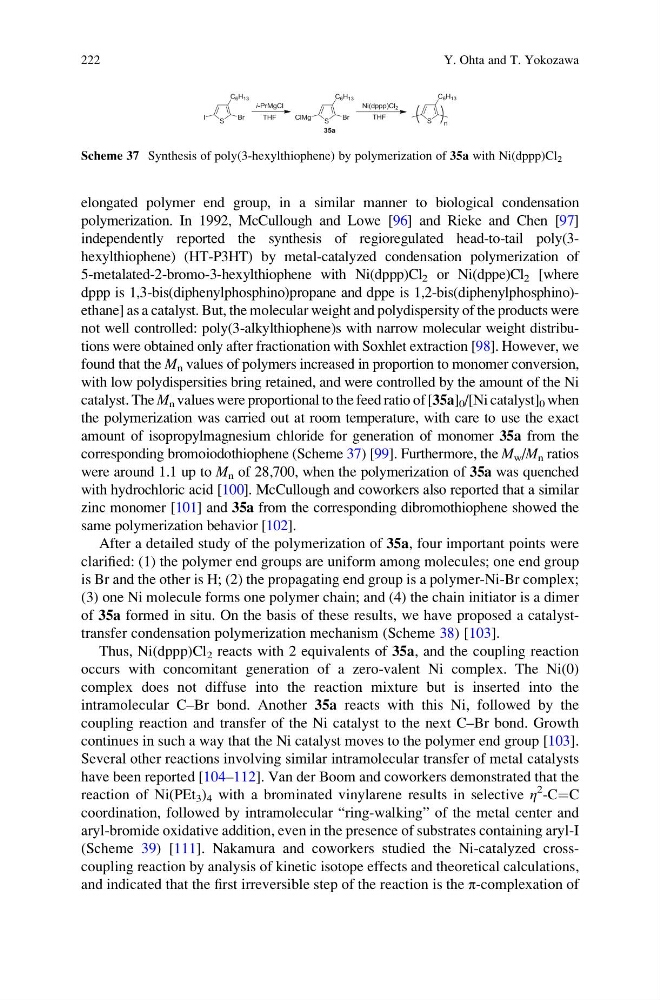
catalyst. The M n values were proportional to the feed ratio of [35a] 0 /[Ni catalyst] 0 when
the polymerization was carried out at room temperature, with care to use the exact
amount of isopropylmagnesium chloride for generation of monomer 35a from the
corresponding bromoiodothiophene (Scheme 37) [99]. Furthermore, the M w /M n ratios
were around 1.1 up to M n of 28,700, when the polymerization of 35a was quenched
with hydrochloric acid [100]. McCullough and coworkers also reported that a similar
zinc monomer [101] and 35a from the corresponding dibromothiophene showed the
same polymerization behavior [102].
After a detailed study of the polymerization of 35a, four important points were
clarified: (1) the polymer end groups are uniform among molecules; one end group
is Br and the other is H; (2) the propagating end group is a polymer-Ni-Br complex;
(3) one Ni molecule forms one polymer chain; and (4) the chain initiator is a dimer
of 35a formed in situ. On the basis of these results, we have proposed a catalysttransfer condensation polymerization mechanism (Scheme 38) [103].
Thus, Ni(dppp)Cl 2 reacts with 2 equivalents of 35a, and the coupling reaction
occurs with concomitant generation of a zero-valent Ni complex. The Ni(0)
complex does not diffuse into the reaction mixture but is inserted into the
intramolecular C–Br bond. Another 35a reacts with this Ni, followed by the
coupling reaction and transfer of the Ni catalyst to the next C–Br bond. Growth
continues in such a way that the Ni catalyst moves to the polymer end group [103].
Several other reactions involving similar intramolecular transfer of metal catalysts
have been reported [104–112]. Van der Boom and coworkers demonstrated that the
reaction of Ni(PEt 3 ) 4 with a brominated vinylarene results in selective η
2 -C¼C
coordination, followed by intramolecular “ring-walking” of the metal center and
aryl-bromide oxidative addition, even in the presence of substrates containing aryl-I
(Scheme 39) [111]. Nakamura and coworkers studied the Ni-catalyzed crosscoupling reaction by analysis of kinetic isotope effects and theoretical calculations,
and indicated that the first irreversible step of the reaction is the π-complexation of
Scheme 37 Synthesis of poly(3-hexylthiophene) by polymerization of 35a with Ni(dppp)Cl 2
222
Y. Ohta and T. Yokozawa
polymerization. In 1992, McCullough and Lowe [96] and Rieke and Chen [97]
independently reported the synthesis of regioregulated head-to-tail poly(3hexylthiophene) (HT-P3HT) by metal-catalyzed condensation polymerization of
5-metalated-2-bromo-3-hexylthiophene with Ni(dppp)Cl 2 or Ni(dppe)Cl 2 [where
dppp is 1,3-bis(diphenylphosphino)propane and dppe is 1,2-bis(diphenylphosphino)ethane] as a catalyst. But, the molecular weight and polydispersity of the products were
not well controlled: poly(3-alkylthiophene)s with narrow molecular weight distributions were obtained only after fractionation with Soxhlet extraction [98]. However, we
found that the M n values of polymers increased in proportion to monomer conversion,
with low polydispersities bring retained, and were controlled by the amount of the Ni
catalyst. The M n values were proportional to the feed ratio of [35a] 0 /[Ni catalyst] 0 when
the polymerization was carried out at room temperature, with care to use the exact
amount of isopropylmagnesium chloride for generation of monomer 35a from the
corresponding bromoiodothiophene (Scheme 37) [99]. Furthermore, the M w /M n ratios
were around 1.1 up to M n of 28,700, when the polymerization of 35a was quenched
with hydrochloric acid [100]. McCullough and coworkers also reported that a similar
zinc monomer [101] and 35a from the corresponding dibromothiophene showed the
same polymerization behavior [102].
After a detailed study of the polymerization of 35a, four important points were
clarified: (1) the polymer end groups are uniform among molecules; one end group
is Br and the other is H; (2) the propagating end group is a polymer-Ni-Br complex;
(3) one Ni molecule forms one polymer chain; and (4) the chain initiator is a dimer
of 35a formed in situ. On the basis of these results, we have proposed a catalysttransfer condensation polymerization mechanism (Scheme 38) [103].
Thus, Ni(dppp)Cl 2 reacts with 2 equivalents of 35a, and the coupling reaction
occurs with concomitant generation of a zero-valent Ni complex. The Ni(0)
complex does not diffuse into the reaction mixture but is inserted into the
intramolecular C–Br bond. Another 35a reacts with this Ni, followed by the
coupling reaction and transfer of the Ni catalyst to the next C–Br bond. Growth
continues in such a way that the Ni catalyst moves to the polymer end group [103].
Several other reactions involving similar intramolecular transfer of metal catalysts
have been reported [104–112]. Van der Boom and coworkers demonstrated that the
reaction of Ni(PEt 3 ) 4 with a brominated vinylarene results in selective η
2 -C¼C
coordination, followed by intramolecular “ring-walking” of the metal center and
aryl-bromide oxidative addition, even in the presence of substrates containing aryl-I
(Scheme 39) [111]. Nakamura and coworkers studied the Ni-catalyzed crosscoupling reaction by analysis of kinetic isotope effects and theoretical calculations,
and indicated that the first irreversible step of the reaction is the π-complexation of
Scheme 37 Synthesis of poly(3-hexylthiophene) by polymerization of 35a with Ni(dppp)Cl 2
222
Y. Ohta and T. Yokozawa