

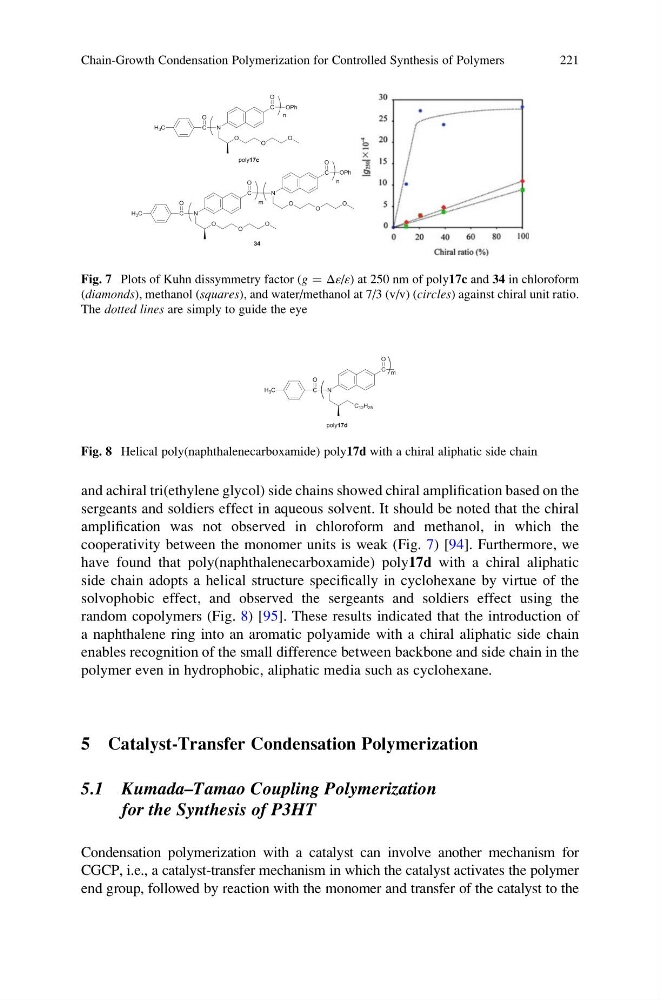
and achiral tri(ethylene glycol) side chains showed chiral amplification based on the
sergeants and soldiers effect in aqueous solvent. It should be noted that the chiral
amplification was not observed in chloroform and methanol, in which the
cooperativity between the monomer units is weak (Fig. 7) [94]. Furthermore, we
have found that poly(naphthalenecarboxamide) poly17d with a chiral aliphatic
side chain adopts a helical structure specifically in cyclohexane by virtue of the
solvophobic effect, and observed the sergeants and soldiers effect using the
random copolymers (Fig. 8) [95]. These results indicated that the introduction of
a naphthalene ring into an aromatic polyamide with a chiral aliphatic side chain
enables recognition of the small difference between backbone and side chain in the
polymer even in hydrophobic, aliphatic media such as cyclohexane.
5 Catalyst-Transfer Condensation Polymerization
5.1 Kumada–Tamao Coupling Polymerization
for the Synthesis of P3HT
Condensation polymerization with a catalyst can involve another mechanism for
CGCP, i.e., a catalyst-transfer mechanism in which the catalyst activates the polymer
end group, followed by reaction with the monomer and transfer of the catalyst to the
Fig. 7 Plots of Kuhn dissymmetry factor (g ¼ Δε/ε) at 250 nm of poly17c and 34 in chloroform
(diamonds), methanol (squares), and water/methanol at 7/3 (v/v) (circles) against chiral unit ratio.
The dotted lines are simply to guide the eye
Fig. 8 Helical poly(naphthalenecarboxamide) poly17d with a chiral aliphatic side chain
Chain-Growth Condensation Polymerization for Controlled Synthesis of Polymers
221
sergeants and soldiers effect in aqueous solvent. It should be noted that the chiral
amplification was not observed in chloroform and methanol, in which the
cooperativity between the monomer units is weak (Fig. 7) [94]. Furthermore, we
have found that poly(naphthalenecarboxamide) poly17d with a chiral aliphatic
side chain adopts a helical structure specifically in cyclohexane by virtue of the
solvophobic effect, and observed the sergeants and soldiers effect using the
random copolymers (Fig. 8) [95]. These results indicated that the introduction of
a naphthalene ring into an aromatic polyamide with a chiral aliphatic side chain
enables recognition of the small difference between backbone and side chain in the
polymer even in hydrophobic, aliphatic media such as cyclohexane.
5 Catalyst-Transfer Condensation Polymerization
5.1 Kumada–Tamao Coupling Polymerization
for the Synthesis of P3HT
Condensation polymerization with a catalyst can involve another mechanism for
CGCP, i.e., a catalyst-transfer mechanism in which the catalyst activates the polymer
end group, followed by reaction with the monomer and transfer of the catalyst to the
Fig. 7 Plots of Kuhn dissymmetry factor (g ¼ Δε/ε) at 250 nm of poly17c and 34 in chloroform
(diamonds), methanol (squares), and water/methanol at 7/3 (v/v) (circles) against chiral unit ratio.
The dotted lines are simply to guide the eye
Fig. 8 Helical poly(naphthalenecarboxamide) poly17d with a chiral aliphatic side chain
Chain-Growth Condensation Polymerization for Controlled Synthesis of Polymers
221