

4.4 Helical Polymer
In the course of our study of CGCP, we found that poly( p-benzamide)s bearing a
chiral tri(ethylene glycol) side chain as an N-substituent adopt a helical conformation
with three monomer units per turn in solution [86]. Variable-temperature circular
dichroism (CD) studies showed that the CD intensity decreased with increase of
temperature, indicating the thermodynamically controlled helical character of this
polyamide. The helical structure arises from the cis preference of N-substituted
aromatic amide linkages [87] and the syn arrangement of the three consecutive
benzene units connected by two amide linkages [88, 89]. In order to elucidate the
helical folding, we studied the cooperativity of the monomer units according to the
“sergeants and soldiers” [90] and “majority rules” [91] effects by using chiral/achiral
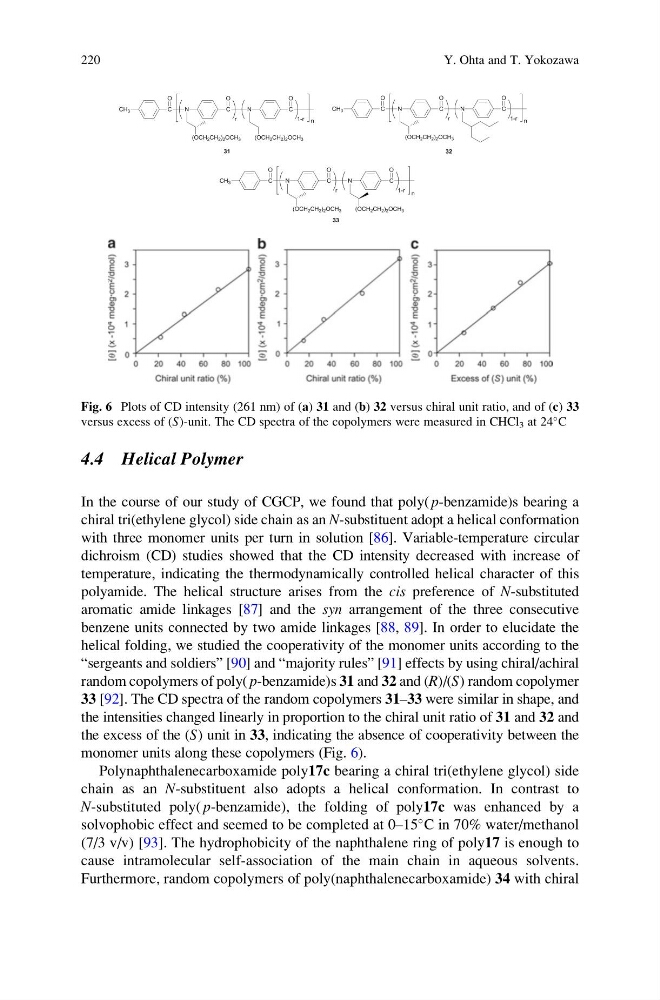
random copolymers of poly( p-benzamide)s 31 and 32 and (R)/(S) random copolymer
33 [92]. The CD spectra of the random copolymers 31–33 were similar in shape, and
the intensities changed linearly in proportion to the chiral unit ratio of 31 and 32 and
the excess of the (S) unit in 33, indicating the absence of cooperativity between the
monomer units along these copolymers (Fig. 6).
Polynaphthalenecarboxamide poly17c bearing a chiral tri(ethylene glycol) side
chain as an N-substituent also adopts a helical conformation. In contrast to
N-substituted poly( p-benzamide), the folding of poly17c was enhanced by a
solvophobic effect and seemed to be completed at 0–15
C in 70% water/methanol
(7/3 v/v) [93]. The hydrophobicity of the naphthalene ring of poly17 is enough to
cause intramolecular self-association of the main chain in aqueous solvents.
Furthermore, random copolymers of poly(naphthalenecarboxamide) 34 with chiral
Fig. 6 Plots of CD intensity (261 nm) of (a) 31 and (b) 32 versus chiral unit ratio, and of (c) 33
versus excess of (S)-unit. The CD spectra of the copolymers were measured in CHCl 3 at 24
C
220
Y. Ohta and T. Yokozawa
In the course of our study of CGCP, we found that poly( p-benzamide)s bearing a
chiral tri(ethylene glycol) side chain as an N-substituent adopt a helical conformation
with three monomer units per turn in solution [86]. Variable-temperature circular
dichroism (CD) studies showed that the CD intensity decreased with increase of
temperature, indicating the thermodynamically controlled helical character of this
polyamide. The helical structure arises from the cis preference of N-substituted
aromatic amide linkages [87] and the syn arrangement of the three consecutive
benzene units connected by two amide linkages [88, 89]. In order to elucidate the
helical folding, we studied the cooperativity of the monomer units according to the
“sergeants and soldiers” [90] and “majority rules” [91] effects by using chiral/achiral
random copolymers of poly( p-benzamide)s 31 and 32 and (R)/(S) random copolymer
33 [92]. The CD spectra of the random copolymers 31–33 were similar in shape, and
the intensities changed linearly in proportion to the chiral unit ratio of 31 and 32 and
the excess of the (S) unit in 33, indicating the absence of cooperativity between the
monomer units along these copolymers (Fig. 6).
Polynaphthalenecarboxamide poly17c bearing a chiral tri(ethylene glycol) side
chain as an N-substituent also adopts a helical conformation. In contrast to
N-substituted poly( p-benzamide), the folding of poly17c was enhanced by a
solvophobic effect and seemed to be completed at 0–15
C in 70% water/methanol
(7/3 v/v) [93]. The hydrophobicity of the naphthalene ring of poly17 is enough to
cause intramolecular self-association of the main chain in aqueous solvents.
Furthermore, random copolymers of poly(naphthalenecarboxamide) 34 with chiral
Fig. 6 Plots of CD intensity (261 nm) of (a) 31 and (b) 32 versus chiral unit ratio, and of (c) 33
versus excess of (S)-unit. The CD spectra of the copolymers were measured in CHCl 3 at 24
C
220
Y. Ohta and T. Yokozawa