

N
O
R
O O
H
N
O
R
O O
N
O
R
O O
H
N
O
R
O
O
N
H
O
O
R
O
N
O
R
O
O
NH 2
O
R
N
O
R
O O
N
O
R
O
O
N
H
O
R
O
NH 2
R
n
R'NH 2 +
-
R'NH 3
+
+
-
R'NH 3
+
+ NCA
H + transfer
- CO 2
-
R'NH 3
+
+
N-aminoacyl NCA
reaction
with NCA
or N-aminoacyl NCA
oligopeptides
further
condensation
ð3Þ
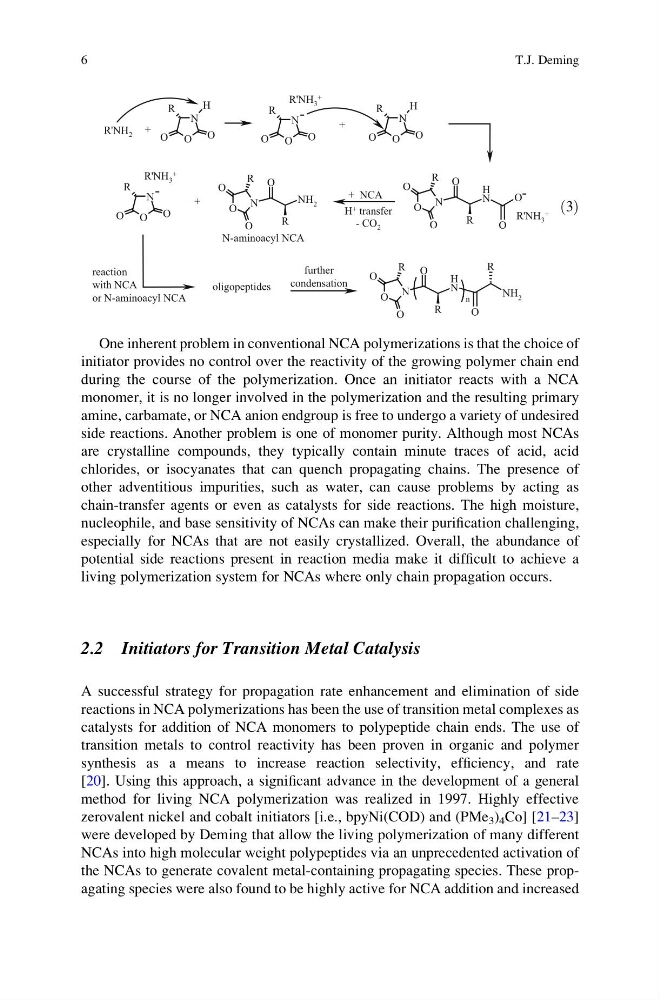
One inherent problem in conventional NCA polymerizations is that the choice of
initiator provides no control over the reactivity of the growing polymer chain end
during the course of the polymerization. Once an initiator reacts with a NCA
monomer, it is no longer involved in the polymerization and the resulting primary
amine, carbamate, or NCA anion endgroup is free to undergo a variety of undesired
side reactions. Another problem is one of monomer purity. Although most NCAs
are crystalline compounds, they typically contain minute traces of acid, acid
chlorides, or isocyanates that can quench propagating chains. The presence of
other adventitious impurities, such as water, can cause problems by acting as
chain-transfer agents or even as catalysts for side reactions. The high moisture,
nucleophile, and base sensitivity of NCAs can make their purification challenging,
especially for NCAs that are not easily crystallized. Overall, the abundance of
potential side reactions present in reaction media make it difficult to achieve a
living polymerization system for NCAs where only chain propagation occurs.
2.2 Initiators for Transition Metal Catalysis
A successful strategy for propagation rate enhancement and elimination of side
reactions in NCA polymerizations has been the use of transition metal complexes as
catalysts for addition of NCA monomers to polypeptide chain ends. The use of
transition metals to control reactivity has been proven in organic and polymer
synthesis as a means to increase reaction selectivity, efficiency, and rate
[20]. Using this approach, a significant advance in the development of a general
method for living NCA polymerization was realized in 1997. Highly effective
zerovalent nickel and cobalt initiators [i.e., bpyNi(COD) and (PMe 3 ) 4 Co] [21–23]
were developed by Deming that allow the living polymerization of many different
NCAs into high molecular weight polypeptides via an unprecedented activation of
the NCAs to generate covalent metal-containing propagating species. These propagating species were also found to be highly active for NCA addition and increased
6
T.J. Deming
O
R
O O
H
N
O
R
O O
N
O
R
O O
H
N
O
R
O
O
N
H
O
O
R
O
N
O
R
O
O
NH 2
O
R
N
O
R
O O
N
O
R
O
O
N
H
O
R
O
NH 2
R
n
R'NH 2 +
-
R'NH 3
+
+
-
R'NH 3
+
+ NCA
H + transfer
- CO 2
-
R'NH 3
+
+
N-aminoacyl NCA
reaction
with NCA
or N-aminoacyl NCA
oligopeptides
further
condensation
ð3Þ
One inherent problem in conventional NCA polymerizations is that the choice of
initiator provides no control over the reactivity of the growing polymer chain end
during the course of the polymerization. Once an initiator reacts with a NCA
monomer, it is no longer involved in the polymerization and the resulting primary
amine, carbamate, or NCA anion endgroup is free to undergo a variety of undesired
side reactions. Another problem is one of monomer purity. Although most NCAs
are crystalline compounds, they typically contain minute traces of acid, acid
chlorides, or isocyanates that can quench propagating chains. The presence of
other adventitious impurities, such as water, can cause problems by acting as
chain-transfer agents or even as catalysts for side reactions. The high moisture,
nucleophile, and base sensitivity of NCAs can make their purification challenging,
especially for NCAs that are not easily crystallized. Overall, the abundance of
potential side reactions present in reaction media make it difficult to achieve a
living polymerization system for NCAs where only chain propagation occurs.
2.2 Initiators for Transition Metal Catalysis
A successful strategy for propagation rate enhancement and elimination of side
reactions in NCA polymerizations has been the use of transition metal complexes as
catalysts for addition of NCA monomers to polypeptide chain ends. The use of
transition metals to control reactivity has been proven in organic and polymer
synthesis as a means to increase reaction selectivity, efficiency, and rate
[20]. Using this approach, a significant advance in the development of a general
method for living NCA polymerization was realized in 1997. Highly effective
zerovalent nickel and cobalt initiators [i.e., bpyNi(COD) and (PMe 3 ) 4 Co] [21–23]
were developed by Deming that allow the living polymerization of many different
NCAs into high molecular weight polypeptides via an unprecedented activation of
the NCAs to generate covalent metal-containing propagating species. These propagating species were also found to be highly active for NCA addition and increased
6
T.J. Deming