

polymerization rates more than an order of magnitude compared to amine-initiated
polymerizations at 20
C. The metal ions were also found to be conveniently
removed from the polymers by simple precipitation or dialysis of the samples
after polymerization.
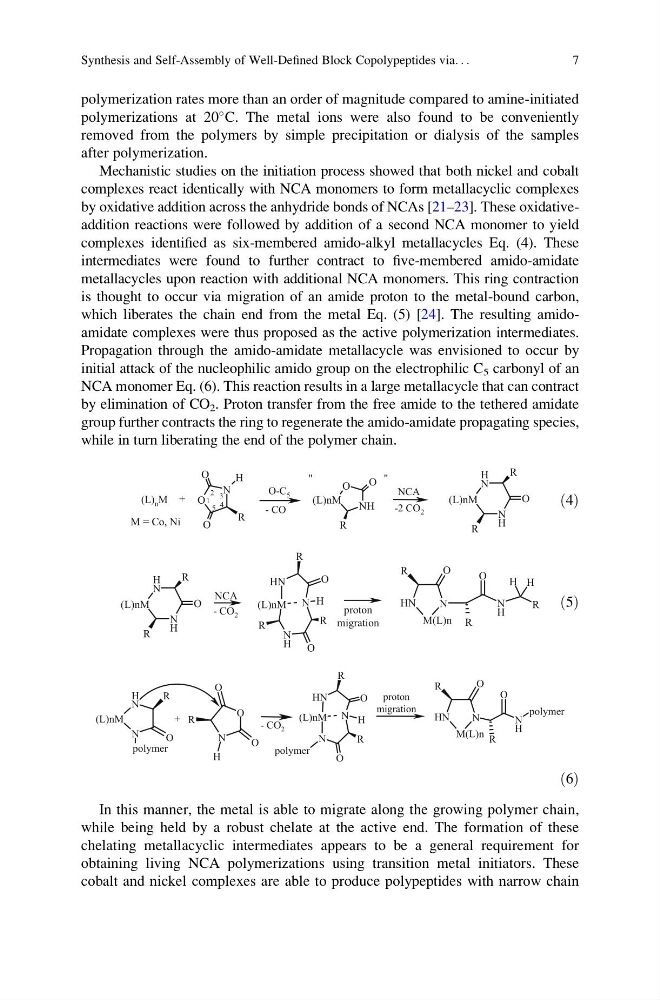
Mechanistic studies on the initiation process showed that both nickel and cobalt
complexes react identically with NCA monomers to form metallacyclic complexes
by oxidative addition across the anhydride bonds of NCAs [21–23]. These oxidativeaddition reactions were followed by addition of a second NCA monomer to yield
complexes identified as six-membered amido-alkyl metallacycles Eq. (4). These
intermediates were found to further contract to five-membered amido-amidate
metallacycles upon reaction with additional NCA monomers. This ring contraction
is thought to occur via migration of an amide proton to the metal-bound carbon,
which liberates the chain end from the metal Eq. (5) [24]. The resulting amidoamidate complexes were thus proposed as the active polymerization intermediates.
Propagation through the amido-amidate metallacycle was envisioned to occur by
initial attack of the nucleophilic amido group on the electrophilic C 5 carbonyl of an
NCA monomer Eq. (6). This reaction results in a large metallacycle that can contract
by elimination of CO 2 . Proton transfer from the free amide to the tethered amidate
group further contracts the ring to regenerate the amido-amidate propagating species,
while in turn liberating the end of the polymer chain.
N
O
R
O
O
H
O
NH
(L)nM
O
R
(L)nM
N
H
R
N
H
O
R
(L) n M +
O-C 5
1
2 3
4
5
M = Co, Ni
NCA
-2 CO 2
"
"
- CO
ð4Þ
(L)nM
N
H
R
N
H
O
R
HN
R
N
(L)nM
N
H
R
O
R
H
O
M(L)n
N
H
N
O
R
N
H
R
O
R
H
H
NCA
proton
migration
- CO 2
ð5Þ
(L)nM
N
H
N
O
R
polymer
N
O
R
O
O
H
M(L)n
N
H
N
O
R
N
H
polymer
O
R
N
H
N
(L)nM
N
R
O
R
O
polymer
H
+
proton
migration
- CO 2
ð6Þ
In this manner, the metal is able to migrate along the growing polymer chain,
while being held by a robust chelate at the active end. The formation of these
chelating metallacyclic intermediates appears to be a general requirement for
obtaining living NCA polymerizations using transition metal initiators. These
cobalt and nickel complexes are able to produce polypeptides with narrow chain
Synthesis and Self-Assembly of Well-Defined Block Copolypeptides via. . .
7
polymerizations at 20
C. The metal ions were also found to be conveniently
removed from the polymers by simple precipitation or dialysis of the samples
after polymerization.
Mechanistic studies on the initiation process showed that both nickel and cobalt
complexes react identically with NCA monomers to form metallacyclic complexes
by oxidative addition across the anhydride bonds of NCAs [21–23]. These oxidativeaddition reactions were followed by addition of a second NCA monomer to yield
complexes identified as six-membered amido-alkyl metallacycles Eq. (4). These
intermediates were found to further contract to five-membered amido-amidate
metallacycles upon reaction with additional NCA monomers. This ring contraction
is thought to occur via migration of an amide proton to the metal-bound carbon,
which liberates the chain end from the metal Eq. (5) [24]. The resulting amidoamidate complexes were thus proposed as the active polymerization intermediates.
Propagation through the amido-amidate metallacycle was envisioned to occur by
initial attack of the nucleophilic amido group on the electrophilic C 5 carbonyl of an
NCA monomer Eq. (6). This reaction results in a large metallacycle that can contract
by elimination of CO 2 . Proton transfer from the free amide to the tethered amidate
group further contracts the ring to regenerate the amido-amidate propagating species,
while in turn liberating the end of the polymer chain.
N
O
R
O
O
H
O
NH
(L)nM
O
R
(L)nM
N
H
R
N
H
O
R
(L) n M +
O-C 5
1
2 3
4
5
M = Co, Ni
NCA
-2 CO 2
"
"
- CO
ð4Þ
(L)nM
N
H
R
N
H
O
R
HN
R
N
(L)nM
N
H
R
O
R
H
O
M(L)n
N
H
N
O
R
N
H
R
O
R
H
H
NCA
proton
migration
- CO 2
ð5Þ
(L)nM
N
H
N
O
R
polymer
N
O
R
O
O
H
M(L)n
N
H
N
O
R
N
H
polymer
O
R
N
H
N
(L)nM
N
R
O
R
O
polymer
H
+
proton
migration
- CO 2
ð6Þ
In this manner, the metal is able to migrate along the growing polymer chain,
while being held by a robust chelate at the active end. The formation of these
chelating metallacyclic intermediates appears to be a general requirement for
obtaining living NCA polymerizations using transition metal initiators. These
cobalt and nickel complexes are able to produce polypeptides with narrow chain
Synthesis and Self-Assembly of Well-Defined Block Copolypeptides via. . .
7