

2 Polypeptide Synthesis Using NCAs
2.1 Conventional Methods
NCA polymerizations have been initiated using many different nucleophiles
and bases, the most common being primary amines and alkoxide anions [11, 12].
Primary amines, being more nucleophilic than basic, are good general initiators for
polymerization of NCA monomers that provide relatively slow polymerization and
are well understood. Tertiary amines, alkoxides, and other initiators that are more
basic than nucleophilic have found use because they are, in some cases, able to
prepare polymers of very high molecular weight where primary amine initiators
cannot. Strong base initiators generally promote much faster NCA polymerization
compared to primary amine initiators, yet the fine mechanistic details of these
systems are poorly understood. Optimal polymerization conditions have often
been determined empirically for each NCA and thus there have been no universal
initiators or conditions by which to prepare high polymers from any monomer. This
is in part due to the different properties (e.g., solubility) of individual NCAs and
their polymers but is also strongly related to the side reactions that occur during
polymerization.
N
O
R
O O
H
R'
N
H
N
H
OH
O
R
O
R'
N
H
NH 2
O
R
N
H O
R
n
NH 2
R'
R'NH 2 +
+ CO 2
+
n CO 2
n NCA
ð2Þ
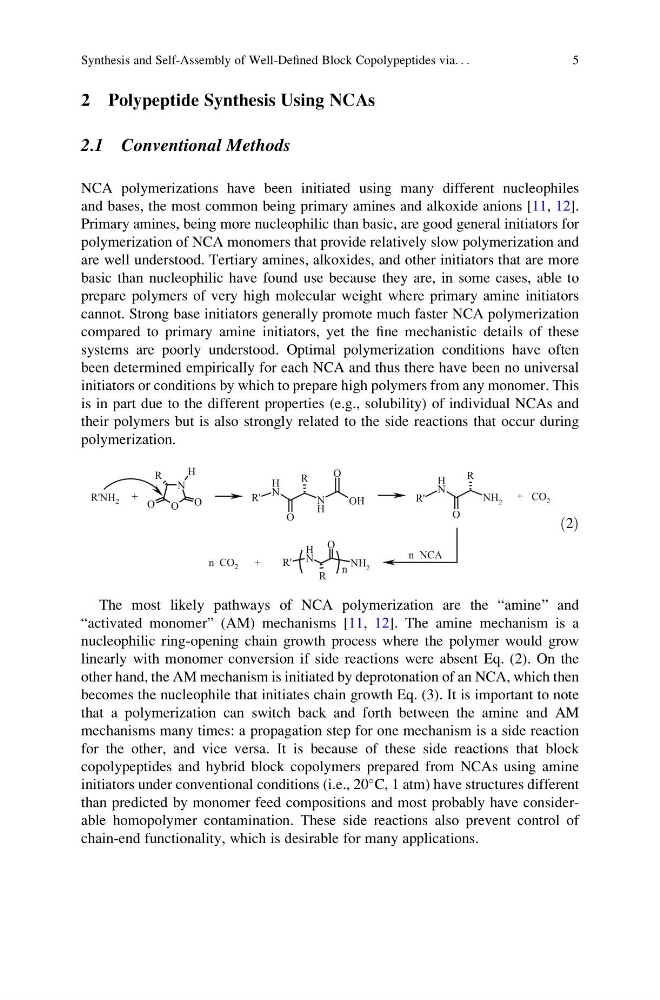
The most likely pathways of NCA polymerization are the “amine” and
“activated monomer” (AM) mechanisms [11, 12]. The amine mechanism is a
nucleophilic ring-opening chain growth process where the polymer would grow
linearly with monomer conversion if side reactions were absent Eq. (2). On the
other hand, the AM mechanism is initiated by deprotonation of an NCA, which then
becomes the nucleophile that initiates chain growth Eq. (3). It is important to note
that a polymerization can switch back and forth between the amine and AM
mechanisms many times: a propagation step for one mechanism is a side reaction
for the other, and vice versa. It is because of these side reactions that block
copolypeptides and hybrid block copolymers prepared from NCAs using amine
initiators under conventional conditions (i.e., 20
C, 1 atm) have structures different
than predicted by monomer feed compositions and most probably have considerable homopolymer contamination. These side reactions also prevent control of
chain-end functionality, which is desirable for many applications.
Synthesis and Self-Assembly of Well-Defined Block Copolypeptides via. . .
5
2.1 Conventional Methods
NCA polymerizations have been initiated using many different nucleophiles
and bases, the most common being primary amines and alkoxide anions [11, 12].
Primary amines, being more nucleophilic than basic, are good general initiators for
polymerization of NCA monomers that provide relatively slow polymerization and
are well understood. Tertiary amines, alkoxides, and other initiators that are more
basic than nucleophilic have found use because they are, in some cases, able to
prepare polymers of very high molecular weight where primary amine initiators
cannot. Strong base initiators generally promote much faster NCA polymerization
compared to primary amine initiators, yet the fine mechanistic details of these
systems are poorly understood. Optimal polymerization conditions have often
been determined empirically for each NCA and thus there have been no universal
initiators or conditions by which to prepare high polymers from any monomer. This
is in part due to the different properties (e.g., solubility) of individual NCAs and
their polymers but is also strongly related to the side reactions that occur during
polymerization.
N
O
R
O O
H
R'
N
H
N
H
OH
O
R
O
R'
N
H
NH 2
O
R
N
H O
R
n
NH 2
R'
R'NH 2 +
+ CO 2
+
n CO 2
n NCA
ð2Þ
The most likely pathways of NCA polymerization are the “amine” and
“activated monomer” (AM) mechanisms [11, 12]. The amine mechanism is a
nucleophilic ring-opening chain growth process where the polymer would grow
linearly with monomer conversion if side reactions were absent Eq. (2). On the
other hand, the AM mechanism is initiated by deprotonation of an NCA, which then
becomes the nucleophile that initiates chain growth Eq. (3). It is important to note
that a polymerization can switch back and forth between the amine and AM
mechanisms many times: a propagation step for one mechanism is a side reaction
for the other, and vice versa. It is because of these side reactions that block
copolypeptides and hybrid block copolymers prepared from NCAs using amine
initiators under conventional conditions (i.e., 20
C, 1 atm) have structures different
than predicted by monomer feed compositions and most probably have considerable homopolymer contamination. These side reactions also prevent control of
chain-end functionality, which is desirable for many applications.
Synthesis and Self-Assembly of Well-Defined Block Copolypeptides via. . .
5