

obtainable within polypeptide segments provide opportunities for hierarchical
self-assembly unobtainable with conventional block copolymers or small-molecule
surfactants.
Upon examining the different methods for polypeptide synthesis, the limitations
of these techniques for preparation of block copolypeptides become apparent.
Conventional solid-phase peptide synthesis is neither economical nor practical
for direct preparation of large polypeptides (>100 residues) due to unavoidable
deletions and truncations that result from incomplete deprotection and coupling
steps. The most economical and expedient process for synthesis of long polypeptide
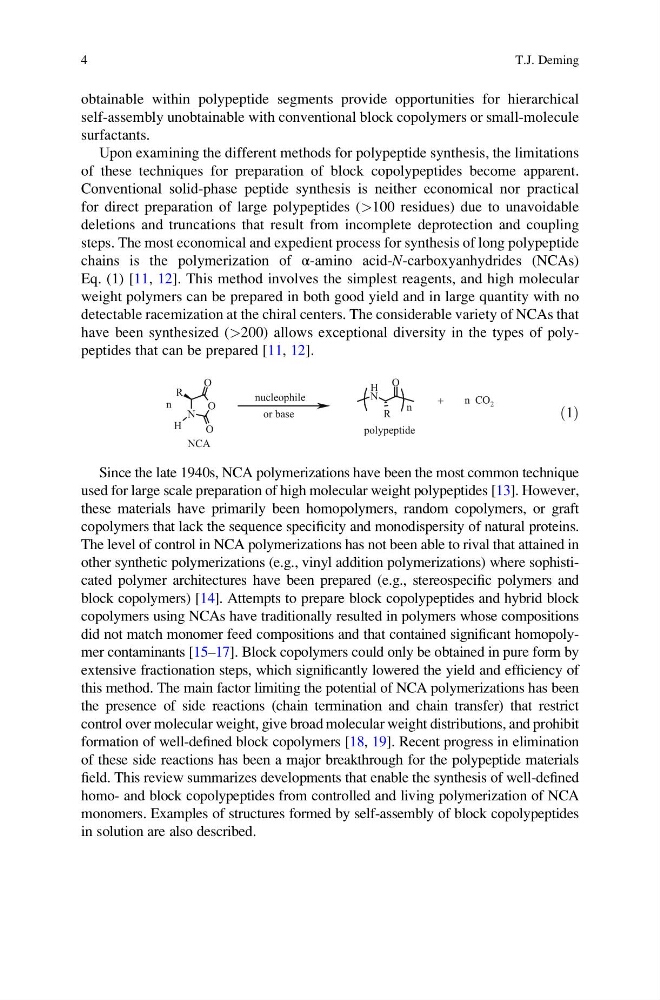
chains is the polymerization of α-amino acid-N-carboxyanhydrides (NCAs)
Eq. (1) [11, 12]. This method involves the simplest reagents, and high molecular
weight polymers can be prepared in both good yield and in large quantity with no
detectable racemization at the chiral centers. The considerable variety of NCAs that
have been synthesized (>200) allows exceptional diversity in the types of polypeptides that can be prepared [11, 12].
N
O
R
O
O
H
N
H O
R
n
NCA
polypeptide
+
nucleophile
or base
n CO 2
n
ð1Þ
Since the late 1940s, NCA polymerizations have been the most common technique
used for large scale preparation of high molecular weight polypeptides [13]. However,
these materials have primarily been homopolymers, random copolymers, or graft
copolymers that lack the sequence specificity and monodispersity of natural proteins.
The level of control in NCA polymerizations has not been able to rival that attained in
other synthetic polymerizations (e.g., vinyl addition polymerizations) where sophisticated polymer architectures have been prepared (e.g., stereospecific polymers and
block copolymers) [14]. Attempts to prepare block copolypeptides and hybrid block
copolymers using NCAs have traditionally resulted in polymers whose compositions
did not match monomer feed compositions and that contained significant homopolymer contaminants [15–17]. Block copolymers could only be obtained in pure form by
extensive fractionation steps, which significantly lowered the yield and efficiency of
this method. The main factor limiting the potential of NCA polymerizations has been
the presence of side reactions (chain termination and chain transfer) that restrict
control over molecular weight, give broad molecular weight distributions, and prohibit
formation of well-defined block copolymers [18, 19]. Recent progress in elimination
of these side reactions has been a major breakthrough for the polypeptide materials
field. This review summarizes developments that enable the synthesis of well-defined
homo- and block copolypeptides from controlled and living polymerization of NCA
monomers. Examples of structures formed by self-assembly of block copolypeptides
in solution are also described.
4
T.J. Deming
self-assembly unobtainable with conventional block copolymers or small-molecule
surfactants.
Upon examining the different methods for polypeptide synthesis, the limitations
of these techniques for preparation of block copolypeptides become apparent.
Conventional solid-phase peptide synthesis is neither economical nor practical
for direct preparation of large polypeptides (>100 residues) due to unavoidable
deletions and truncations that result from incomplete deprotection and coupling
steps. The most economical and expedient process for synthesis of long polypeptide
chains is the polymerization of α-amino acid-N-carboxyanhydrides (NCAs)
Eq. (1) [11, 12]. This method involves the simplest reagents, and high molecular
weight polymers can be prepared in both good yield and in large quantity with no
detectable racemization at the chiral centers. The considerable variety of NCAs that
have been synthesized (>200) allows exceptional diversity in the types of polypeptides that can be prepared [11, 12].
N
O
R
O
O
H
N
H O
R
n
NCA
polypeptide
+
nucleophile
or base
n CO 2
n
ð1Þ
Since the late 1940s, NCA polymerizations have been the most common technique
used for large scale preparation of high molecular weight polypeptides [13]. However,
these materials have primarily been homopolymers, random copolymers, or graft
copolymers that lack the sequence specificity and monodispersity of natural proteins.
The level of control in NCA polymerizations has not been able to rival that attained in
other synthetic polymerizations (e.g., vinyl addition polymerizations) where sophisticated polymer architectures have been prepared (e.g., stereospecific polymers and
block copolymers) [14]. Attempts to prepare block copolypeptides and hybrid block
copolymers using NCAs have traditionally resulted in polymers whose compositions
did not match monomer feed compositions and that contained significant homopolymer contaminants [15–17]. Block copolymers could only be obtained in pure form by
extensive fractionation steps, which significantly lowered the yield and efficiency of
this method. The main factor limiting the potential of NCA polymerizations has been
the presence of side reactions (chain termination and chain transfer) that restrict
control over molecular weight, give broad molecular weight distributions, and prohibit
formation of well-defined block copolymers [18, 19]. Recent progress in elimination
of these side reactions has been a major breakthrough for the polypeptide materials
field. This review summarizes developments that enable the synthesis of well-defined
homo- and block copolypeptides from controlled and living polymerization of NCA
monomers. Examples of structures formed by self-assembly of block copolypeptides
in solution are also described.
4
T.J. Deming