

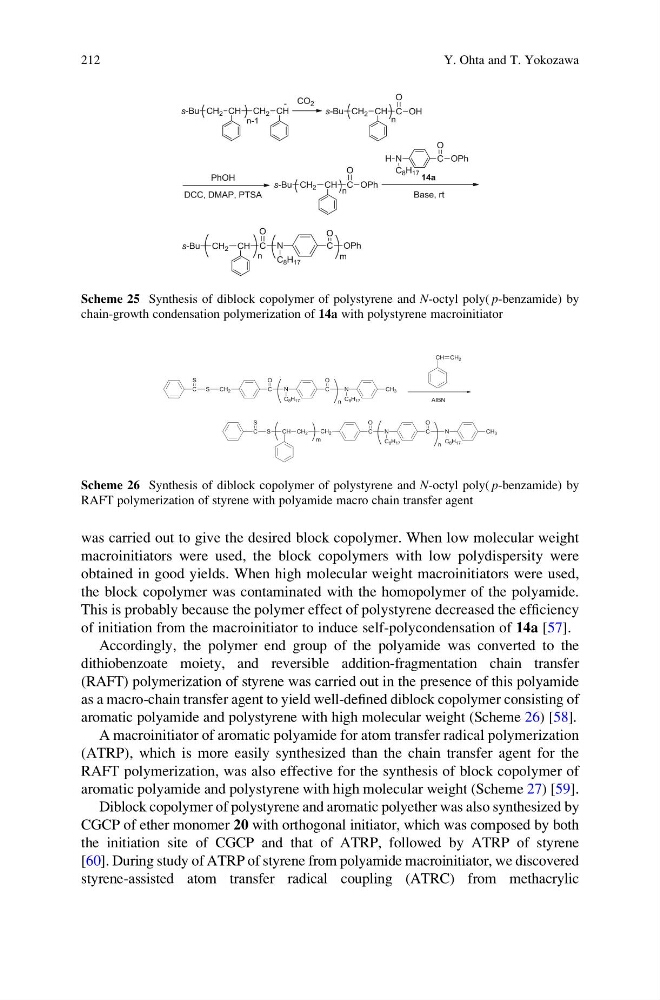
was carried out to give the desired block copolymer. When low molecular weight
macroinitiators were used, the block copolymers with low polydispersity were
obtained in good yields. When high molecular weight macroinitiators were used,
the block copolymer was contaminated with the homopolymer of the polyamide.
This is probably because the polymer effect of polystyrene decreased the efficiency
of initiation from the macroinitiator to induce self-polycondensation of 14a [57].
Accordingly, the polymer end group of the polyamide was converted to the
dithiobenzoate moiety, and reversible addition-fragmentation chain transfer
(RAFT) polymerization of styrene was carried out in the presence of this polyamide
as a macro-chain transfer agent to yield well-defined diblock copolymer consisting of
aromatic polyamide and polystyrene with high molecular weight (Scheme 26) [58].
A macroinitiator of aromatic polyamide for atom transfer radical polymerization
(ATRP), which is more easily synthesized than the chain transfer agent for the
RAFT polymerization, was also effective for the synthesis of block copolymer of
aromatic polyamide and polystyrene with high molecular weight (Scheme 27) [59].
Diblock copolymer of polystyrene and aromatic polyether was also synthesized by
CGCP of ether monomer 20 with orthogonal initiator, which was composed by both
the initiation site of CGCP and that of ATRP, followed by ATRP of styrene
[60]. During study of ATRP of styrene from polyamide macroinitiator, we discovered
styrene-assisted atom transfer radical coupling (ATRC) from methacrylic
Scheme 25 Synthesis of diblock copolymer of polystyrene and N-octyl poly( p-benzamide) by
chain-growth condensation polymerization of 14a with polystyrene macroinitiator
Scheme 26 Synthesis of diblock copolymer of polystyrene and N-octyl poly( p-benzamide) by
RAFT polymerization of styrene with polyamide macro chain transfer agent
212
Y. Ohta and T. Yokozawa
macroinitiators were used, the block copolymers with low polydispersity were
obtained in good yields. When high molecular weight macroinitiators were used,
the block copolymer was contaminated with the homopolymer of the polyamide.
This is probably because the polymer effect of polystyrene decreased the efficiency
of initiation from the macroinitiator to induce self-polycondensation of 14a [57].
Accordingly, the polymer end group of the polyamide was converted to the
dithiobenzoate moiety, and reversible addition-fragmentation chain transfer
(RAFT) polymerization of styrene was carried out in the presence of this polyamide
as a macro-chain transfer agent to yield well-defined diblock copolymer consisting of
aromatic polyamide and polystyrene with high molecular weight (Scheme 26) [58].
A macroinitiator of aromatic polyamide for atom transfer radical polymerization
(ATRP), which is more easily synthesized than the chain transfer agent for the
RAFT polymerization, was also effective for the synthesis of block copolymer of
aromatic polyamide and polystyrene with high molecular weight (Scheme 27) [59].
Diblock copolymer of polystyrene and aromatic polyether was also synthesized by
CGCP of ether monomer 20 with orthogonal initiator, which was composed by both
the initiation site of CGCP and that of ATRP, followed by ATRP of styrene
[60]. During study of ATRP of styrene from polyamide macroinitiator, we discovered
styrene-assisted atom transfer radical coupling (ATRC) from methacrylic
Scheme 25 Synthesis of diblock copolymer of polystyrene and N-octyl poly( p-benzamide) by
chain-growth condensation polymerization of 14a with polystyrene macroinitiator
Scheme 26 Synthesis of diblock copolymer of polystyrene and N-octyl poly( p-benzamide) by
RAFT polymerization of styrene with polyamide macro chain transfer agent
212
Y. Ohta and T. Yokozawa