

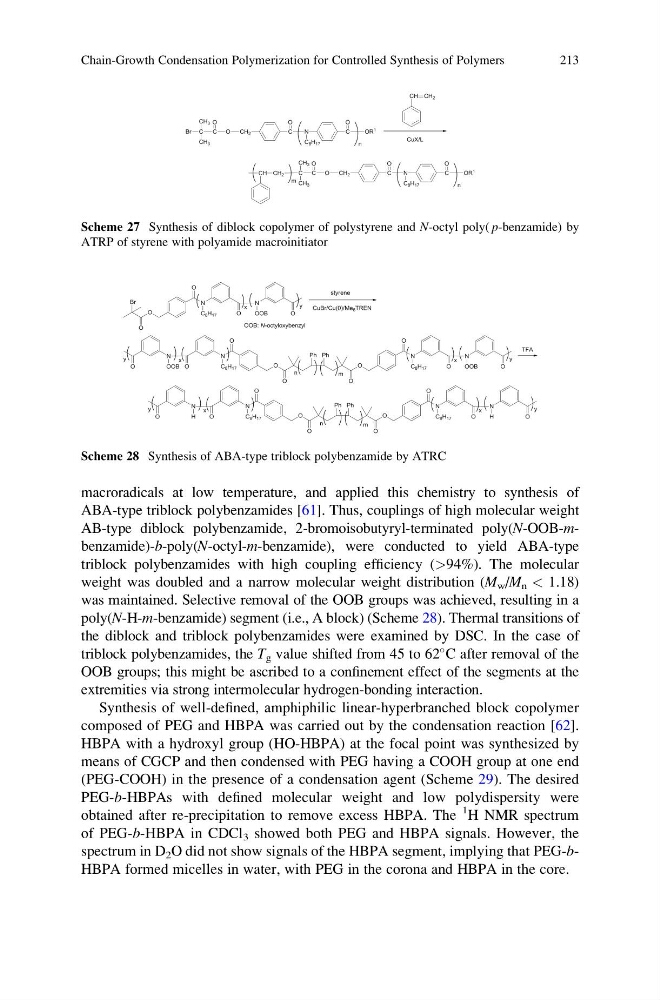
macroradicals at low temperature, and applied this chemistry to synthesis of
ABA-type triblock polybenzamides [61]. Thus, couplings of high molecular weight
AB-type diblock polybenzamide, 2-bromoisobutyryl-terminated poly(N-OOB-mbenzamide)-b-poly(N-octyl-m-benzamide), were conducted to yield ABA-type
triblock polybenzamides with high coupling efficiency (>94%). The molecular
weight was doubled and a narrow molecular weight distribution (M w /M n < 1.18)
was maintained. Selective removal of the OOB groups was achieved, resulting in a
poly(N-H-m-benzamide) segment (i.e., A block) (Scheme 28). Thermal transitions of
the diblock and triblock polybenzamides were examined by DSC. In the case of
triblock polybenzamides, the T g value shifted from 45 to 62
C after removal of the
OOB groups; this might be ascribed to a confinement effect of the segments at the
extremities via strong intermolecular hydrogen-bonding interaction.
Synthesis of well-defined, amphiphilic linear-hyperbranched block copolymer
composed of PEG and HBPA was carried out by the condensation reaction [62].
HBPA with a hydroxyl group (HO-HBPA) at the focal point was synthesized by
means of CGCP and then condensed with PEG having a COOH group at one end
(PEG-COOH) in the presence of a condensation agent (Scheme 29). The desired
PEG-b-HBPAs with defined molecular weight and low polydispersity were
obtained after re-precipitation to remove excess HBPA. The
1 H NMR spectrum
of PEG-b-HBPA in CDCl 3 showed both PEG and HBPA signals. However, the
spectrum in D 2 O did not show signals of the HBPA segment, implying that PEG-bHBPA formed micelles in water, with PEG in the corona and HBPA in the core.
Scheme 27 Synthesis of diblock copolymer of polystyrene and N-octyl poly( p-benzamide) by
ATRP of styrene with polyamide macroinitiator
Scheme 28 Synthesis of ABA-type triblock polybenzamide by ATRC
Chain-Growth Condensation Polymerization for Controlled Synthesis of Polymers
213
ABA-type triblock polybenzamides [61]. Thus, couplings of high molecular weight
AB-type diblock polybenzamide, 2-bromoisobutyryl-terminated poly(N-OOB-mbenzamide)-b-poly(N-octyl-m-benzamide), were conducted to yield ABA-type
triblock polybenzamides with high coupling efficiency (>94%). The molecular
weight was doubled and a narrow molecular weight distribution (M w /M n < 1.18)
was maintained. Selective removal of the OOB groups was achieved, resulting in a
poly(N-H-m-benzamide) segment (i.e., A block) (Scheme 28). Thermal transitions of
the diblock and triblock polybenzamides were examined by DSC. In the case of
triblock polybenzamides, the T g value shifted from 45 to 62
C after removal of the
OOB groups; this might be ascribed to a confinement effect of the segments at the
extremities via strong intermolecular hydrogen-bonding interaction.
Synthesis of well-defined, amphiphilic linear-hyperbranched block copolymer
composed of PEG and HBPA was carried out by the condensation reaction [62].
HBPA with a hydroxyl group (HO-HBPA) at the focal point was synthesized by
means of CGCP and then condensed with PEG having a COOH group at one end
(PEG-COOH) in the presence of a condensation agent (Scheme 29). The desired
PEG-b-HBPAs with defined molecular weight and low polydispersity were
obtained after re-precipitation to remove excess HBPA. The
1 H NMR spectrum
of PEG-b-HBPA in CDCl 3 showed both PEG and HBPA signals. However, the
spectrum in D 2 O did not show signals of the HBPA segment, implying that PEG-bHBPA formed micelles in water, with PEG in the corona and HBPA in the core.
Scheme 27 Synthesis of diblock copolymer of polystyrene and N-octyl poly( p-benzamide) by
ATRP of styrene with polyamide macroinitiator
Scheme 28 Synthesis of ABA-type triblock polybenzamide by ATRC
Chain-Growth Condensation Polymerization for Controlled Synthesis of Polymers
213