

possession of definite end group structures. The end groups of polymers obtained by
CGCP are available as the initiation moiety of living anion, cation, and radical
polymerization and as the coupling site of radical reactions and condensation
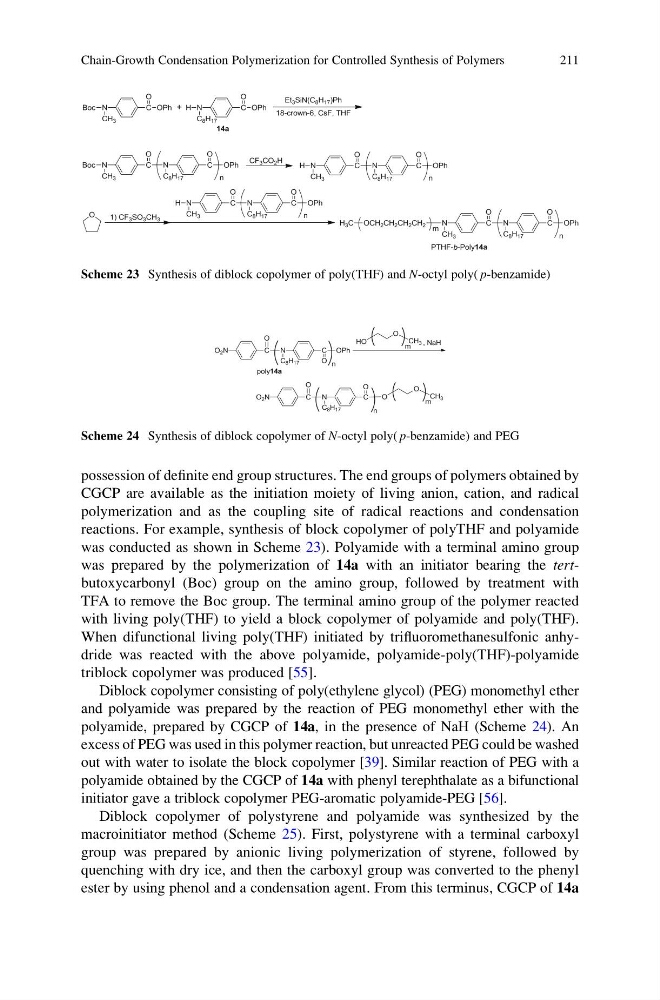
reactions. For example, synthesis of block copolymer of polyTHF and polyamide
was conducted as shown in Scheme 23). Polyamide with a terminal amino group
was prepared by the polymerization of 14a with an initiator bearing the tertbutoxycarbonyl (Boc) group on the amino group, followed by treatment with
TFA to remove the Boc group. The terminal amino group of the polymer reacted
with living poly(THF) to yield a block copolymer of polyamide and poly(THF).
When difunctional living poly(THF) initiated by trifluoromethanesulfonic anhydride was reacted with the above polyamide, polyamide-poly(THF)-polyamide
triblock copolymer was produced [55].
Diblock copolymer consisting of poly(ethylene glycol) (PEG) monomethyl ether
and polyamide was prepared by the reaction of PEG monomethyl ether with the
polyamide, prepared by CGCP of 14a, in the presence of NaH (Scheme 24). An
excess of PEG was used in this polymer reaction, but unreacted PEG could be washed
out with water to isolate the block copolymer [39]. Similar reaction of PEG with a
polyamide obtained by the CGCP of 14a with phenyl terephthalate as a bifunctional
initiator gave a triblock copolymer PEG-aromatic polyamide-PEG [56].
Diblock copolymer of polystyrene and polyamide was synthesized by the
macroinitiator method (Scheme 25). First, polystyrene with a terminal carboxyl
group was prepared by anionic living polymerization of styrene, followed by
quenching with dry ice, and then the carboxyl group was converted to the phenyl
ester by using phenol and a condensation agent. From this terminus, CGCP of 14a
Scheme 23 Synthesis of diblock copolymer of poly(THF) and N-octyl poly( p-benzamide)
Scheme 24 Synthesis of diblock copolymer of N-octyl poly( p-benzamide) and PEG
Chain-Growth Condensation Polymerization for Controlled Synthesis of Polymers
211
CGCP are available as the initiation moiety of living anion, cation, and radical
polymerization and as the coupling site of radical reactions and condensation
reactions. For example, synthesis of block copolymer of polyTHF and polyamide
was conducted as shown in Scheme 23). Polyamide with a terminal amino group
was prepared by the polymerization of 14a with an initiator bearing the tertbutoxycarbonyl (Boc) group on the amino group, followed by treatment with
TFA to remove the Boc group. The terminal amino group of the polymer reacted
with living poly(THF) to yield a block copolymer of polyamide and poly(THF).
When difunctional living poly(THF) initiated by trifluoromethanesulfonic anhydride was reacted with the above polyamide, polyamide-poly(THF)-polyamide
triblock copolymer was produced [55].
Diblock copolymer consisting of poly(ethylene glycol) (PEG) monomethyl ether
and polyamide was prepared by the reaction of PEG monomethyl ether with the
polyamide, prepared by CGCP of 14a, in the presence of NaH (Scheme 24). An
excess of PEG was used in this polymer reaction, but unreacted PEG could be washed
out with water to isolate the block copolymer [39]. Similar reaction of PEG with a
polyamide obtained by the CGCP of 14a with phenyl terephthalate as a bifunctional
initiator gave a triblock copolymer PEG-aromatic polyamide-PEG [56].
Diblock copolymer of polystyrene and polyamide was synthesized by the
macroinitiator method (Scheme 25). First, polystyrene with a terminal carboxyl
group was prepared by anionic living polymerization of styrene, followed by
quenching with dry ice, and then the carboxyl group was converted to the phenyl
ester by using phenol and a condensation agent. From this terminus, CGCP of 14a
Scheme 23 Synthesis of diblock copolymer of poly(THF) and N-octyl poly( p-benzamide)
Scheme 24 Synthesis of diblock copolymer of N-octyl poly( p-benzamide) and PEG
Chain-Growth Condensation Polymerization for Controlled Synthesis of Polymers
211