

composed of polymers with a broad molecular weight distribution or oligomers
synthesized in a stepwise manner. Synthesis of well-defined diblock condensation
copolymer with controlled molecular weight and low polydispersity remains a
challenging topic. Diblock copolymers composed poly(m-benzamide) and aromatic
polyether were synthesized by means of successive CGCP [54]. When an
orthogonal initiator for the synthesis of the polyamide and aromatic polyether
segments was used, side reactions occurred at the 4-fluorobenzophenone unit of
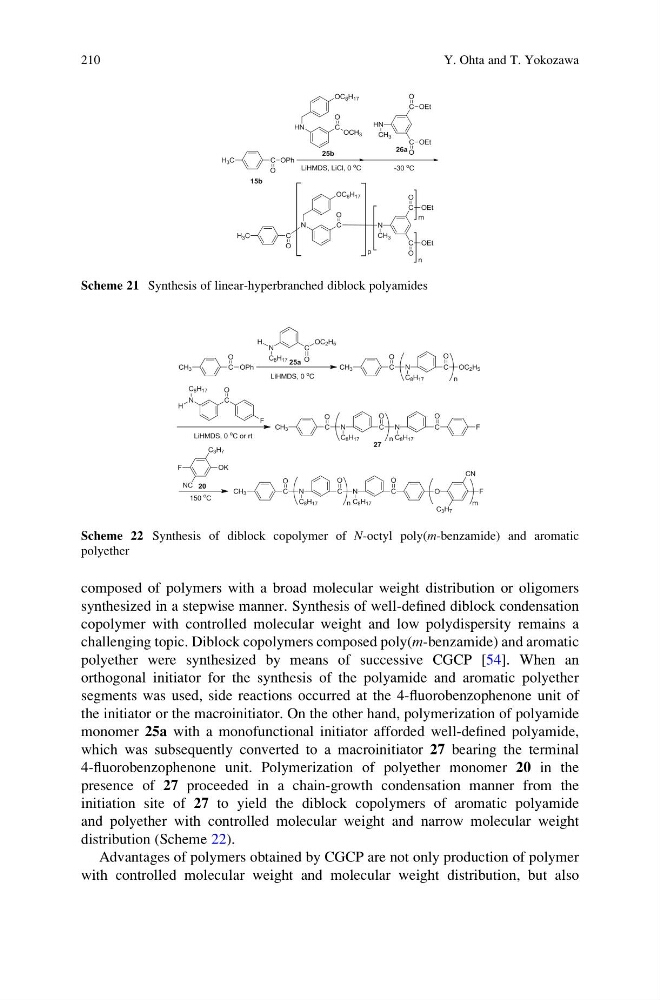
the initiator or the macroinitiator. On the other hand, polymerization of polyamide
monomer 25a with a monofunctional initiator afforded well-defined polyamide,
which was subsequently converted to a macroinitiator 27 bearing the terminal
4-fluorobenzophenone unit. Polymerization of polyether monomer 20 in the
presence of 27 proceeded in a chain-growth condensation manner from the
initiation site of 27 to yield the diblock copolymers of aromatic polyamide
and polyether with controlled molecular weight and narrow molecular weight
distribution (Scheme 22).
Advantages of polymers obtained by CGCP are not only production of polymer
with controlled molecular weight and molecular weight distribution, but also
Scheme 21 Synthesis of linear-hyperbranched diblock polyamides
Scheme 22 Synthesis of diblock copolymer of N-octyl poly(m-benzamide) and aromatic
polyether
210
Y. Ohta and T. Yokozawa
synthesized in a stepwise manner. Synthesis of well-defined diblock condensation
copolymer with controlled molecular weight and low polydispersity remains a
challenging topic. Diblock copolymers composed poly(m-benzamide) and aromatic
polyether were synthesized by means of successive CGCP [54]. When an
orthogonal initiator for the synthesis of the polyamide and aromatic polyether
segments was used, side reactions occurred at the 4-fluorobenzophenone unit of
the initiator or the macroinitiator. On the other hand, polymerization of polyamide
monomer 25a with a monofunctional initiator afforded well-defined polyamide,
which was subsequently converted to a macroinitiator 27 bearing the terminal
4-fluorobenzophenone unit. Polymerization of polyether monomer 20 in the
presence of 27 proceeded in a chain-growth condensation manner from the
initiation site of 27 to yield the diblock copolymers of aromatic polyamide
and polyether with controlled molecular weight and narrow molecular weight
distribution (Scheme 22).
Advantages of polymers obtained by CGCP are not only production of polymer
with controlled molecular weight and molecular weight distribution, but also
Scheme 21 Synthesis of linear-hyperbranched diblock polyamides
Scheme 22 Synthesis of diblock copolymer of N-octyl poly(m-benzamide) and aromatic
polyether
210
Y. Ohta and T. Yokozawa