

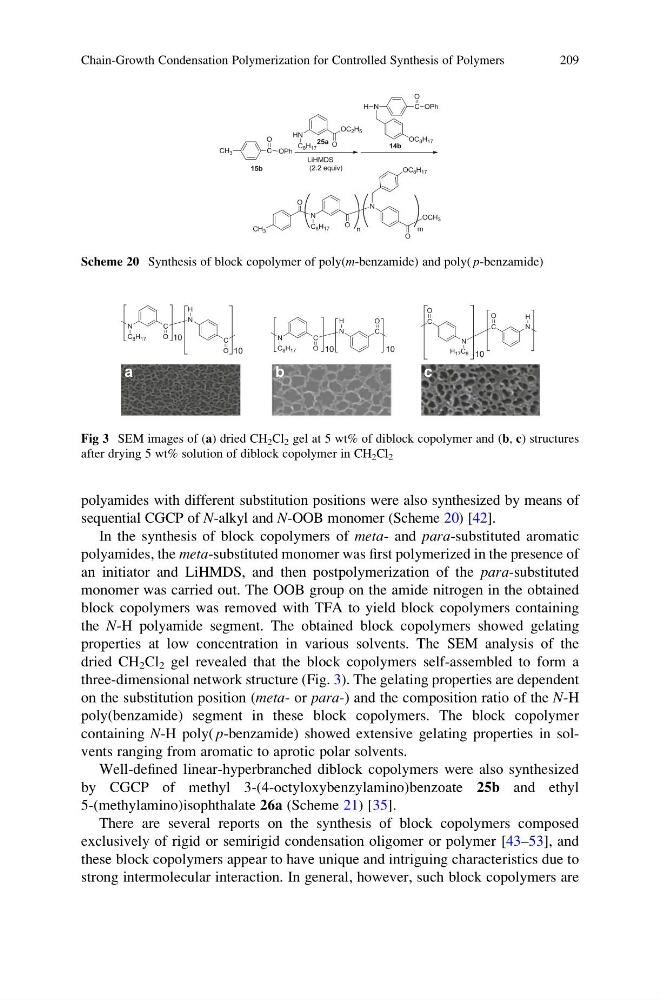
polyamides with different substitution positions were also synthesized by means of
sequential CGCP of N-alkyl and N-OOB monomer (Scheme 20) [42].
In the synthesis of block copolymers of meta- and para-substituted aromatic
polyamides, the meta-substituted monomer was first polymerized in the presence of
an initiator and LiHMDS, and then postpolymerization of the para-substituted
monomer was carried out. The OOB group on the amide nitrogen in the obtained
block copolymers was removed with TFA to yield block copolymers containing
the N-H polyamide segment. The obtained block copolymers showed gelating
properties at low concentration in various solvents. The SEM analysis of the
dried CH 2 Cl 2 gel revealed that the block copolymers self-assembled to form a
three-dimensional network structure (Fig. 3). The gelating properties are dependent
on the substitution position (meta- or para-) and the composition ratio of the N-H
poly(benzamide) segment in these block copolymers. The block copolymer
containing N-H poly( p-benzamide) showed extensive gelating properties in solvents ranging from aromatic to aprotic polar solvents.
Well-defined linear-hyperbranched diblock copolymers were also synthesized
by CGCP of methyl 3-(4-octyloxybenzylamino)benzoate 25b and ethyl
5-(methylamino)isophthalate 26a (Scheme 21) [35].
There are several reports on the synthesis of block copolymers composed
exclusively of rigid or semirigid condensation oligomer or polymer [43–53], and
these block copolymers appear to have unique and intriguing characteristics due to
strong intermolecular interaction. In general, however, such block copolymers are
a
b
c
Fig 3 SEM images of (a) dried CH 2 Cl 2 gel at 5 wt% of diblock copolymer and (b, c) structures
after drying 5 wt% solution of diblock copolymer in CH 2 Cl 2
Scheme 20 Synthesis of block copolymer of poly(m-benzamide) and poly( p-benzamide)
Chain-Growth Condensation Polymerization for Controlled Synthesis of Polymers
209
sequential CGCP of N-alkyl and N-OOB monomer (Scheme 20) [42].
In the synthesis of block copolymers of meta- and para-substituted aromatic
polyamides, the meta-substituted monomer was first polymerized in the presence of
an initiator and LiHMDS, and then postpolymerization of the para-substituted
monomer was carried out. The OOB group on the amide nitrogen in the obtained
block copolymers was removed with TFA to yield block copolymers containing
the N-H polyamide segment. The obtained block copolymers showed gelating
properties at low concentration in various solvents. The SEM analysis of the
dried CH 2 Cl 2 gel revealed that the block copolymers self-assembled to form a
three-dimensional network structure (Fig. 3). The gelating properties are dependent
on the substitution position (meta- or para-) and the composition ratio of the N-H
poly(benzamide) segment in these block copolymers. The block copolymer
containing N-H poly( p-benzamide) showed extensive gelating properties in solvents ranging from aromatic to aprotic polar solvents.
Well-defined linear-hyperbranched diblock copolymers were also synthesized
by CGCP of methyl 3-(4-octyloxybenzylamino)benzoate 25b and ethyl
5-(methylamino)isophthalate 26a (Scheme 21) [35].
There are several reports on the synthesis of block copolymers composed
exclusively of rigid or semirigid condensation oligomer or polymer [43–53], and
these block copolymers appear to have unique and intriguing characteristics due to
strong intermolecular interaction. In general, however, such block copolymers are
a
b
c
Fig 3 SEM images of (a) dried CH 2 Cl 2 gel at 5 wt% of diblock copolymer and (b, c) structures
after drying 5 wt% solution of diblock copolymer in CH 2 Cl 2
Scheme 20 Synthesis of block copolymer of poly(m-benzamide) and poly( p-benzamide)
Chain-Growth Condensation Polymerization for Controlled Synthesis of Polymers
209