

4 Polymer Architecture Using CGCP Through
the Substituent Effects
4.1 Block Copolymer
Development of condensation polymerization with the character of living polymerization enables condensation polymer architectures to be produced in a similar way
to those attained by living polymerization of vinyl and cyclic monomers.
Block copolymers of aromatic polyamides have been synthesized by CGCP of
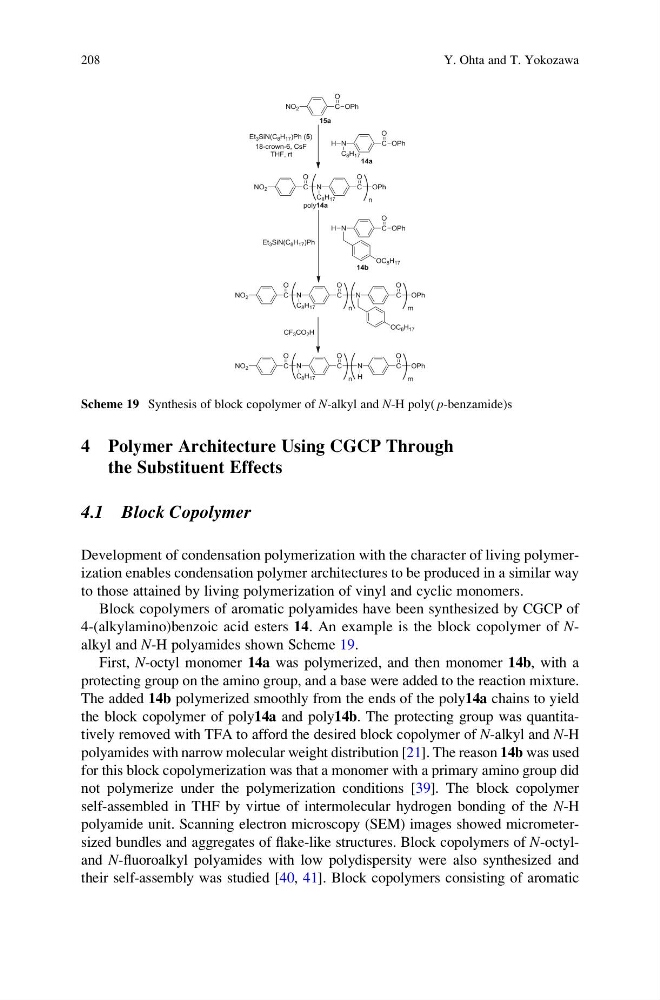
4-(alkylamino)benzoic acid esters 14. An example is the block copolymer of Nalkyl and N-H polyamides shown Scheme 19.
First, N-octyl monomer 14a was polymerized, and then monomer 14b, with a
protecting group on the amino group, and a base were added to the reaction mixture.
The added 14b polymerized smoothly from the ends of the poly14a chains to yield
the block copolymer of poly14a and poly14b. The protecting group was quantitatively removed with TFA to afford the desired block copolymer of N-alkyl and N-H
polyamides with narrow molecular weight distribution [21]. The reason 14b was used
for this block copolymerization was that a monomer with a primary amino group did
not polymerize under the polymerization conditions [39]. The block copolymer
self-assembled in THF by virtue of intermolecular hydrogen bonding of the N-H
polyamide unit. Scanning electron microscopy (SEM) images showed micrometersized bundles and aggregates of flake-like structures. Block copolymers of N-octyland N-fluoroalkyl polyamides with low polydispersity were also synthesized and
their self-assembly was studied [40, 41]. Block copolymers consisting of aromatic
Scheme 19 Synthesis of block copolymer of N-alkyl and N-H poly( p-benzamide)s
208
Y. Ohta and T. Yokozawa
the Substituent Effects
4.1 Block Copolymer
Development of condensation polymerization with the character of living polymerization enables condensation polymer architectures to be produced in a similar way
to those attained by living polymerization of vinyl and cyclic monomers.
Block copolymers of aromatic polyamides have been synthesized by CGCP of
4-(alkylamino)benzoic acid esters 14. An example is the block copolymer of Nalkyl and N-H polyamides shown Scheme 19.
First, N-octyl monomer 14a was polymerized, and then monomer 14b, with a
protecting group on the amino group, and a base were added to the reaction mixture.
The added 14b polymerized smoothly from the ends of the poly14a chains to yield
the block copolymer of poly14a and poly14b. The protecting group was quantitatively removed with TFA to afford the desired block copolymer of N-alkyl and N-H
polyamides with narrow molecular weight distribution [21]. The reason 14b was used
for this block copolymerization was that a monomer with a primary amino group did
not polymerize under the polymerization conditions [39]. The block copolymer
self-assembled in THF by virtue of intermolecular hydrogen bonding of the N-H
polyamide unit. Scanning electron microscopy (SEM) images showed micrometersized bundles and aggregates of flake-like structures. Block copolymers of N-octyland N-fluoroalkyl polyamides with low polydispersity were also synthesized and
their self-assembly was studied [40, 41]. Block copolymers consisting of aromatic
Scheme 19 Synthesis of block copolymer of N-alkyl and N-H poly( p-benzamide)s
208
Y. Ohta and T. Yokozawa