

of polymerization are mixed, a lower surface energy component is enriched at the
surface. The molecular weight disparity between the components also causes the
surface segregation of a smaller component. The latter can be explained in terms of
less conformational or translational entropic penalty for the shorter chain at the
surface, in addition to the surface localization of chain end groups. If chain ends
have a smaller surface energy than the repeating unit, they act as buoys. Thus, when
hyperbranched polymer is mixed into a liner polymer, hyperbranched polymer is
partitioned to the surface because of the buoys. In addition, the chain dimension of
hyperbranched polymer is smaller than that of a liner polymer with comparable
molecular weight. This also leads to the surface segregation of hyperbranched
polymer in a matrix polymer. When N-octyl, ethyl, and methyl HBPAs were
compared, the extent of segregation was in this order. This is probably because
HBPA with a shorter alkyl side chain can form aggregates, leading to an increase in
apparent molecular weight. It is entropically unfavorable for such aggregates to be
segregated at the surface.
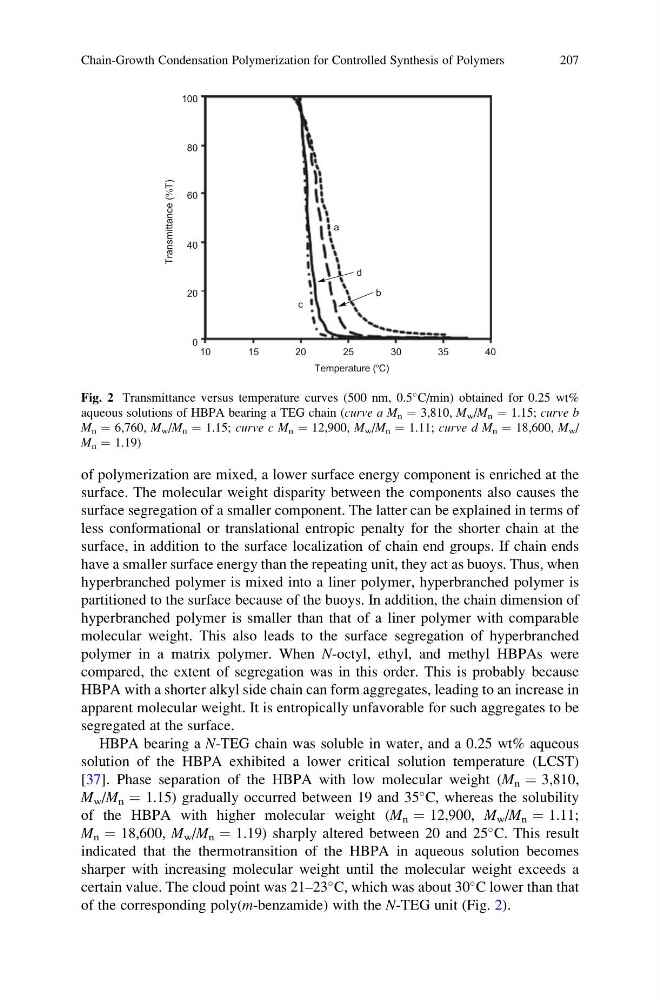
HBPA bearing a N-TEG chain was soluble in water, and a 0.25 wt% aqueous
solution of the HBPA exhibited a lower critical solution temperature (LCST)
[37]. Phase separation of the HBPA with low molecular weight (M n ¼ 3,810,
M w /M n ¼ 1.15) gradually occurred between 19 and 35
C, whereas the solubility
of the HBPA with higher molecular weight (M n ¼ 12,900, M w /M n ¼ 1.11;
M n ¼ 18,600, M w /M n ¼ 1.19) sharply altered between 20 and 25
C. This result
indicated that the thermotransition of the HBPA in aqueous solution becomes
sharper with increasing molecular weight until the molecular weight exceeds a
certain value. The cloud point was 21–23
C, which was about 30
C lower than that
of the corresponding poly(m-benzamide) with the N-TEG unit (Fig. 2).
Temperature (
o C)
Transmittance (%T)
20
30
40
35
25
10
15
20
40
60
80
100
0
a
b
c
d
Fig. 2 Transmittance versus temperature curves (500 nm, 0.5
C/min) obtained for 0.25 wt%
aqueous solutions of HBPA bearing a TEG chain (curve a M n ¼ 3,810, M w /M n ¼ 1.15; curve b
M n ¼ 6,760, M w /M n ¼ 1.15; curve c M n ¼ 12,900, M w /M n ¼ 1.11; curve d M n ¼ 18,600, M w /
M n ¼ 1.19)
Chain-Growth Condensation Polymerization for Controlled Synthesis of Polymers
207
surface. The molecular weight disparity between the components also causes the
surface segregation of a smaller component. The latter can be explained in terms of
less conformational or translational entropic penalty for the shorter chain at the
surface, in addition to the surface localization of chain end groups. If chain ends
have a smaller surface energy than the repeating unit, they act as buoys. Thus, when
hyperbranched polymer is mixed into a liner polymer, hyperbranched polymer is
partitioned to the surface because of the buoys. In addition, the chain dimension of
hyperbranched polymer is smaller than that of a liner polymer with comparable
molecular weight. This also leads to the surface segregation of hyperbranched
polymer in a matrix polymer. When N-octyl, ethyl, and methyl HBPAs were
compared, the extent of segregation was in this order. This is probably because
HBPA with a shorter alkyl side chain can form aggregates, leading to an increase in
apparent molecular weight. It is entropically unfavorable for such aggregates to be
segregated at the surface.
HBPA bearing a N-TEG chain was soluble in water, and a 0.25 wt% aqueous
solution of the HBPA exhibited a lower critical solution temperature (LCST)
[37]. Phase separation of the HBPA with low molecular weight (M n ¼ 3,810,
M w /M n ¼ 1.15) gradually occurred between 19 and 35
C, whereas the solubility
of the HBPA with higher molecular weight (M n ¼ 12,900, M w /M n ¼ 1.11;
M n ¼ 18,600, M w /M n ¼ 1.19) sharply altered between 20 and 25
C. This result
indicated that the thermotransition of the HBPA in aqueous solution becomes
sharper with increasing molecular weight until the molecular weight exceeds a
certain value. The cloud point was 21–23
C, which was about 30
C lower than that
of the corresponding poly(m-benzamide) with the N-TEG unit (Fig. 2).
Temperature (
o C)
Transmittance (%T)
20
30
40
35
25
10
15
20
40
60
80
100
0
a
b
c
d
Fig. 2 Transmittance versus temperature curves (500 nm, 0.5
C/min) obtained for 0.25 wt%
aqueous solutions of HBPA bearing a TEG chain (curve a M n ¼ 3,810, M w /M n ¼ 1.15; curve b
M n ¼ 6,760, M w /M n ¼ 1.15; curve c M n ¼ 12,900, M w /M n ¼ 1.11; curve d M n ¼ 18,600, M w /
M n ¼ 1.19)
Chain-Growth Condensation Polymerization for Controlled Synthesis of Polymers
207