

[35]. The CGCP of other AB 2 monomers with N-ethyl, octyl, OOB, and TEG
groups afforded the corresponding well-defined HBPAs [36, 37]. HBPA with the
N-OOB group was converted to unsubstituted N-H HBPA with low polydispersity
by treatment with TFA. Since all HBPAs possess well-controlled molecular weight
and low polydispersity, we can evaluate precisely the molecular weight dependency
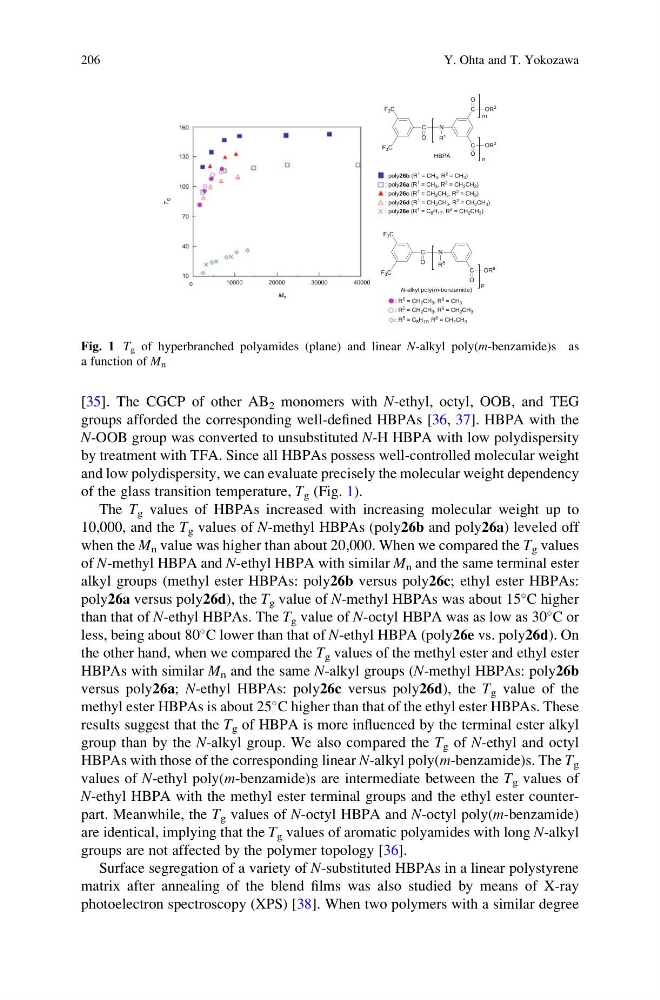
of the glass transition temperature, T g (Fig. 1).
The T g values of HBPAs increased with increasing molecular weight up to
10,000, and the T g values of N-methyl HBPAs (poly26b and poly26a) leveled off
when the M n value was higher than about 20,000. When we compared the T g values
of N-methyl HBPA and N-ethyl HBPA with similar M n and the same terminal ester
alkyl groups (methyl ester HBPAs: poly26b versus poly26c; ethyl ester HBPAs:
poly26a versus poly26d), the T g value of N-methyl HBPAs was about 15
C higher
than that of N-ethyl HBPAs. The T g value of N-octyl HBPA was as low as 30
C or
less, being about 80
C lower than that of N-ethyl HBPA (poly26e vs. poly26d). On
the other hand, when we compared the T g values of the methyl ester and ethyl ester
HBPAs with similar M n and the same N-alkyl groups (N-methyl HBPAs: poly26b
versus poly26a; N-ethyl HBPAs: poly26c versus poly26d), the T g value of the
methyl ester HBPAs is about 25
C higher than that of the ethyl ester HBPAs. These
results suggest that the T g of HBPA is more influenced by the terminal ester alkyl
group than by the N-alkyl group. We also compared the T g of N-ethyl and octyl
HBPAs with those of the corresponding linear N-alkyl poly(m-benzamide)s. The T g
values of N-ethyl poly(m-benzamide)s are intermediate between the T g values of
N-ethyl HBPA with the methyl ester terminal groups and the ethyl ester counterpart. Meanwhile, the T g values of N-octyl HBPA and N-octyl poly(m-benzamide)
are identical, implying that the T g values of aromatic polyamides with long N-alkyl
groups are not affected by the polymer topology [36].
Surface segregation of a variety of N-substituted HBPAs in a linear polystyrene
matrix after annealing of the blend films was also studied by means of X-ray
photoelectron spectroscopy (XPS) [38]. When two polymers with a similar degree
Fig. 1 T g of hyperbranched polyamides (plane) and linear N-alkyl poly(m-benzamide)s as
a function of M n
206
Y. Ohta and T. Yokozawa
groups afforded the corresponding well-defined HBPAs [36, 37]. HBPA with the
N-OOB group was converted to unsubstituted N-H HBPA with low polydispersity
by treatment with TFA. Since all HBPAs possess well-controlled molecular weight
and low polydispersity, we can evaluate precisely the molecular weight dependency
of the glass transition temperature, T g (Fig. 1).
The T g values of HBPAs increased with increasing molecular weight up to
10,000, and the T g values of N-methyl HBPAs (poly26b and poly26a) leveled off
when the M n value was higher than about 20,000. When we compared the T g values
of N-methyl HBPA and N-ethyl HBPA with similar M n and the same terminal ester
alkyl groups (methyl ester HBPAs: poly26b versus poly26c; ethyl ester HBPAs:
poly26a versus poly26d), the T g value of N-methyl HBPAs was about 15
C higher
than that of N-ethyl HBPAs. The T g value of N-octyl HBPA was as low as 30
C or
less, being about 80
C lower than that of N-ethyl HBPA (poly26e vs. poly26d). On
the other hand, when we compared the T g values of the methyl ester and ethyl ester
HBPAs with similar M n and the same N-alkyl groups (N-methyl HBPAs: poly26b
versus poly26a; N-ethyl HBPAs: poly26c versus poly26d), the T g value of the
methyl ester HBPAs is about 25
C higher than that of the ethyl ester HBPAs. These
results suggest that the T g of HBPA is more influenced by the terminal ester alkyl
group than by the N-alkyl group. We also compared the T g of N-ethyl and octyl
HBPAs with those of the corresponding linear N-alkyl poly(m-benzamide)s. The T g
values of N-ethyl poly(m-benzamide)s are intermediate between the T g values of
N-ethyl HBPA with the methyl ester terminal groups and the ethyl ester counterpart. Meanwhile, the T g values of N-octyl HBPA and N-octyl poly(m-benzamide)
are identical, implying that the T g values of aromatic polyamides with long N-alkyl
groups are not affected by the polymer topology [36].
Surface segregation of a variety of N-substituted HBPAs in a linear polystyrene
matrix after annealing of the blend films was also studied by means of X-ray
photoelectron spectroscopy (XPS) [38]. When two polymers with a similar degree
Fig. 1 T g of hyperbranched polyamides (plane) and linear N-alkyl poly(m-benzamide)s as
a function of M n
206
Y. Ohta and T. Yokozawa