

separation of poly(m-benzamide)s with a N-tetra(ethylene glycol) chain gradually
occurred between 58 and 72
C, i.e., a higher temperature than that of
poly(m-benzamide)s with the N-TEG chain. The temperature-dependent phase
separation process of each polymer was actually reversible, but a hysteresis on
temperature (ΔT > 1.5
C) was observed during heating and cooling cycles
(Æ0.5
C min
À1 ) [34].
On the basis of the above successful CGCP of meta-substituted monomer,
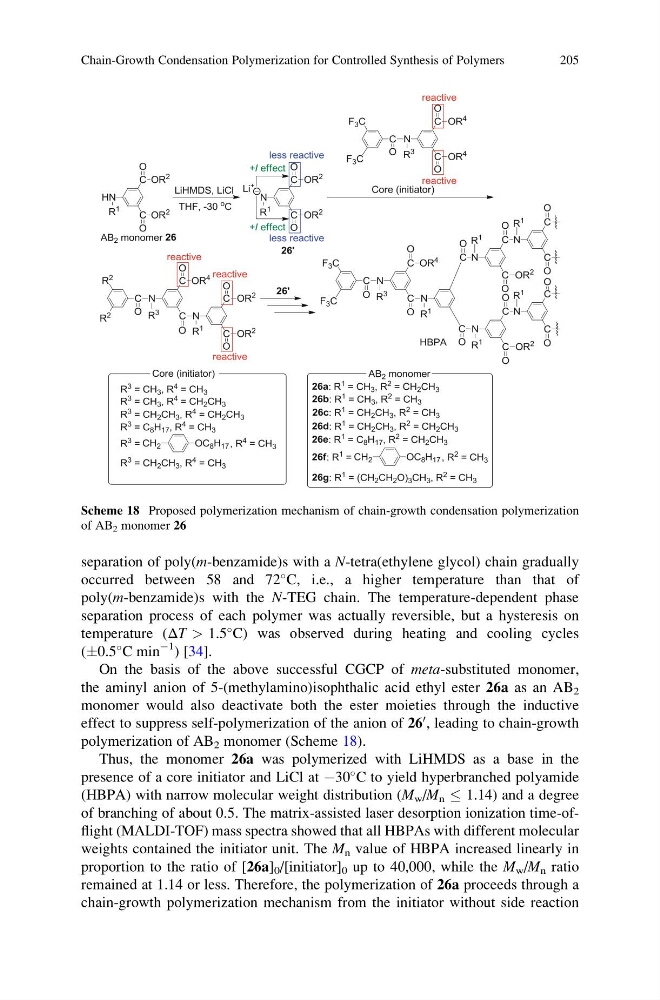
the aminyl anion of 5-(methylamino)isophthalic acid ethyl ester 26a as an AB 2
monomer would also deactivate both the ester moieties through the inductive
effect to suppress self-polymerization of the anion of 26
0 , leading to chain-growth
polymerization of AB 2 monomer (Scheme 18).
Thus, the monomer 26a was polymerized with LiHMDS as a base in the
presence of a core initiator and LiCl at À30
C to yield hyperbranched polyamide
(HBPA) with narrow molecular weight distribution (M w /M n 1.14) and a degree
of branching of about 0.5. The matrix-assisted laser desorption ionization time-offlight (MALDI-TOF) mass spectra showed that all HBPAs with different molecular
weights contained the initiator unit. The M n value of HBPA increased linearly in
proportion to the ratio of [26a] 0 /[initiator] 0 up to 40,000, while the M w /M n ratio
remained at 1.14 or less. Therefore, the polymerization of 26a proceeds through a
chain-growth polymerization mechanism from the initiator without side reaction
Scheme 18 Proposed polymerization mechanism of chain-growth condensation polymerization
of AB 2 monomer 26
Chain-Growth Condensation Polymerization for Controlled Synthesis of Polymers
205
occurred between 58 and 72
C, i.e., a higher temperature than that of
poly(m-benzamide)s with the N-TEG chain. The temperature-dependent phase
separation process of each polymer was actually reversible, but a hysteresis on
temperature (ΔT > 1.5
C) was observed during heating and cooling cycles
(Æ0.5
C min
À1 ) [34].
On the basis of the above successful CGCP of meta-substituted monomer,
the aminyl anion of 5-(methylamino)isophthalic acid ethyl ester 26a as an AB 2
monomer would also deactivate both the ester moieties through the inductive
effect to suppress self-polymerization of the anion of 26
0 , leading to chain-growth
polymerization of AB 2 monomer (Scheme 18).
Thus, the monomer 26a was polymerized with LiHMDS as a base in the
presence of a core initiator and LiCl at À30
C to yield hyperbranched polyamide
(HBPA) with narrow molecular weight distribution (M w /M n 1.14) and a degree
of branching of about 0.5. The matrix-assisted laser desorption ionization time-offlight (MALDI-TOF) mass spectra showed that all HBPAs with different molecular
weights contained the initiator unit. The M n value of HBPA increased linearly in
proportion to the ratio of [26a] 0 /[initiator] 0 up to 40,000, while the M w /M n ratio
remained at 1.14 or less. Therefore, the polymerization of 26a proceeds through a
chain-growth polymerization mechanism from the initiator without side reaction
Scheme 18 Proposed polymerization mechanism of chain-growth condensation polymerization
of AB 2 monomer 26
Chain-Growth Condensation Polymerization for Controlled Synthesis of Polymers
205