

derivatives shows that the –I effect of the m-nitro group, a strong electronwithdrawing substituent, is as strong as the –R effect of the p-nitro group: pK a of
m-nitrobenzoic acid is 3.45, and that of p-nitrobenzoic acid is 3.44 [31]. Therefore,
the strong electron-donating nucleophilic site is expected to show a +I effect on the
reactivity of the electrophilic site at the meta-position as strong as the R effect,
resulting in suppression of self-condensation of the monomer in a similar manner to
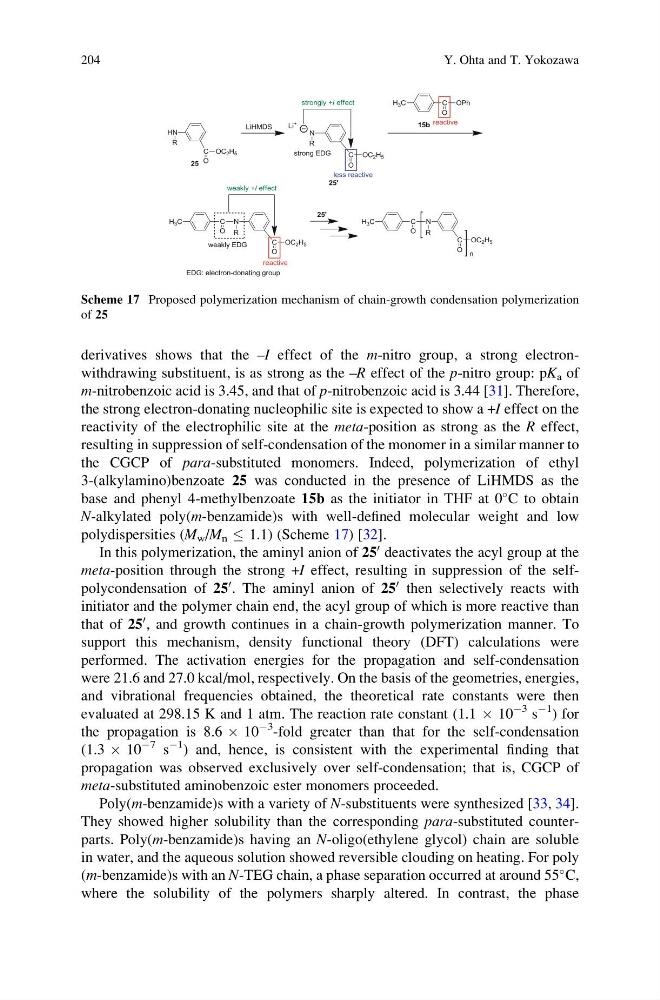
the CGCP of para-substituted monomers. Indeed, polymerization of ethyl
3-(alkylamino)benzoate 25 was conducted in the presence of LiHMDS as the
base and phenyl 4-methylbenzoate 15b as the initiator in THF at 0
C to obtain
N-alkylated poly(m-benzamide)s with well-defined molecular weight and low
polydispersities (M w /M n 1.1) (Scheme 17) [32].
In this polymerization, the aminyl anion of 25
0 deactivates the acyl group at the
meta-position through the strong +I effect, resulting in suppression of the selfpolycondensation of 25
0 . The aminyl anion of 25
0 then selectively reacts with
initiator and the polymer chain end, the acyl group of which is more reactive than
that of 25
0 , and growth continues in a chain-growth polymerization manner. To
support this mechanism, density functional theory (DFT) calculations were
performed. The activation energies for the propagation and self-condensation
were 21.6 and 27.0 kcal/mol, respectively. On the basis of the geometries, energies,
and vibrational frequencies obtained, the theoretical rate constants were then
evaluated at 298.15 K and 1 atm. The reaction rate constant (1.1 Â 10
À3 s
À1 ) for
the propagation is 8.6 Â 10
À3
-fold greater than that for the self-condensation
(1.3 Â 10
À7 s
À1 ) and, hence, is consistent with the experimental finding that
propagation was observed exclusively over self-condensation; that is, CGCP of
meta-substituted aminobenzoic ester monomers proceeded.
Poly(m-benzamide)s with a variety of N-substituents were synthesized [33, 34].
They showed higher solubility than the corresponding para-substituted counterparts. Poly(m-benzamide)s having an N-oligo(ethylene glycol) chain are soluble
in water, and the aqueous solution showed reversible clouding on heating. For poly
(m-benzamide)s with an N-TEG chain, a phase separation occurred at around 55
C,
where the solubility of the polymers sharply altered. In contrast, the phase
Scheme 17 Proposed polymerization mechanism of chain-growth condensation polymerization
of 25
204
Y. Ohta and T. Yokozawa
m-nitrobenzoic acid is 3.45, and that of p-nitrobenzoic acid is 3.44 [31]. Therefore,
the strong electron-donating nucleophilic site is expected to show a +I effect on the
reactivity of the electrophilic site at the meta-position as strong as the R effect,
resulting in suppression of self-condensation of the monomer in a similar manner to
the CGCP of para-substituted monomers. Indeed, polymerization of ethyl
3-(alkylamino)benzoate 25 was conducted in the presence of LiHMDS as the
base and phenyl 4-methylbenzoate 15b as the initiator in THF at 0
C to obtain
N-alkylated poly(m-benzamide)s with well-defined molecular weight and low
polydispersities (M w /M n 1.1) (Scheme 17) [32].
In this polymerization, the aminyl anion of 25
0 deactivates the acyl group at the
meta-position through the strong +I effect, resulting in suppression of the selfpolycondensation of 25
0 . The aminyl anion of 25
0 then selectively reacts with
initiator and the polymer chain end, the acyl group of which is more reactive than
that of 25
0 , and growth continues in a chain-growth polymerization manner. To
support this mechanism, density functional theory (DFT) calculations were
performed. The activation energies for the propagation and self-condensation
were 21.6 and 27.0 kcal/mol, respectively. On the basis of the geometries, energies,
and vibrational frequencies obtained, the theoretical rate constants were then
evaluated at 298.15 K and 1 atm. The reaction rate constant (1.1 Â 10
À3 s
À1 ) for
the propagation is 8.6 Â 10
À3
-fold greater than that for the self-condensation
(1.3 Â 10
À7 s
À1 ) and, hence, is consistent with the experimental finding that
propagation was observed exclusively over self-condensation; that is, CGCP of
meta-substituted aminobenzoic ester monomers proceeded.
Poly(m-benzamide)s with a variety of N-substituents were synthesized [33, 34].
They showed higher solubility than the corresponding para-substituted counterparts. Poly(m-benzamide)s having an N-oligo(ethylene glycol) chain are soluble
in water, and the aqueous solution showed reversible clouding on heating. For poly
(m-benzamide)s with an N-TEG chain, a phase separation occurred at around 55
C,
where the solubility of the polymers sharply altered. In contrast, the phase
Scheme 17 Proposed polymerization mechanism of chain-growth condensation polymerization
of 25
204
Y. Ohta and T. Yokozawa