

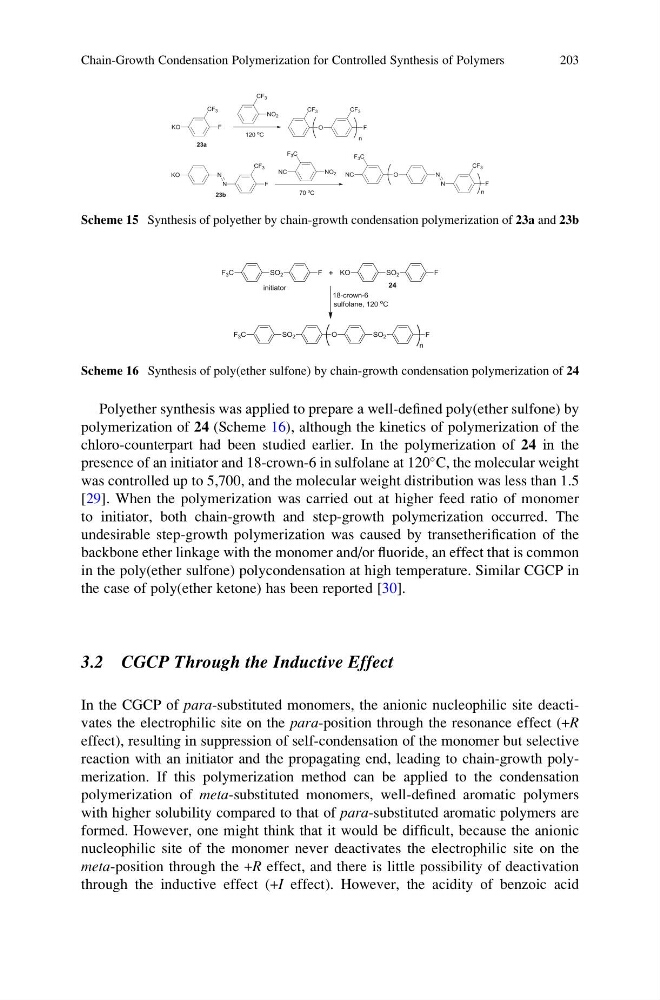
Polyether synthesis was applied to prepare a well-defined poly(ether sulfone) by
polymerization of 24 (Scheme 16), although the kinetics of polymerization of the
chloro-counterpart had been studied earlier. In the polymerization of 24 in the
presence of an initiator and 18-crown-6 in sulfolane at 120
C, the molecular weight
was controlled up to 5,700, and the molecular weight distribution was less than 1.5
[29]. When the polymerization was carried out at higher feed ratio of monomer
to initiator, both chain-growth and step-growth polymerization occurred. The
undesirable step-growth polymerization was caused by transetherification of the
backbone ether linkage with the monomer and/or fluoride, an effect that is common
in the poly(ether sulfone) polycondensation at high temperature. Similar CGCP in
the case of poly(ether ketone) has been reported [30].
3.2 CGCP Through the Inductive Effect
In the CGCP of para-substituted monomers, the anionic nucleophilic site deactivates the electrophilic site on the para-position through the resonance effect (+R
effect), resulting in suppression of self-condensation of the monomer but selective
reaction with an initiator and the propagating end, leading to chain-growth polymerization. If this polymerization method can be applied to the condensation
polymerization of meta-substituted monomers, well-defined aromatic polymers
with higher solubility compared to that of para-substituted aromatic polymers are
formed. However, one might think that it would be difficult, because the anionic
nucleophilic site of the monomer never deactivates the electrophilic site on the
meta-position through the +R effect, and there is little possibility of deactivation
through the inductive effect (+I effect). However, the acidity of benzoic acid
Scheme 15 Synthesis of polyether by chain-growth condensation polymerization of 23a and 23b
Scheme 16 Synthesis of poly(ether sulfone) by chain-growth condensation polymerization of 24
Chain-Growth Condensation Polymerization for Controlled Synthesis of Polymers
203
polymerization of 24 (Scheme 16), although the kinetics of polymerization of the
chloro-counterpart had been studied earlier. In the polymerization of 24 in the
presence of an initiator and 18-crown-6 in sulfolane at 120
C, the molecular weight
was controlled up to 5,700, and the molecular weight distribution was less than 1.5
[29]. When the polymerization was carried out at higher feed ratio of monomer
to initiator, both chain-growth and step-growth polymerization occurred. The
undesirable step-growth polymerization was caused by transetherification of the
backbone ether linkage with the monomer and/or fluoride, an effect that is common
in the poly(ether sulfone) polycondensation at high temperature. Similar CGCP in
the case of poly(ether ketone) has been reported [30].
3.2 CGCP Through the Inductive Effect
In the CGCP of para-substituted monomers, the anionic nucleophilic site deactivates the electrophilic site on the para-position through the resonance effect (+R
effect), resulting in suppression of self-condensation of the monomer but selective
reaction with an initiator and the propagating end, leading to chain-growth polymerization. If this polymerization method can be applied to the condensation
polymerization of meta-substituted monomers, well-defined aromatic polymers
with higher solubility compared to that of para-substituted aromatic polymers are
formed. However, one might think that it would be difficult, because the anionic
nucleophilic site of the monomer never deactivates the electrophilic site on the
meta-position through the +R effect, and there is little possibility of deactivation
through the inductive effect (+I effect). However, the acidity of benzoic acid
Scheme 15 Synthesis of polyether by chain-growth condensation polymerization of 23a and 23b
Scheme 16 Synthesis of poly(ether sulfone) by chain-growth condensation polymerization of 24
Chain-Growth Condensation Polymerization for Controlled Synthesis of Polymers
203