

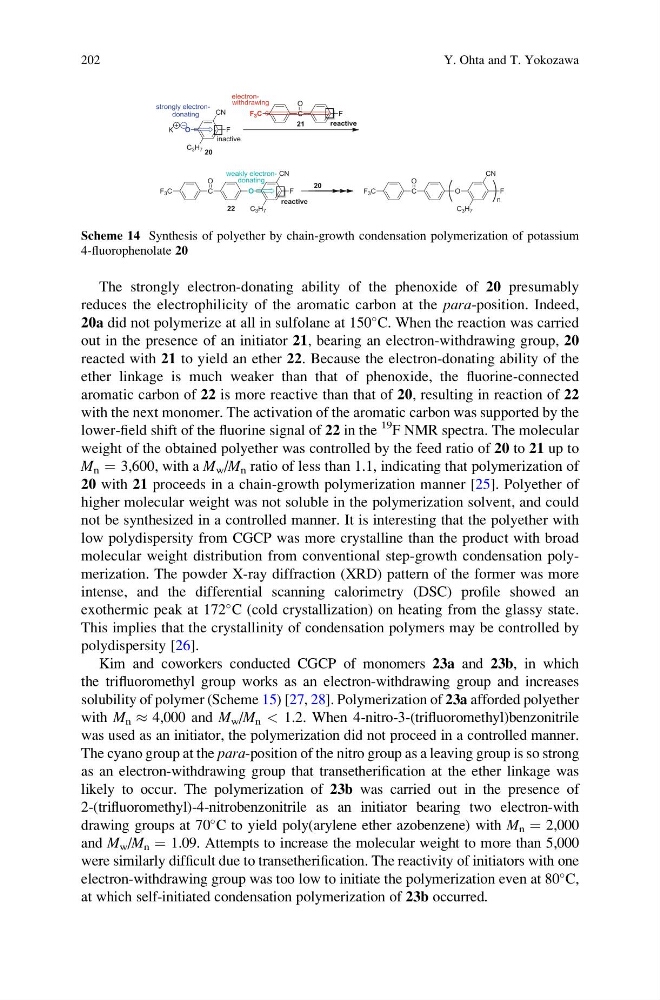
The strongly electron-donating ability of the phenoxide of 20 presumably
reduces the electrophilicity of the aromatic carbon at the para-position. Indeed,
20a did not polymerize at all in sulfolane at 150
C. When the reaction was carried
out in the presence of an initiator 21, bearing an electron-withdrawing group, 20
reacted with 21 to yield an ether 22. Because the electron-donating ability of the
ether linkage is much weaker than that of phenoxide, the fluorine-connected
aromatic carbon of 22 is more reactive than that of 20, resulting in reaction of 22
with the next monomer. The activation of the aromatic carbon was supported by the
lower-field shift of the fluorine signal of 22 in the
19 F NMR spectra. The molecular
weight of the obtained polyether was controlled by the feed ratio of 20 to 21 up to
M n ¼ 3,600, with a M w /M n ratio of less than 1.1, indicating that polymerization of
20 with 21 proceeds in a chain-growth polymerization manner [25]. Polyether of
higher molecular weight was not soluble in the polymerization solvent, and could
not be synthesized in a controlled manner. It is interesting that the polyether with
low polydispersity from CGCP was more crystalline than the product with broad
molecular weight distribution from conventional step-growth condensation polymerization. The powder X-ray diffraction (XRD) pattern of the former was more
intense, and the differential scanning calorimetry (DSC) profile showed an
exothermic peak at 172
C (cold crystallization) on heating from the glassy state.
This implies that the crystallinity of condensation polymers may be controlled by
polydispersity [26].
Kim and coworkers conducted CGCP of monomers 23a and 23b, in which
the trifluoromethyl group works as an electron-withdrawing group and increases
solubility of polymer (Scheme 15) [27, 28]. Polymerization of 23a afforded polyether
with M n % 4,000 and M w /M n < 1.2. When 4-nitro-3-(trifluoromethyl)benzonitrile
was used as an initiator, the polymerization did not proceed in a controlled manner.
The cyano group at the para-position of the nitro group as a leaving group is so strong
as an electron-withdrawing group that transetherification at the ether linkage was
likely to occur. The polymerization of 23b was carried out in the presence of
2-(trifluoromethyl)-4-nitrobenzonitrile as an initiator bearing two electron-with
drawing groups at 70
C to yield poly(arylene ether azobenzene) with M n ¼ 2,000
and M w /M n ¼ 1.09. Attempts to increase the molecular weight to more than 5,000
were similarly difficult due to transetherification. The reactivity of initiators with one
electron-withdrawing group was too low to initiate the polymerization even at 80
C,
at which self-initiated condensation polymerization of 23b occurred.
Scheme 14 Synthesis of polyether by chain-growth condensation polymerization of potassium
4-fluorophenolate 20
202
Y. Ohta and T. Yokozawa
reduces the electrophilicity of the aromatic carbon at the para-position. Indeed,
20a did not polymerize at all in sulfolane at 150
C. When the reaction was carried
out in the presence of an initiator 21, bearing an electron-withdrawing group, 20
reacted with 21 to yield an ether 22. Because the electron-donating ability of the
ether linkage is much weaker than that of phenoxide, the fluorine-connected
aromatic carbon of 22 is more reactive than that of 20, resulting in reaction of 22
with the next monomer. The activation of the aromatic carbon was supported by the
lower-field shift of the fluorine signal of 22 in the
19 F NMR spectra. The molecular
weight of the obtained polyether was controlled by the feed ratio of 20 to 21 up to
M n ¼ 3,600, with a M w /M n ratio of less than 1.1, indicating that polymerization of
20 with 21 proceeds in a chain-growth polymerization manner [25]. Polyether of
higher molecular weight was not soluble in the polymerization solvent, and could
not be synthesized in a controlled manner. It is interesting that the polyether with
low polydispersity from CGCP was more crystalline than the product with broad
molecular weight distribution from conventional step-growth condensation polymerization. The powder X-ray diffraction (XRD) pattern of the former was more
intense, and the differential scanning calorimetry (DSC) profile showed an
exothermic peak at 172
C (cold crystallization) on heating from the glassy state.
This implies that the crystallinity of condensation polymers may be controlled by
polydispersity [26].
Kim and coworkers conducted CGCP of monomers 23a and 23b, in which
the trifluoromethyl group works as an electron-withdrawing group and increases
solubility of polymer (Scheme 15) [27, 28]. Polymerization of 23a afforded polyether
with M n % 4,000 and M w /M n < 1.2. When 4-nitro-3-(trifluoromethyl)benzonitrile
was used as an initiator, the polymerization did not proceed in a controlled manner.
The cyano group at the para-position of the nitro group as a leaving group is so strong
as an electron-withdrawing group that transetherification at the ether linkage was
likely to occur. The polymerization of 23b was carried out in the presence of
2-(trifluoromethyl)-4-nitrobenzonitrile as an initiator bearing two electron-with
drawing groups at 70
C to yield poly(arylene ether azobenzene) with M n ¼ 2,000
and M w /M n ¼ 1.09. Attempts to increase the molecular weight to more than 5,000
were similarly difficult due to transetherification. The reactivity of initiators with one
electron-withdrawing group was too low to initiate the polymerization even at 80
C,
at which self-initiated condensation polymerization of 23b occurred.
Scheme 14 Synthesis of polyether by chain-growth condensation polymerization of potassium
4-fluorophenolate 20
202
Y. Ohta and T. Yokozawa