

The polymerization of the methyl ester monomer 17a bearing a 3,7-dimethyloctyl
side chain in the presence of an initiator 15b and lithium 1,1,1,3,3,3hexamethyldisilazide (LiHMDS) as a base gave well-defined poly(naphthalenecarboxamide), together with a very small amount of a cyclic trimer, formed by
self-condensation of 17a in the early stage of the polymerization [22]. On the other
hand, polymerization of phenyl ester monomer 17b with the tri(ethylene glycol)
(TEG) monomethyl ether side chain yielded poly(naphthalenecarboxamide) with
controlled molecular weight in the case of [17b] 0 /[initiator] 0 ¼ 10. Polymerization
at higher feed ratio was accompanied by self-condensation to afford polyamides via
chain-growth and step-growth polymerization, so that the M n value of the polymer
did not reach the theoretical value. The undesirable self-condensation is accounted
for by insufficient deactivation of the electrophilic ester moiety by the electrondonating resonance effect of the amide anion, due to the greater distance between
the 2 and 6 positions of the naphthalene ring, in comparison with the corresponding
para-substituted benzene monomer, which proceeds in CGCP without selfcondensation until the feed ratio reaches 100.
To extend the range of application of CGCP of para-substituted monomer, the
nucleophilic site of the monomer was changed from an amino group to a hydroxyl
group. One might think that it would be easy to synthesize well-defined aromatic
polyesters, such as poly(4-hydroxybenzoate)s, by CGCP of 4-hydroxybenzoic acid
derivatives in a similar manner to that of 4-(alkylamino)benzoic acid derivatives.
But, synthesis of well-defined aromatic polyester is more difficult than that of
polyamide because polyester easily undergoes transesterification. The monomer
can attack the polymer ester linkage to generate a cleaved chain with the phenoxide
moiety at one end and the acyl group at the other end, leading to conventional stepgrowth polycondensation. Actually, transesterification occurred in the condensation
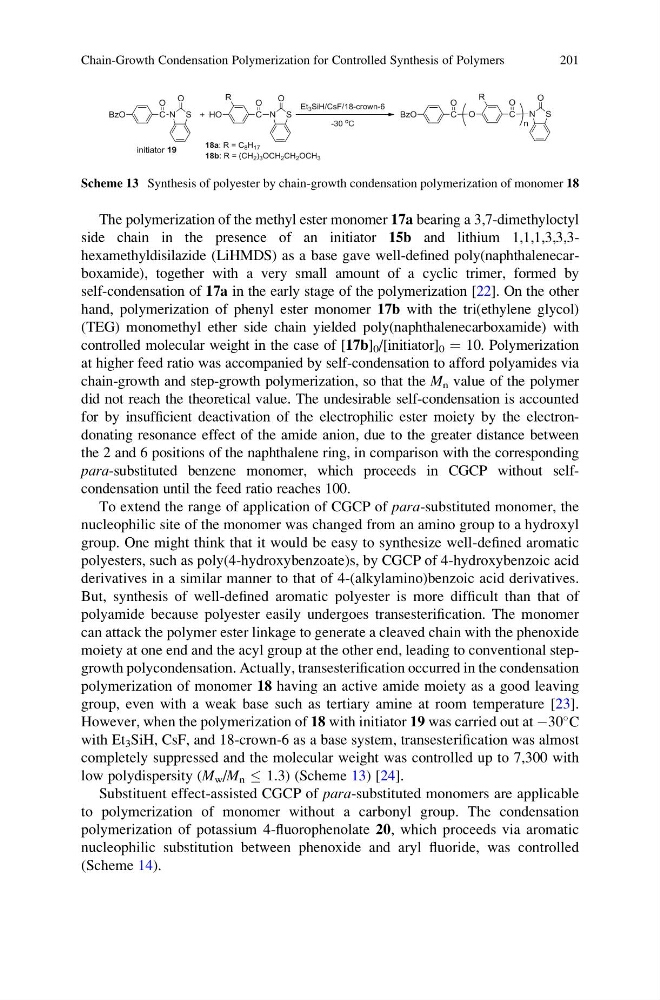
polymerization of monomer 18 having an active amide moiety as a good leaving
group, even with a weak base such as tertiary amine at room temperature [23].
However, when the polymerization of 18 with initiator 19 was carried out at À30
C
with Et 3 SiH, CsF, and 18-crown-6 as a base system, transesterification was almost
completely suppressed and the molecular weight was controlled up to 7,300 with
low polydispersity (M w /M n 1.3) (Scheme 13) [24].
Substituent effect-assisted CGCP of para-substituted monomers are applicable
to polymerization of monomer without a carbonyl group. The condensation
polymerization of potassium 4-fluorophenolate 20, which proceeds via aromatic
nucleophilic substitution between phenoxide and aryl fluoride, was controlled
(Scheme 14).
Scheme 13 Synthesis of polyester by chain-growth condensation polymerization of monomer 18
Chain-Growth Condensation Polymerization for Controlled Synthesis of Polymers
201
side chain in the presence of an initiator 15b and lithium 1,1,1,3,3,3hexamethyldisilazide (LiHMDS) as a base gave well-defined poly(naphthalenecarboxamide), together with a very small amount of a cyclic trimer, formed by
self-condensation of 17a in the early stage of the polymerization [22]. On the other
hand, polymerization of phenyl ester monomer 17b with the tri(ethylene glycol)
(TEG) monomethyl ether side chain yielded poly(naphthalenecarboxamide) with
controlled molecular weight in the case of [17b] 0 /[initiator] 0 ¼ 10. Polymerization
at higher feed ratio was accompanied by self-condensation to afford polyamides via
chain-growth and step-growth polymerization, so that the M n value of the polymer
did not reach the theoretical value. The undesirable self-condensation is accounted
for by insufficient deactivation of the electrophilic ester moiety by the electrondonating resonance effect of the amide anion, due to the greater distance between
the 2 and 6 positions of the naphthalene ring, in comparison with the corresponding
para-substituted benzene monomer, which proceeds in CGCP without selfcondensation until the feed ratio reaches 100.
To extend the range of application of CGCP of para-substituted monomer, the
nucleophilic site of the monomer was changed from an amino group to a hydroxyl
group. One might think that it would be easy to synthesize well-defined aromatic
polyesters, such as poly(4-hydroxybenzoate)s, by CGCP of 4-hydroxybenzoic acid
derivatives in a similar manner to that of 4-(alkylamino)benzoic acid derivatives.
But, synthesis of well-defined aromatic polyester is more difficult than that of
polyamide because polyester easily undergoes transesterification. The monomer
can attack the polymer ester linkage to generate a cleaved chain with the phenoxide
moiety at one end and the acyl group at the other end, leading to conventional stepgrowth polycondensation. Actually, transesterification occurred in the condensation
polymerization of monomer 18 having an active amide moiety as a good leaving
group, even with a weak base such as tertiary amine at room temperature [23].
However, when the polymerization of 18 with initiator 19 was carried out at À30
C
with Et 3 SiH, CsF, and 18-crown-6 as a base system, transesterification was almost
completely suppressed and the molecular weight was controlled up to 7,300 with
low polydispersity (M w /M n 1.3) (Scheme 13) [24].
Substituent effect-assisted CGCP of para-substituted monomers are applicable
to polymerization of monomer without a carbonyl group. The condensation
polymerization of potassium 4-fluorophenolate 20, which proceeds via aromatic
nucleophilic substitution between phenoxide and aryl fluoride, was controlled
(Scheme 14).
Scheme 13 Synthesis of polyester by chain-growth condensation polymerization of monomer 18
Chain-Growth Condensation Polymerization for Controlled Synthesis of Polymers
201