

in strong acid and are essentially insoluble in common organic solvents, complete
deprotection should be carried out under homogeneous conditions in strongly acidic
media. A suitable protecting group is the octyloxybezyl (OOB) group, not only
because it can be easily removed by treatment with trifluoroacetic acid (TFA), but
also because the octyloxy group enhances the solubility of the protected polymer. If
the solubility of the protected polymer is insufficient, control of the condensation
polymerization is difficult due to precipitation of the polymer, as in the case of
the polymerization of N-methoxybenzyl monomer. Polymerization of N-OOB
monomer gave polyamide with controlled molecular weight and narrow molecular
weight distribution. Treatment of the polyamide with TFA resulted in complete
removal of the N-OOB group from the polyamide [21].
Since resonance effects can work between functional groups not only at the para
position of benzene, but also at the 1,5- or 2,6-posiotion of naphthalene, we
extended the range of monomers, leading to well-defined aromatic polyamides,
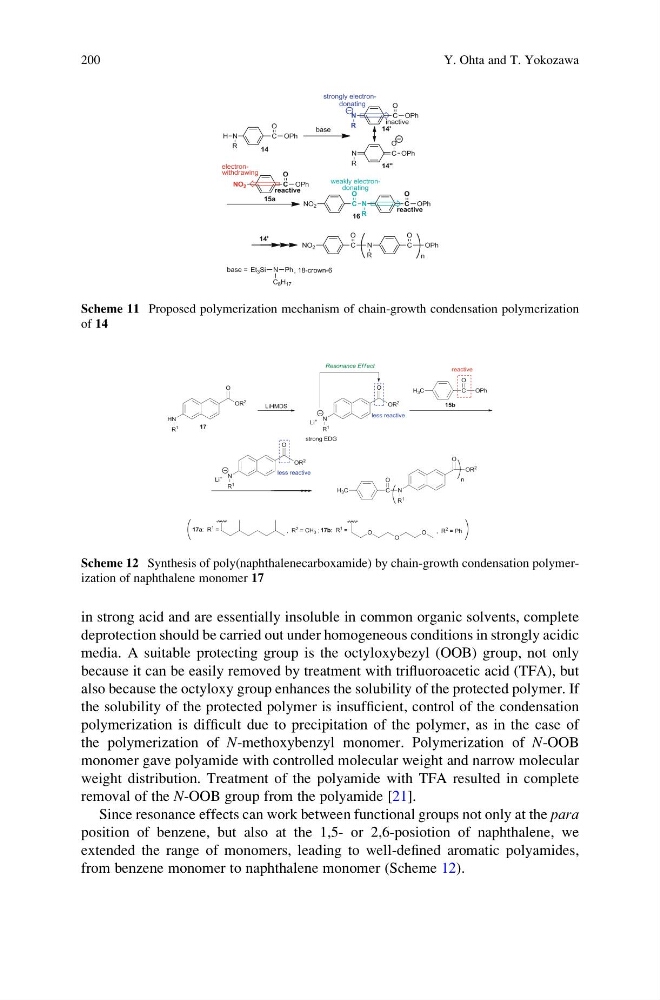
from benzene monomer to naphthalene monomer (Scheme 12).
Scheme 12 Synthesis of poly(naphthalenecarboxamide) by chain-growth condensation polymerization of naphthalene monomer 17
Scheme 11 Proposed polymerization mechanism of chain-growth condensation polymerization
of 14
200
Y. Ohta and T. Yokozawa
deprotection should be carried out under homogeneous conditions in strongly acidic
media. A suitable protecting group is the octyloxybezyl (OOB) group, not only
because it can be easily removed by treatment with trifluoroacetic acid (TFA), but
also because the octyloxy group enhances the solubility of the protected polymer. If
the solubility of the protected polymer is insufficient, control of the condensation
polymerization is difficult due to precipitation of the polymer, as in the case of
the polymerization of N-methoxybenzyl monomer. Polymerization of N-OOB
monomer gave polyamide with controlled molecular weight and narrow molecular
weight distribution. Treatment of the polyamide with TFA resulted in complete
removal of the N-OOB group from the polyamide [21].
Since resonance effects can work between functional groups not only at the para
position of benzene, but also at the 1,5- or 2,6-posiotion of naphthalene, we
extended the range of monomers, leading to well-defined aromatic polyamides,
from benzene monomer to naphthalene monomer (Scheme 12).
Scheme 12 Synthesis of poly(naphthalenecarboxamide) by chain-growth condensation polymerization of naphthalene monomer 17
Scheme 11 Proposed polymerization mechanism of chain-growth condensation polymerization
of 14
200
Y. Ohta and T. Yokozawa