

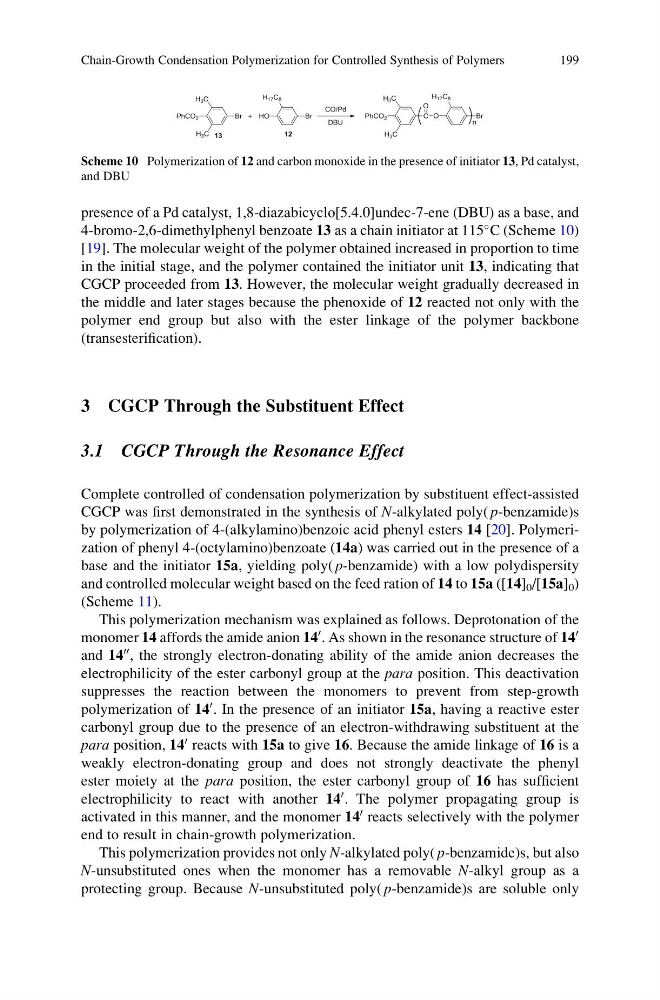
presence of a Pd catalyst, 1,8-diazabicyclo[5.4.0]undec-7-ene (DBU) as a base, and
4-bromo-2,6-dimethylphenyl benzoate 13 as a chain initiator at 115
C (Scheme 10)
[19]. The molecular weight of the polymer obtained increased in proportion to time
in the initial stage, and the polymer contained the initiator unit 13, indicating that
CGCP proceeded from 13. However, the molecular weight gradually decreased in
the middle and later stages because the phenoxide of 12 reacted not only with the
polymer end group but also with the ester linkage of the polymer backbone
(transesterification).
3 CGCP Through the Substituent Effect
3.1 CGCP Through the Resonance Effect
Complete controlled of condensation polymerization by substituent effect-assisted
CGCP was first demonstrated in the synthesis of N-alkylated poly( p-benzamide)s
by polymerization of 4-(alkylamino)benzoic acid phenyl esters 14 [20]. Polymerization of phenyl 4-(octylamino)benzoate (14a) was carried out in the presence of a
base and the initiator 15a, yielding poly( p-benzamide) with a low polydispersity
and controlled molecular weight based on the feed ration of 14 to 15a ([14] 0 /[15a] 0 )
(Scheme 11).
This polymerization mechanism was explained as follows. Deprotonation of the
monomer 14 affords the amide anion 14
0 . As shown in the resonance structure of 14
0
and 14
00 , the strongly electron-donating ability of the amide anion decreases the
electrophilicity of the ester carbonyl group at the para position. This deactivation
suppresses the reaction between the monomers to prevent from step-growth
polymerization of 14
0 . In the presence of an initiator 15a, having a reactive ester
carbonyl group due to the presence of an electron-withdrawing substituent at the
para position, 14
0 reacts with 15a to give 16. Because the amide linkage of 16 is a
weakly electron-donating group and does not strongly deactivate the phenyl
ester moiety at the para position, the ester carbonyl group of 16 has sufficient
electrophilicity to react with another 14
0 . The polymer propagating group is
activated in this manner, and the monomer 14
0 reacts selectively with the polymer
end to result in chain-growth polymerization.
This polymerization provides not only N-alkylated poly( p-benzamide)s, but also
N-unsubstituted ones when the monomer has a removable N-alkyl group as a
protecting group. Because N-unsubstituted poly( p-benzamide)s are soluble only
Scheme 10 Polymerization of 12 and carbon monoxide in the presence of initiator 13, Pd catalyst,
and DBU
Chain-Growth Condensation Polymerization for Controlled Synthesis of Polymers
199
4-bromo-2,6-dimethylphenyl benzoate 13 as a chain initiator at 115
C (Scheme 10)
[19]. The molecular weight of the polymer obtained increased in proportion to time
in the initial stage, and the polymer contained the initiator unit 13, indicating that
CGCP proceeded from 13. However, the molecular weight gradually decreased in
the middle and later stages because the phenoxide of 12 reacted not only with the
polymer end group but also with the ester linkage of the polymer backbone
(transesterification).
3 CGCP Through the Substituent Effect
3.1 CGCP Through the Resonance Effect
Complete controlled of condensation polymerization by substituent effect-assisted
CGCP was first demonstrated in the synthesis of N-alkylated poly( p-benzamide)s
by polymerization of 4-(alkylamino)benzoic acid phenyl esters 14 [20]. Polymerization of phenyl 4-(octylamino)benzoate (14a) was carried out in the presence of a
base and the initiator 15a, yielding poly( p-benzamide) with a low polydispersity
and controlled molecular weight based on the feed ration of 14 to 15a ([14] 0 /[15a] 0 )
(Scheme 11).
This polymerization mechanism was explained as follows. Deprotonation of the
monomer 14 affords the amide anion 14
0 . As shown in the resonance structure of 14
0
and 14
00 , the strongly electron-donating ability of the amide anion decreases the
electrophilicity of the ester carbonyl group at the para position. This deactivation
suppresses the reaction between the monomers to prevent from step-growth
polymerization of 14
0 . In the presence of an initiator 15a, having a reactive ester
carbonyl group due to the presence of an electron-withdrawing substituent at the
para position, 14
0 reacts with 15a to give 16. Because the amide linkage of 16 is a
weakly electron-donating group and does not strongly deactivate the phenyl
ester moiety at the para position, the ester carbonyl group of 16 has sufficient
electrophilicity to react with another 14
0 . The polymer propagating group is
activated in this manner, and the monomer 14
0 reacts selectively with the polymer
end to result in chain-growth polymerization.
This polymerization provides not only N-alkylated poly( p-benzamide)s, but also
N-unsubstituted ones when the monomer has a removable N-alkyl group as a
protecting group. Because N-unsubstituted poly( p-benzamide)s are soluble only
Scheme 10 Polymerization of 12 and carbon monoxide in the presence of initiator 13, Pd catalyst,
and DBU
Chain-Growth Condensation Polymerization for Controlled Synthesis of Polymers
199