

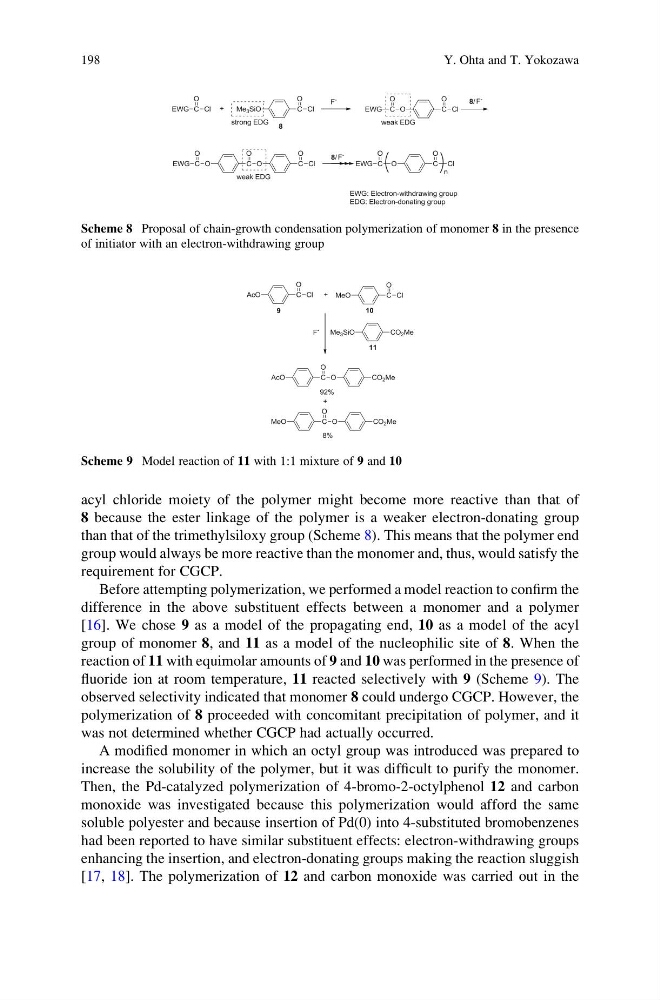
acyl chloride moiety of the polymer might become more reactive than that of
8 because the ester linkage of the polymer is a weaker electron-donating group
than that of the trimethylsiloxy group (Scheme 8). This means that the polymer end
group would always be more reactive than the monomer and, thus, would satisfy the
requirement for CGCP.
Before attempting polymerization, we performed a model reaction to confirm the
difference in the above substituent effects between a monomer and a polymer
[16]. We chose 9 as a model of the propagating end, 10 as a model of the acyl
group of monomer 8, and 11 as a model of the nucleophilic site of 8. When the
reaction of 11 with equimolar amounts of 9 and 10 was performed in the presence of
fluoride ion at room temperature, 11 reacted selectively with 9 (Scheme 9). The
observed selectivity indicated that monomer 8 could undergo CGCP. However, the
polymerization of 8 proceeded with concomitant precipitation of polymer, and it
was not determined whether CGCP had actually occurred.
A modified monomer in which an octyl group was introduced was prepared to
increase the solubility of the polymer, but it was difficult to purify the monomer.
Then, the Pd-catalyzed polymerization of 4-bromo-2-octylphenol 12 and carbon
monoxide was investigated because this polymerization would afford the same
soluble polyester and because insertion of Pd(0) into 4-substituted bromobenzenes
had been reported to have similar substituent effects: electron-withdrawing groups
enhancing the insertion, and electron-donating groups making the reaction sluggish
[17, 18]. The polymerization of 12 and carbon monoxide was carried out in the
Scheme 8 Proposal of chain-growth condensation polymerization of monomer 8 in the presence
of initiator with an electron-withdrawing group
Scheme 9 Model reaction of 11 with 1:1 mixture of 9 and 10
198
Y. Ohta and T. Yokozawa
8 because the ester linkage of the polymer is a weaker electron-donating group
than that of the trimethylsiloxy group (Scheme 8). This means that the polymer end
group would always be more reactive than the monomer and, thus, would satisfy the
requirement for CGCP.
Before attempting polymerization, we performed a model reaction to confirm the
difference in the above substituent effects between a monomer and a polymer
[16]. We chose 9 as a model of the propagating end, 10 as a model of the acyl
group of monomer 8, and 11 as a model of the nucleophilic site of 8. When the
reaction of 11 with equimolar amounts of 9 and 10 was performed in the presence of
fluoride ion at room temperature, 11 reacted selectively with 9 (Scheme 9). The
observed selectivity indicated that monomer 8 could undergo CGCP. However, the
polymerization of 8 proceeded with concomitant precipitation of polymer, and it
was not determined whether CGCP had actually occurred.
A modified monomer in which an octyl group was introduced was prepared to
increase the solubility of the polymer, but it was difficult to purify the monomer.
Then, the Pd-catalyzed polymerization of 4-bromo-2-octylphenol 12 and carbon
monoxide was investigated because this polymerization would afford the same
soluble polyester and because insertion of Pd(0) into 4-substituted bromobenzenes
had been reported to have similar substituent effects: electron-withdrawing groups
enhancing the insertion, and electron-donating groups making the reaction sluggish
[17, 18]. The polymerization of 12 and carbon monoxide was carried out in the
Scheme 8 Proposal of chain-growth condensation polymerization of monomer 8 in the presence
of initiator with an electron-withdrawing group
Scheme 9 Model reaction of 11 with 1:1 mixture of 9 and 10
198
Y. Ohta and T. Yokozawa