

When 4 was used as a monomer, the polymerization proceeded with a base such
as potassium tert-butoxide to yield a high molecular weight polymer (Scheme 6).
Contrary to the oxidative polymerization of 3, no oxygen was needed for polymer
formation, but the bivalent state of copper was necessary. Polymerizations of
4 were also carried out by varying the mole ratio of 5 to yield polymers, the
molecular weights of which were in good agreement with the values calculated
on the basis of the mole ratio of 4 to 5 (M n ¼ 880–3,900). The polydispersities were
not noted. The low molecular weight fraction characterized by gas chromatography
contained monofunctional dimer and trimer formed by 4 itself, without the 5 unit.
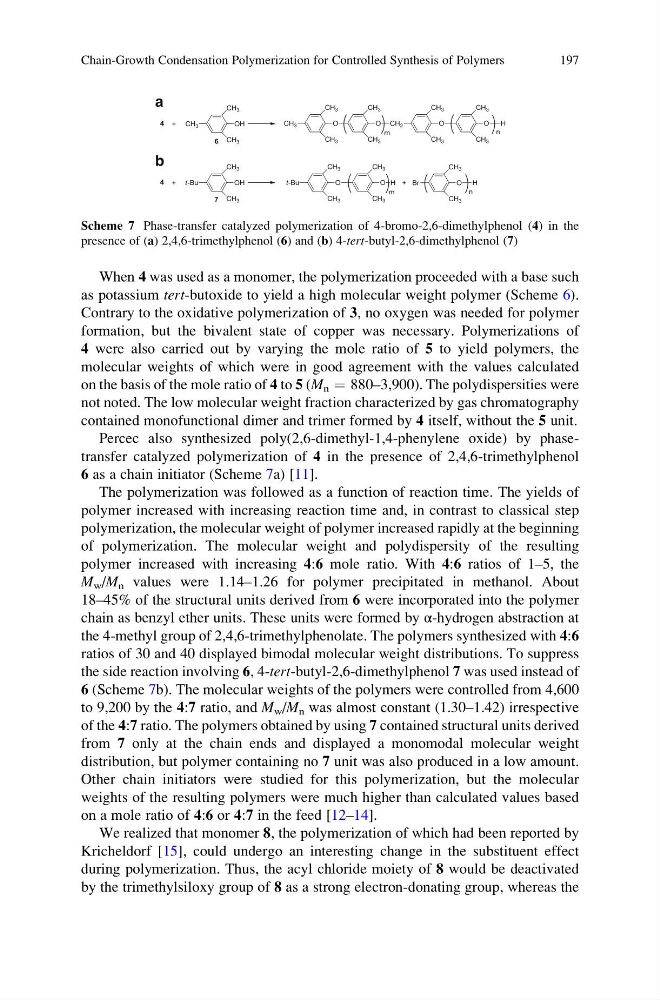
Percec also synthesized poly(2,6-dimethyl-1,4-phenylene oxide) by phasetransfer catalyzed polymerization of 4 in the presence of 2,4,6-trimethylphenol
6 as a chain initiator (Scheme 7a) [11].
The polymerization was followed as a function of reaction time. The yields of
polymer increased with increasing reaction time and, in contrast to classical step
polymerization, the molecular weight of polymer increased rapidly at the beginning
of polymerization. The molecular weight and polydispersity of the resulting
polymer increased with increasing 4:6 mole ratio. With 4:6 ratios of 1–5, the
M w /M n values were 1.14–1.26 for polymer precipitated in methanol. About
18–45% of the structural units derived from 6 were incorporated into the polymer
chain as benzyl ether units. These units were formed by α-hydrogen abstraction at
the 4-methyl group of 2,4,6-trimethylphenolate. The polymers synthesized with 4:6
ratios of 30 and 40 displayed bimodal molecular weight distributions. To suppress
the side reaction involving 6, 4-tert-butyl-2,6-dimethylphenol 7 was used instead of
6 (Scheme 7b). The molecular weights of the polymers were controlled from 4,600
to 9,200 by the 4:7 ratio, and M w /M n was almost constant (1.30–1.42) irrespective
of the 4:7 ratio. The polymers obtained by using 7 contained structural units derived
from 7 only at the chain ends and displayed a monomodal molecular weight
distribution, but polymer containing no 7 unit was also produced in a low amount.
Other chain initiators were studied for this polymerization, but the molecular
weights of the resulting polymers were much higher than calculated values based
on a mole ratio of 4:6 or 4:7 in the feed [12–14].
We realized that monomer 8, the polymerization of which had been reported by
Kricheldorf [15], could undergo an interesting change in the substituent effect
during polymerization. Thus, the acyl chloride moiety of 8 would be deactivated
by the trimethylsiloxy group of 8 as a strong electron-donating group, whereas the
a
b
Scheme 7 Phase-transfer catalyzed polymerization of 4-bromo-2,6-dimethylphenol (4) in the
presence of (a) 2,4,6-trimethylphenol (6) and (b) 4-tert-butyl-2,6-dimethylphenol (7)
Chain-Growth Condensation Polymerization for Controlled Synthesis of Polymers
197
as potassium tert-butoxide to yield a high molecular weight polymer (Scheme 6).
Contrary to the oxidative polymerization of 3, no oxygen was needed for polymer
formation, but the bivalent state of copper was necessary. Polymerizations of
4 were also carried out by varying the mole ratio of 5 to yield polymers, the
molecular weights of which were in good agreement with the values calculated
on the basis of the mole ratio of 4 to 5 (M n ¼ 880–3,900). The polydispersities were
not noted. The low molecular weight fraction characterized by gas chromatography
contained monofunctional dimer and trimer formed by 4 itself, without the 5 unit.
Percec also synthesized poly(2,6-dimethyl-1,4-phenylene oxide) by phasetransfer catalyzed polymerization of 4 in the presence of 2,4,6-trimethylphenol
6 as a chain initiator (Scheme 7a) [11].
The polymerization was followed as a function of reaction time. The yields of
polymer increased with increasing reaction time and, in contrast to classical step
polymerization, the molecular weight of polymer increased rapidly at the beginning
of polymerization. The molecular weight and polydispersity of the resulting
polymer increased with increasing 4:6 mole ratio. With 4:6 ratios of 1–5, the
M w /M n values were 1.14–1.26 for polymer precipitated in methanol. About
18–45% of the structural units derived from 6 were incorporated into the polymer
chain as benzyl ether units. These units were formed by α-hydrogen abstraction at
the 4-methyl group of 2,4,6-trimethylphenolate. The polymers synthesized with 4:6
ratios of 30 and 40 displayed bimodal molecular weight distributions. To suppress
the side reaction involving 6, 4-tert-butyl-2,6-dimethylphenol 7 was used instead of
6 (Scheme 7b). The molecular weights of the polymers were controlled from 4,600
to 9,200 by the 4:7 ratio, and M w /M n was almost constant (1.30–1.42) irrespective
of the 4:7 ratio. The polymers obtained by using 7 contained structural units derived
from 7 only at the chain ends and displayed a monomodal molecular weight
distribution, but polymer containing no 7 unit was also produced in a low amount.
Other chain initiators were studied for this polymerization, but the molecular
weights of the resulting polymers were much higher than calculated values based
on a mole ratio of 4:6 or 4:7 in the feed [12–14].
We realized that monomer 8, the polymerization of which had been reported by
Kricheldorf [15], could undergo an interesting change in the substituent effect
during polymerization. Thus, the acyl chloride moiety of 8 would be deactivated
by the trimethylsiloxy group of 8 as a strong electron-donating group, whereas the
a
b
Scheme 7 Phase-transfer catalyzed polymerization of 4-bromo-2,6-dimethylphenol (4) in the
presence of (a) 2,4,6-trimethylphenol (6) and (b) 4-tert-butyl-2,6-dimethylphenol (7)
Chain-Growth Condensation Polymerization for Controlled Synthesis of Polymers
197